Overview
Few birds in North America capture the imagination quite like the wood duck. Known scientifically as Aix sponsa — a name derived from Latin and Greek meaning roughly "waterfowl in bridal dress" — this species stands in a category all its own when it comes to visual splendor. Widely regarded as one of the most beautiful ducks in the world, the wood duck has become an iconic symbol of North American wetlands, forests, and waterways. From the backwater sloughs of the Deep South to the lake-dotted landscapes of the Upper Midwest, this remarkable bird has carved out a unique ecological niche that sets it apart from virtually every other waterfowl species on the continent.
For hunters, naturalists, birdwatchers, and conservationists alike, the wood duck holds a special place. It is a bird with a remarkable comeback story, a fascinating life history, and a deeply intertwined relationship with the forested wetlands of North America. In a state like Minnesota — celebrated as the "Land of 10,000 Lakes" with an astonishing 14,420 lakes within its borders — the wood duck is more than just a pretty face. It is a living, breathing emblem of the rich natural heritage that makes the region one of the premier wildlife destinations in the United States.
Biological Traits
The wood duck (Aix sponsa) belongs to the family Anatidae, the large family of birds that includes ducks, geese, and swans. It is placed in the genus Aix, a group that also includes the Mandarin duck of Asia — another species famous for its extraordinary plumage. The wood duck is the only member of the genus Aix native to North America.
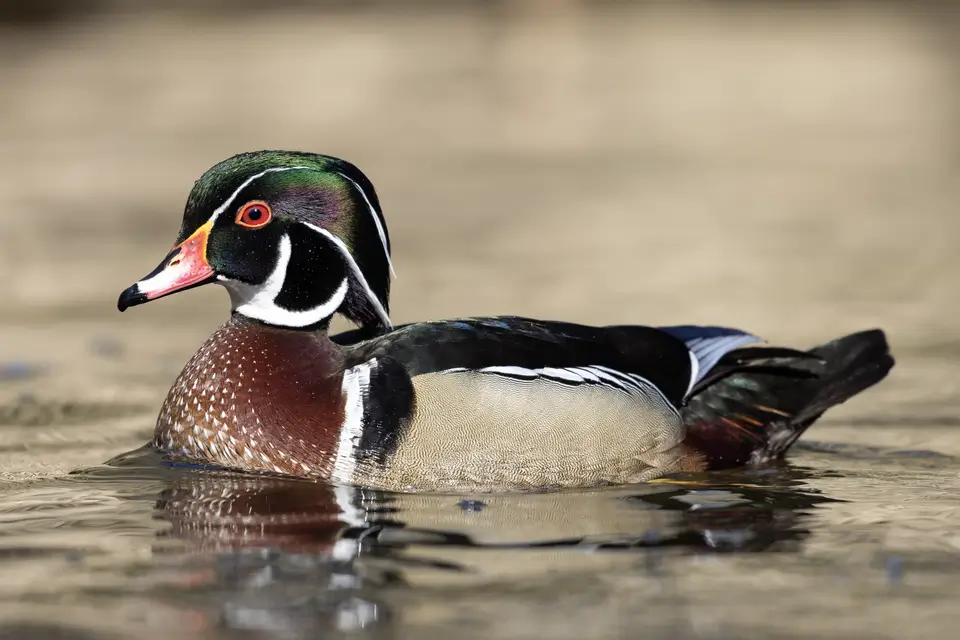
The male wood duck in breeding plumage is truly a sight to behold. Its head is adorned with an iridescent green and purple crested helmet, accented by bold white markings that trace lines along the face and throat. The chest is a rich chestnut brown speckled with white dots, while the flanks display a warm golden buff separated from the breast by bold black and white vertical stripes. The bill is a striking patterned combination of red, white, and black, and the eyes are a vivid crimson red. Taken together, the male wood duck's appearance looks almost too elaborate to be the product of nature — more like a painting brought to life.
Female wood ducks, as is common among many duck species, are more subtly colored. Their plumage is primarily grayish-brown, providing excellent camouflage while nesting. They are identified by a distinctive white teardrop-shaped eye ring, a feature that makes them readily distinguishable in the field.
One of the most extraordinary aspects of wood duck biology is the species' adaptation to life in forested environments. Unlike most ducks that nest on the ground, wood ducks are cavity nesters. They use natural tree hollows and nest boxes, often located many feet above the ground, to lay and incubate their eggs. The female typically lays between 9 and 14 eggs per clutch, though "dump nesting" — where multiple females lay eggs in the same cavity — can result in larger clutches.
Perhaps the most dramatic moment in a wood duck's early life comes just one to two days after hatching. The ducklings, not yet capable of flight, must leap from their nest cavity — sometimes from heights of 50 feet or more — to reach the ground below. Their tiny, downy bodies and light weight allow them to tumble safely to the forest floor, where they quickly follow their mother to water. This extraordinary behavior is one of the most memorable spectacles in all of North American wildlife.
Wood ducks are also notably different from most waterfowl in their diet. While they do consume aquatic invertebrates and small insects — particularly during the breeding season when protein is critical — they are largely herbivorous. Acorns, seeds, berries, aquatic plants, and various other plant materials form the bulk of their diet. Their affinity for acorns in particular draws them to forested bottomlands and hardwood swamps where oak trees are plentiful.
The wood duck is also one of the few North American duck species capable of producing two broods in a single season, a trait that contributes to its resilience as a species.
Habitat & Range
The wood duck thrives at the intersection of forests and water. Wooded swamps, beaver ponds, forested river corridors, bottomland hardwoods, and the vegetated edges of lakes and streams all provide ideal habitat. The species has a particular affinity for slow-moving or still water bodies surrounded by mature trees, which supply both the cavity nesting sites it requires and the acorns and other mast crops it depends on for food.
The wood duck's range spans a significant portion of North America. Eastern populations breed throughout the eastern United States and into southeastern Canada. Western populations are found along the Pacific Coast. In between, the species is found across much of the central and northern United States wherever suitable habitat exists.
Minnesota represents some of the finest wood duck habitat anywhere on the continent. The state's extraordinary abundance of lakes, ponds, rivers, and wetlands — that famous count of 14,420 lakes — combined with extensive tracts of riparian forest and bottomland hardwoods creates ideal conditions for wood ducks throughout much of the breeding season. Minnesota's wetland complexes, beaver flowages, and forested river corridors across the eastern and central parts of the state are particularly productive wood duck areas.
During fall migration, Minnesota wood ducks join birds from farther north as they move southward toward wintering grounds. Wood ducks are relatively short-distance migrants compared to some other waterfowl, with many birds wintering in the southern United States, particularly in the bottomland hardwood forests and swamps of the Southeast.
Hunting Information
The wood duck occupies a cherished place in the world of waterfowl hunting. For hunters who pursue ducks in the timber — working through flooded bottomlands, beaver swamps, and wooded sloughs — the wood duck is often the primary quarry. Its distinctive whistling call, its explosive speed through the trees, and its breathtaking appearance make it one of the most prized game birds in North America.
Wood duck hunting in Minnesota offers some genuinely exciting opportunities. The state's vast network of wetlands, forested river bottoms, and beaver ponds provides excellent habitat that attracts and holds wood ducks throughout the early portion of the waterfowl season. Early-season hunting, before the leaves drop and visibility in the timber opens up, is a classic way to pursue wood ducks. Hunters working small wooded ponds, creek bottoms, and backwater areas during the early teal and duck seasons can encounter wood ducks in impressive numbers.
Hunting wood ducks typically involves calling with a distinctive squealing wood duck call, setting decoys in flooded timber or along wooded waterways, and waiting patiently for birds to work through the canopy. The challenge of shooting through tree branches, combined with the bird's erratic flight in wooded terrain, makes wood duck hunting a uniquely demanding and rewarding experience.
It is important for Minnesota hunters to consult the Minnesota Department of Natural Resources (DNR) for current, up-to-date season dates, bag limits, and licensing requirements before pursuing wood ducks. Waterfowl regulations are subject to annual review and can change from season to season. Hunters should always verify current rules and obtain all required licenses and stamps before heading afield.
Conservation
The conservation story of the wood duck is one of the great success narratives in North American wildlife management. By the late 19th and early 20th centuries, unregulated market hunting and widespread deforestation had driven wood duck populations to dangerously low levels. Many observers feared the species could face extinction. The passage of the Migratory Bird Treaty Act of 1918 provided the legal framework to protect migratory birds, including wood ducks, and began the slow process of population recovery.
The deployment of artificial nest boxes has been one of the most impactful conservation tools ever applied to a waterfowl species. Because wood ducks depend on tree cavities for nesting — cavities that become scarcer as old-growth and mature timber is removed — the widespread installation of nest boxes across suitable habitat has dramatically boosted breeding success. Duck hunters, conservation organizations like Ducks Unlimited, state wildlife agencies, and private landowners have collectively installed hundreds of thousands of nest boxes across North America, with profound positive effects on wood duck populations.
Today, wood duck populations are considered healthy and stable across much of their range. The species serves as a powerful reminder of what thoughtful wildlife management, habitat protection, and conservation investment can achieve. In Minnesota, the Minnesota DNR and partner organizations continue to work on wetland preservation, riparian habitat protection, and nest box programs that benefit wood ducks and countless other species.
The wood duck's recovery is a testament to the dedication of hunters, conservationists, and wildlife managers who recognized the value of this extraordinary bird and committed to protecting it for future generations.