Overview
Few birds in North America evoke as much admiration, fascination, and pursuit as the wild turkey (Meleagris gallopavo). Once nearly vanished from large portions of its native range, the wild turkey has staged one of the most remarkable wildlife comebacks in conservation history. Today, it thrives across diverse landscapes from the deep forests of the Appalachians to the prairie edges of the Upper Midwest, including the woodlands and farm country of Minnesota.
For hunters, birdwatchers, and naturalists alike, the wild turkey represents a perfect blend of beauty, intelligence, and challenge. Its iridescent feathers shimmer in the sunlight with hues of bronze, copper, green, and gold. Its booming gobble carries through the spring woods, marking the dawn of one of the most cherished hunting seasons in North America. And its keen senses—particularly its eyesight and hearing—make it a worthy adversary for even the most experienced sportsman.
This article explores the biology, habitat, hunting traditions, and conservation legacy of the wild turkey, with particular attention to its place in the Minnesota outdoor experience.
Biological Traits
The wild turkey belongs to the order Galliformes, the same group that includes pheasants, grouse, quail, and domestic chickens. Its scientific name, Meleagris gallopavo, reflects its taxonomic classification within the family Phasianidae (though some classifications place turkeys in their own family, Meleagrididae). The species is the heaviest member of the Galliformes order found in the wild in North America.
Physical Characteristics
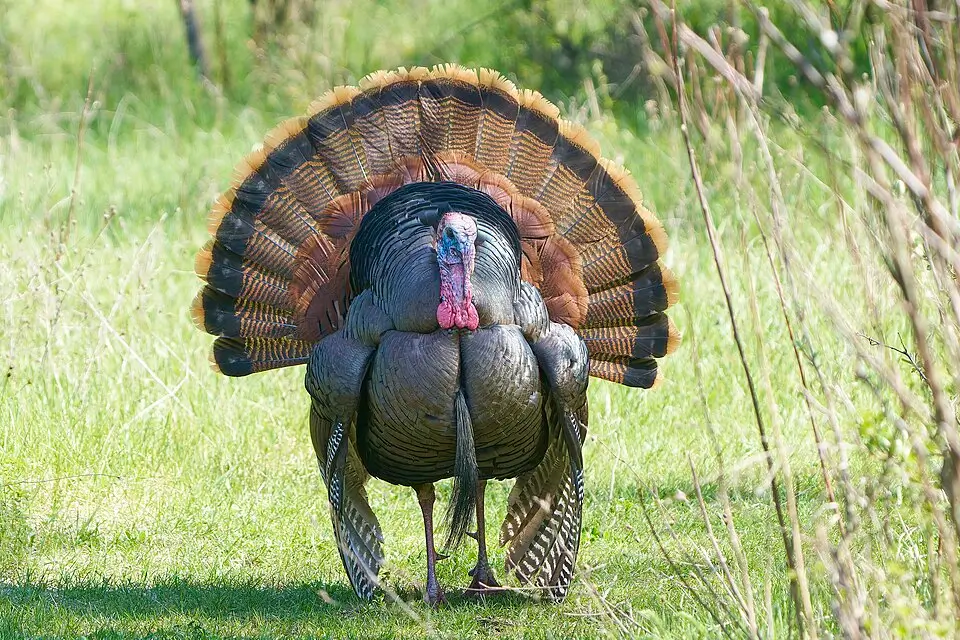
Adult wild turkeys are large, ground-dwelling birds with long legs, broad wings, and a distinctive fan-shaped tail. Males, known as toms or gobblers, are noticeably larger than females (hens) and display more dramatic plumage. A mature tom may stand roughly three to four feet tall and possess striking features including:
- Iridescent body feathers that shift in color depending on the angle of light, ranging from copper and bronze to greens, reds, and purples.
- A bare, brightly colored head and neck that can change hue—red, blue, or white—based on the bird's mood, particularly during breeding displays.
- A "beard", which is a tuft of specialized feathers protruding from the chest. While most prominent in males, a small percentage of hens also grow beards.
- Spurs on the back of the legs, used for fighting rival males and defending against predators. Spur length is often used by hunters to estimate a tom's age.
- A snood and wattle, fleshy protuberances on the head and throat that become engorged and vivid during courtship.
Hens, by contrast, are smaller and have more muted brown and gray plumage that provides excellent camouflage while nesting on the ground.
Senses and Behavior
Wild turkeys possess exceptional eyesight, with a wide field of view and the ability to see in color. Some researchers believe they can detect ultraviolet light, which may help them spot predators or judge the quality of potential mates. Their hearing is also acute, allowing them to pinpoint distant sounds with remarkable accuracy. Their sense of smell, by contrast, is considered relatively poor compared to mammals.
Despite their large size, wild turkeys are surprisingly capable fliers over short distances. They typically roost in trees at night, flying up to elevated branches at dusk and gliding down at dawn. On the ground, they are swift runners and can sprint to escape danger when flight is not an option.
Vocalizations
Turkeys are highly vocal birds. The gobble of the tom—loud, resonant, and unmistakable—serves as a territorial announcement and a call to attract hens during the spring breeding season. Hens use a variety of yelps, clucks, purrs, and cutts to communicate with their poults and other flock members. Skilled hunters learn to mimic these calls using box calls, slate calls, mouth diaphragms, and other devices to draw birds within range.
Diet
Wild turkeys are omnivorous and opportunistic foragers. Their diet includes acorns and other mast, seeds, berries, leaves, grasses, insects, and occasionally small reptiles and amphibians. Their willingness to feed on a wide variety of foods is one reason they thrive in such a broad range of habitats.
Habitat & Range
The wild turkey is native to North America, with its historical range covering much of the eastern and central United States, parts of the southwestern U.S., and northern Mexico. Several subspecies are recognized, including the Eastern, Osceola, Rio Grande, Merriam's, and Gould's wild turkey. The Eastern wild turkey is the most widely distributed and is the subspecies typically encountered in Minnesota and the broader Upper Midwest.
Preferred Habitat
Wild turkeys favor a mix of mature hardwood forests interspersed with openings, fields, meadows, and agricultural lands. They need trees large enough to provide secure overnight roosting sites, along with open ground for foraging and brood-rearing. Oak-hickory forests are especially productive because acorns and other hard mast supply abundant fall and winter food. Riparian corridors, field edges, pastures, and small woodlots all play important roles in turkey habitat.
Wild Turkeys in Minnesota
Minnesota, with its rolling hardwood forests, river valleys, agricultural lands, and abundant edge habitat, provides excellent conditions for wild turkeys—particularly in the southern and central parts of the state. The "Land of 10,000 Lakes" offers more than just water resources; its mosaic of woodlands and farm country supports thriving turkey populations that have expanded significantly in recent decades. Whether along the bluff country of the Mississippi River, the deciduous forests of the central counties, or the farm-and-woodlot mix of the south, Minnesota outdoor enthusiasts have ample opportunity to encounter these magnificent birds.
Hunting Information
Wild turkey hunting is one of the most popular and time-honored traditions in American outdoor sport. It combines woodsmanship, patience, calling skill, and respect for a worthy quarry.
General Hunting Approach
Most turkey hunting takes place in the spring, when toms are actively gobbling and seeking hens, making them responsive to calls. A typical spring hunt begins well before dawn, with the hunter slipping quietly into the woods to set up near a known roosting area. As the sun rises, the hunter uses calls to imitate a hen, attempting to lure a tom within shotgun range. Camouflage is essential because of the turkey's extraordinary eyesight. Fall hunting, where permitted, often focuses on locating and scattering flocks before calling birds back together.
Equipment
Common turkey hunting gear includes:
- A shotgun (commonly 12, 20, or .410 gauge) with turkey-specific loads, or a bow for archery hunters.
- Full camouflage clothing, including gloves and a face mask.
- Turkey calls such as box calls, slate/pot calls, push-button calls, and diaphragm mouth calls.
- Decoys to lure curious or competitive toms into shooting range.
- A comfortable seat or vest with a built-in cushion for long sits against a tree.
Hunting in Minnesota
For hunters interested in pursuing wild turkeys in Minnesota, official state-specific season dates, license requirements, zone designations, and bag limits should be obtained directly from the Minnesota Department of Natural Resources (DNR). The state typically manages spring and fall turkey hunting seasons with structured permit systems designed to balance hunter opportunity with sustainable population management. Always consult the most current regulations before heading afield.
Safety
Turkey hunting requires special attention to safety because hunters wear full camouflage and often imitate the sounds of the very animal being pursued. Key safety practices include positively identifying your target before shooting, never stalking a gobbling bird (it may actually be another hunter calling), wearing blaze orange when moving through the woods, and sitting against a tree wider than your shoulders.
Conservation
The story of the wild turkey is one of conservation triumph. By the early 20th century, habitat loss and unregulated harvest had reduced wild turkey numbers to a fraction of their historical population, and the species was extirpated from much of its former range. Through the combined efforts of state wildlife agencies, conservation organizations such as the National Wild Turkey Federation, hunters, landowners, and scientists, the wild turkey has been restored to nearly all of its native range and even introduced to areas where it never historically occurred.
Trap-and-transfer programs—where birds were captured in healthy populations and relocated to suitable but unoccupied habitat—proved enormously successful. Funded in large part by hunting license fees and excise taxes on firearms and ammunition (through programs like the Pittman-Robertson Act), these efforts represent the North American Model of Wildlife Conservation at its best.
Today, wild turkey populations are healthy across most of their range, including Minnesota. Continued conservation depends on habitat stewardship—maintaining mature forests with openings, protecting roosting trees, encouraging diverse plant communities, and managing edge habitat on private and public lands. Hunters play a vital role by funding wildlife management through their license purchases and by participating in habitat improvement projects.