Overview
Few sights in the natural world capture the imagination quite like a Trumpeter swan gliding across a glassy northern lake, its brilliant white plumage reflecting in the still water. The Trumpeter swan (Cygnus buccinator) is a bird of superlatives — the largest native waterfowl species in North America and one of the heaviest flying birds on the entire continent. Stately, powerful, and deeply connected to the wetland ecosystems of North America, the Trumpeter swan has a story that spans millennia of natural history and, more recently, decades of dedicated conservation effort.
For residents of Minnesota — a state celebrated as the "Land of 10,000 Lakes" and home to over 14,000 individual lakes — the Trumpeter swan holds a special place in the natural and cultural landscape. These magnificent birds can be spotted on quiet marshes, slow-moving rivers, and expansive lake systems throughout the Upper Midwest, their resonant calls echoing across open water in a sound that feels as wild and timeless as the land itself. Understanding the Trumpeter swan means appreciating not only its biological magnificence but also the remarkable conservation journey that brought it back from the brink of extinction and restored it to the wetlands of Minnesota and beyond.
Biological Traits
The Trumpeter swan (Cygnus buccinator) is a member of the family Anatidae, which includes all ducks, geese, and swans. Within this large family, swans belong to the genus Cygnus, which encompasses some of the largest and most recognizable waterfowl in the world. The species name buccinator is derived from the Latin word for "trumpeter" or "bugler," a direct reference to the bird's distinctive, resonant vocalizations — a deep, horn-like call that carries impressively across open water and wetland landscapes.
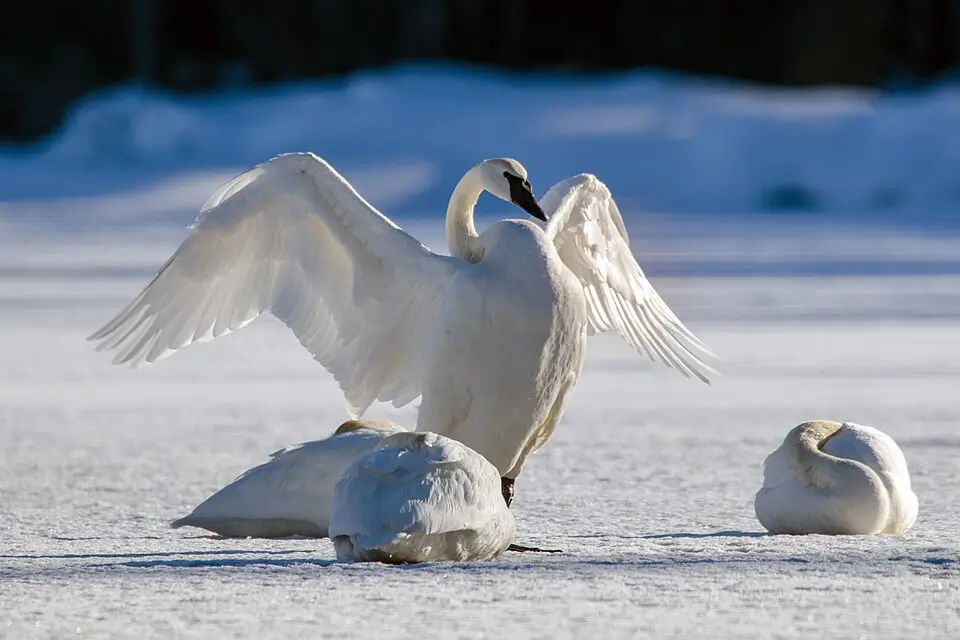
As the largest native waterfowl in North America, Trumpeter swans are truly impressive in scale. Adult birds typically have a wingspan that can stretch well beyond six feet, and large males — known as cobs — can weigh upward of 25 to 30 pounds, making them among the heaviest birds capable of sustained flight on the continent. Females, called pens, are somewhat smaller but still impressively large by waterfowl standards.
Adult Trumpeter swans are almost entirely snow-white in plumage, a striking appearance that makes them immediately recognizable on the water or in flight. Juvenile birds, known as cygnets, begin life covered in gray or brownish-gray down, gradually transitioning to white plumage over their first year or two of life. The bill is black and distinctly shaped, with a salmon-pink or reddish line along the edge of the lower mandible that can help differentiate Trumpeter swans from the closely related and similarly appearing Tundra swan (Cygnus columbianus).
Trumpeter swans are long-lived birds. Under favorable conditions, individuals in the wild can live for 20 years or more, and captive birds have been recorded living even longer. They are also notably faithful to their mates, typically forming long-term pair bonds that may last for many years or even for life. Breeding pairs establish and defend territories on suitable wetlands, and the nest itself is a substantial structure — a large mound of aquatic vegetation, grasses, and other plant material, typically built near the water's edge or on small islands or floating vegetation mats.
Clutch sizes generally range from four to six eggs, though larger clutches are documented. Incubation lasts approximately 32 to 37 days, with both parents sharing incubation duties to varying degrees. Once hatched, cygnets are precocial — they are covered in down and capable of swimming shortly after hatching — though they remain closely attended by both parents for many months. Young swans typically do not reach sexual maturity until they are three to four years of age, a relatively slow developmental timeline that is typical of large, long-lived birds.
Trumpeter swans are primarily herbivorous, feeding on a wide variety of aquatic plants. They use their long necks to reach submerged vegetation in shallow water, a feeding behavior known as "dabbling" or "tipping up," similar to that seen in surface-feeding ducks. Roots, tubers, stems, and leaves of aquatic plants form the core of their diet, though they may also consume small invertebrates, particularly during the breeding season when protein demands are higher.
Habitat & Range
Trumpeter swans are closely associated with large, shallow wetlands, lakes, ponds, rivers, and marshes. They require clear, clean water with abundant aquatic vegetation, as well as open shorelines or emergent vegetation for nesting sites. The quality and availability of these wetland habitats are critical determinants of where Trumpeter swans can successfully breed and overwinter.
Historically, the Trumpeter swan had a vast breeding range that extended across much of the northern and western portions of North America, from Alaska and Canada south through the Great Plains and into parts of the Upper Midwest. Their wintering range extended further south and west, following open water along river corridors and coastal areas.
Minnesota, with its extraordinary abundance of lakes, rivers, wetlands, and wild rice beds, represents some of the finest Trumpeter swan habitat in the eastern portion of the species' range. The state's network of shallow glacial lakes and marshes — particularly in the northern and central regions — provides ideal conditions for nesting, brood-rearing, and migration staging. The presence of wild rice (Zizania spp.) in many Minnesota water bodies is particularly valuable, as the nutritious seeds and plant parts of wild rice are an important food source for swans and other waterfowl.
During migration and winter, Trumpeter swans seek out open water — areas where rivers, spring-fed streams, or geothermal activity prevent water from freezing solid. In Minnesota and across the Upper Midwest, these open-water refuges are critical wintering areas, and flocks of swans gathering on such sites can number in the hundreds during cold winter months.
Hunting Information
The Trumpeter swan is a fully protected species under the Migratory Bird Treaty Act of the United States, and it is not legal to hunt Trumpeter swans in Minnesota or anywhere else in the lower 48 contiguous United States. This protection reflects the species' long and difficult history with overexploitation and the ongoing importance of conservation management to maintain healthy population levels.
It is important for hunters — particularly waterfowl hunters pursuing species such as Canada geese, ducks, or even the huntable Tundra swan in certain western states and territories — to be able to accurately identify Trumpeter swans in the field. The Trumpeter swan closely resembles the Tundra swan, and misidentification is a genuine concern. Key identification features include the Trumpeter's larger overall size, its entirely black bill (the Tundra swan typically shows a yellow spot near the eye), and its deeper, more resonant call compared to the Tundra swan's higher-pitched, musical vocalizations.
For wildlife enthusiasts and outdoor recreationists in Minnesota, Trumpeter swans offer exceptional opportunities for wildlife watching, photography, and nature appreciation throughout the year. Wetlands, lake shores, and wildlife management areas across the state host these magnificent birds, and encounters with Trumpeter swans — whether a lone pair on a quiet northern lake or a large winter flock gathered on an open river — rank among the most memorable wildlife experiences the Upper Midwest has to offer.
Conservation
The conservation history of the Trumpeter swan is one of the most compelling success stories in North American wildlife management. By the early twentieth century, the species had been reduced to perilously low numbers across its former range, decimated by market hunting for feathers and meat during the 18th and 19th centuries, as well as by widespread habitat loss. At their lowest point, fewer than 100 individuals were believed to remain in the contiguous United States.
Protections under the Migratory Bird Treaty Act and sustained recovery efforts — including captive breeding programs, reintroduction projects, and habitat conservation — have allowed Trumpeter swan populations to recover substantially over the decades. Minnesota has been an active participant in these recovery efforts, with state wildlife managers and conservation organizations working together to reintroduce swans and protect critical wetland habitats.
Today, Trumpeter swans can once again be found across a broad swath of their historical range, and Minnesota's wetlands support a meaningful and growing population. While the species is no longer considered to be in immediate peril of extinction, continued habitat protection, water quality management, and monitoring remain essential to ensuring that Trumpeter swan populations remain robust and self-sustaining into the future.
The return of the Trumpeter swan to Minnesota's lakes and waterways stands as a testament to what dedicated conservation work can achieve — and a reminder of the extraordinary natural heritage that careful stewardship can preserve for generations to come.