Overview
Few sights in the natural world rival the spectacle of sandhill cranes (Grus canadensis) gathering by the thousands along shallow river bends or rising from prairie wetlands at sunrise. With their tall, slender silhouettes, sweeping wingbeats, and unmistakable bugling calls that can carry for miles, sandhill cranes have captivated naturalists, photographers, hunters, and casual observers for generations. They are among the oldest living bird species on the continent, with a fossil record stretching back millions of years, making them living connections to a deep prehistoric past.
Sandhill cranes occupy a unique place in North American wildlife heritage. They are wetland sentinels, agricultural neighbors, ceremonial figures in indigenous traditions, and game birds in a growing number of states. From the wide-open prairies of the Great Plains to the boreal edges of Canada and the wintering grounds of the southern United States and northern Mexico, these cranes embody the seasonal rhythms of the continent. In Minnesota — the "Land of 10,000 Lakes" — the species has become an increasingly common sight, particularly in marshy regions and along migration corridors where suitable habitat abounds.
This article explores the sandhill crane in depth: its biological characteristics, its habitat and range, considerations for hunters interested in pursuing the species, and the conservation story that has helped restore populations across much of its historical territory.
Biological Traits
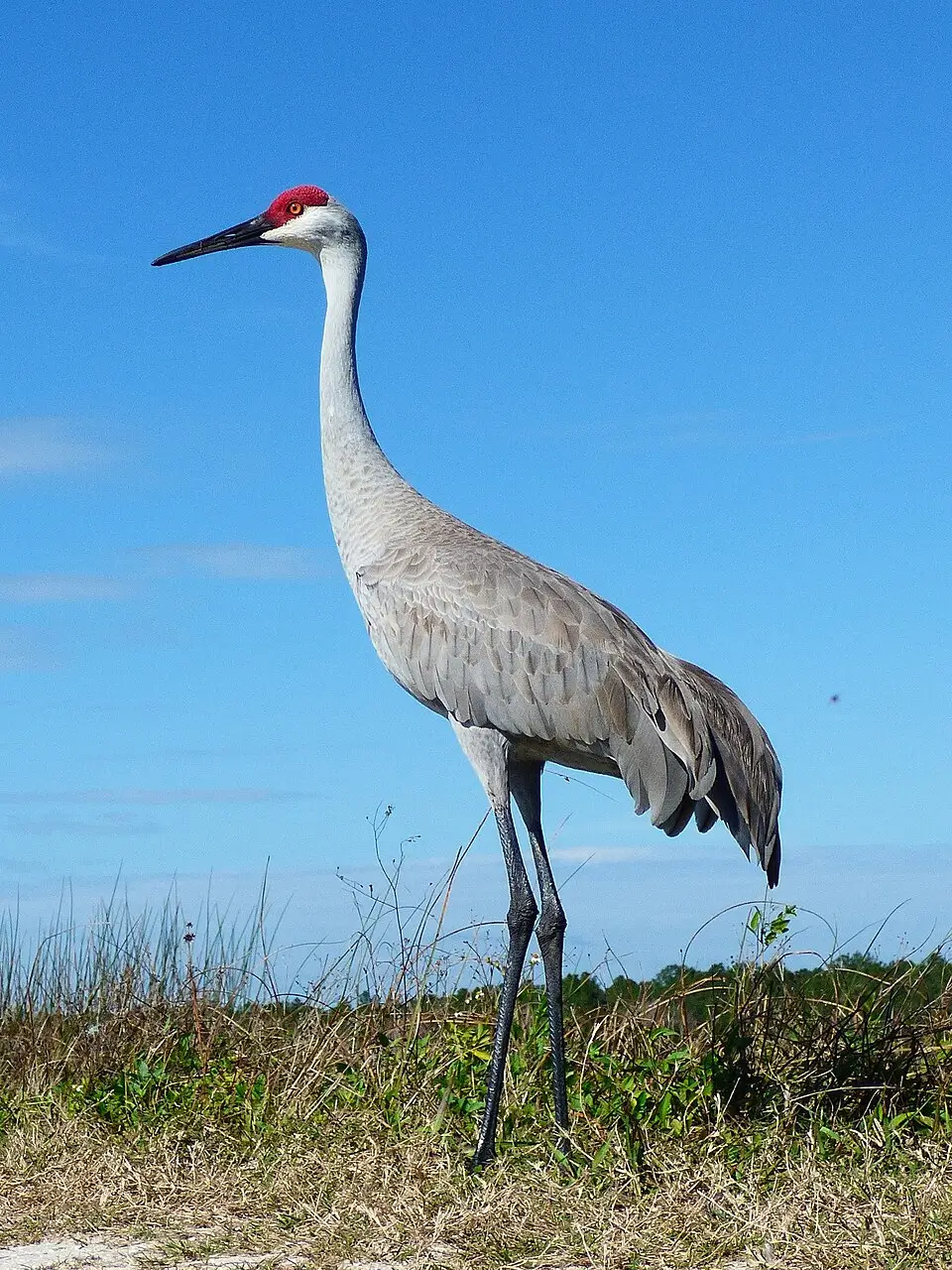
The sandhill crane belongs to the family Gruidae, the cranes, and is one of the most widespread crane species in the world. Adults are large, long-legged, long-necked birds, typically standing between three and four feet tall, with a wingspan that can exceed six feet. Their plumage is predominantly slate gray, though many individuals appear rusty or reddish-brown due to a fascinating behavior known as "preening with iron-rich mud." Cranes deliberately stain their feathers using mud from ferrous soils, providing camouflage during the nesting season. As feathers molt and new ones grow in, the gray base color returns.
One of the sandhill crane's most distinguishing features is the bare patch of red skin on the crown of its head. This featherless cap, combined with white cheeks and a sharp, pointed bill, gives the species an unmistakable profile. Males and females are visually similar, though males are generally slightly larger.
Sandhill cranes are renowned for their resonant, rattling calls — a sound produced in part by an elongated trachea that coils within the breastbone, acting like a natural brass instrument. These calls serve a wide variety of social functions, from pair bonding and territory defense to maintaining contact between family groups in flight.
The species is also famous for its elaborate courtship dances. Mated pairs — which generally remain together for life — engage in leaping, bowing, wing-spreading, and stick-tossing displays that strengthen their bonds and synchronize breeding readiness. Younger cranes also dance, often as a form of social practice. Cranes are long-lived birds; in the wild, they can live two decades or more, and captive individuals have lived considerably longer.
Sandhill cranes are omnivorous foragers. Their diet includes grains, seeds, tubers, berries, insects, snails, amphibians, small reptiles, rodents, and the occasional bird egg. This dietary flexibility allows them to thrive in landscapes ranging from natural wetlands to agricultural fields, where waste grain — especially corn — provides crucial energy during migration.
Several subspecies of sandhill crane are recognized, generally divided into migratory and non-migratory groups. Migratory subspecies include the lesser, greater, and Canadian sandhill cranes, while resident populations include the Florida, Mississippi, and Cuban sandhill cranes. The greater sandhill crane is the subspecies most commonly encountered across the Upper Midwest, including Minnesota.
Habitat & Range
Sandhill cranes inhabit a remarkable variety of landscapes across their broad range. Breeding habitat typically consists of shallow freshwater wetlands, sedge meadows, bogs, marshes, and wet prairies, where cranes can build their nests of piled vegetation in or near standing water. These secluded, water-rimmed nesting sites provide protection from many ground-based predators.
During migration and on wintering grounds, sandhill cranes often shift to a mix of agricultural fields and shallow river systems. The Platte River in Nebraska is perhaps the most famous staging area in the world, where hundreds of thousands of cranes gather each spring before continuing northward. Wintering populations concentrate in the southern Great Plains, the Southwest, the Gulf Coast, parts of Mexico, and Florida.
Geographically, the species ranges from northeastern Siberia and Alaska across much of Canada, throughout the Great Plains and Midwest, and into wintering areas across the southern United States. Minnesota lies within both the breeding range and a key migratory corridor for the greater sandhill crane. The state's abundant lakes, peatlands, and managed wetlands provide excellent habitat. Northwestern and east-central Minnesota in particular have hosted growing crane populations as the species recovered from historic lows.
Minnesota's geography — bordered by Canada to the north, the Great Lakes region to the east, and the agricultural plains to the south and west — places it at a meaningful crossroads of crane movement. Birds that breed in the boreal fringes of Canada often pass through Minnesota airspace, while resident breeders use the state's vast wetland complexes.
Hunting Information
Sandhill cranes are classified as a migratory game bird in several U.S. states and Canadian provinces, with hunting seasons established under federal frameworks coordinated through flyway councils and approved by the U.S. Fish and Wildlife Service. Where seasons are open, sandhill crane hunting is typically managed conservatively to maintain healthy population levels, with specific permits, tags, zones, and bag limits.
Because the source data does not include specific Minnesota season dates, license requirements, or regulations for sandhill crane, hunters interested in pursuing the species in Minnesota should always consult the Minnesota Department of Natural Resources (DNR) and the U.S. Fish and Wildlife Service for current rules, season availability, zone designations, permit applications, and bag limits before heading afield. Regulations can change from year to year, and crane hunting in some states is limited to specific zones or requires drawing a special permit.
In states where crane hunting is permitted, common practices include:
- Field hunting over decoys: Hunters set up in or near harvested agricultural fields — often corn or small grain stubble — where cranes feed during migration. Full-body or silhouette decoys, combined with effective concealment in layout blinds or natural cover, can be highly effective.
- Pass shooting near roost areas: Hunters position themselves along flight paths between roosting wetlands and feeding fields, taking shots as birds travel to and from these locations. Care is taken not to disturb roosts directly.
- Calling: While cranes are not as call-responsive as waterfowl, well-timed bugles can help finish birds working toward a decoy spread.
Crane hunters typically use 12-gauge shotguns with heavy non-toxic shot loads suitable for large-bodied birds. Identification is critical: cranes can share airspace and habitats with whooping cranes (an endangered species that must never be harvested) and various heron and waterfowl species. Many states require hunter education specific to crane identification before issuing permits.
Sandhill crane is also widely regarded as excellent table fare. The breast meat is dark, lean, and often described as among the finest of any game bird — earning it the nickname "ribeye of the sky" in some hunting circles.
Conservation
The sandhill crane is one of North America's notable wildlife conservation success stories. In the early twentieth century, populations were severely diminished by unregulated hunting and the widespread draining of wetlands. Some subspecies were reduced to alarmingly low numbers, and breeding populations disappeared from large portions of their former range, including much of the Upper Midwest.
Through decades of habitat protection, wetland restoration, regulated harvest under the Migratory Bird Treaty Act, and coordinated management between U.S., Canadian, and Mexican wildlife agencies, the species has rebounded dramatically. The greater sandhill crane, in particular, has expanded back into states like Minnesota, Wisconsin, and Michigan, where breeding populations are now well established and growing.
Conservation efforts continue to focus on:
- Protecting and restoring wetland breeding habitat
- Maintaining safe stopover areas along migration corridors, especially the Platte River
- Monitoring populations through annual surveys to inform sustainable harvest
- Supporting research on the smaller, non-migratory subspecies, some of which remain of conservation concern
- Educating the public to prevent accidental take of the closely related whooping crane
Hunters, birders, farmers, and conservation organizations all play important roles in this ongoing work. Wetland habitat conservation funded in part by hunting license sales and federal duck stamp revenues benefits sandhill cranes alongside countless other species.
The sandhill crane's recovery serves as a powerful reminder that science-based management, habitat investment, and cooperation across borders can restore even severely depleted wildlife populations. As these ancient birds continue to fill the skies of Minnesota and beyond each spring and fall, they offer a living testament to the enduring richness of North American wildlife heritage.