Overview
Few birds capture the spirit of the North American forest quite like the ruffed grouse (Bonasa umbellus). Known to many simply as "the partridge" in the Upper Midwest and New England, this medium-sized game bird has earned a near-mythical status among upland hunters, naturalists, and forest enthusiasts. Its explosive flush from the underbrush, distinctive drumming display, and cryptic plumage have made it a symbol of healthy young forests across its range. In Minnesota — the "Land of 10,000 Lakes" — the ruffed grouse occupies a particularly prominent place in outdoor culture, thriving in the state's vast mixed and deciduous forests and offering some of the finest wingshooting opportunities in the country.
The ruffed grouse is a bird of contradictions: shy and reclusive, yet boldly territorial; small in stature, yet powerful in flight; common in suitable habitat, yet often invisible to those who walk past it. Understanding this remarkable species means appreciating not just the bird itself but the dynamic forest ecosystems it depends upon. This article examines the ruffed grouse's biology, habitat preferences, hunting traditions, and conservation status, with a particular focus on its place in Minnesota's outdoor heritage.
Biological Traits
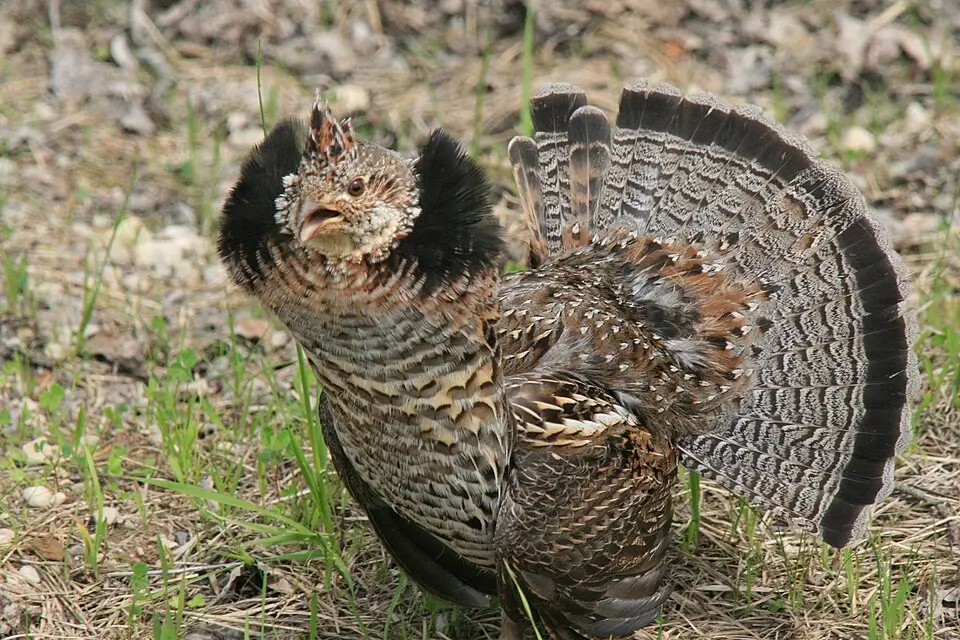
The ruffed grouse belongs to the order Galliformes and the family Phasianidae, which also includes pheasants, turkeys, and other grouse species. Its scientific name, Bonasa umbellus, refers in part to the umbrella-like ruff of dark feathers around its neck — a key identifying feature that gives the bird its common name. The genus Bonasa contains only a few species, and the ruffed grouse is the most widely distributed of them in North America.
Adult ruffed grouse are medium-sized birds, generally weighing between one and one-and-a-half pounds, with a compact body, short legs, and a relatively long, fan-shaped tail. The tail typically displays a broad dark band near its tip, another reliable field mark. Plumage occurs in two main color phases — a grey phase and a red (or brown) phase — with the grey phase more common in northern populations such as those found in Minnesota, and the red phase more frequent in southern parts of the range. Both phases offer outstanding camouflage among leaf litter, fallen logs, and dappled forest light.
Males and females look similar at a glance, though males tend to be slightly larger and possess more pronounced ruffs and longer, more uniformly banded tails. During the breeding season, males perform one of the most iconic displays in the bird world: drumming. By standing on a fallen log or raised perch and beating their wings rapidly against the air, males produce a low-frequency thumping sound that begins slowly and accelerates into a rolling crescendo. This drumming serves both to attract females and to advertise territorial boundaries to rival males. The sound carries surprisingly far through the forest and is often felt as much as heard.
Ruffed grouse are non-migratory and remain in their home ranges year-round. They are well adapted to harsh northern winters. In autumn, they grow comb-like projections called pectinations along the sides of their toes, which act like natural snowshoes, allowing them to walk efficiently across deep snow. They also frequently roost beneath the snowpack — a behavior known as snow roosting — using the insulating properties of snow to survive sub-zero temperatures.
The diet of the ruffed grouse shifts dramatically with the seasons. In spring and summer, they feed on green leaves, fruits, seeds, and insects, with chicks especially dependent on protein-rich invertebrates during their first few weeks of life. In fall, they consume berries, acorns, hazelnuts, and other mast. In winter, when herbaceous food is buried under snow, they rely heavily on the buds and catkins of trees — particularly aspen, birch, and willow. The strong relationship between ruffed grouse and aspen is one of the most well-known wildlife-habitat associations in North American ornithology.
Habitat & Range
The ruffed grouse is broadly distributed across northern North America, occupying forested regions from Alaska across Canada and into the northern and Appalachian United States. It is a bird of young, regenerating forests, especially mixed hardwood and aspen-birch communities. Mature, closed-canopy forests with little understory generally support far fewer grouse than diverse, structurally complex woodlands featuring a mix of age classes.
Optimal ruffed grouse habitat typically includes dense young stands of trees for cover and protection from predators, older trees for winter food and drumming logs, and openings or edges where understory plants produce fruits and attract insects. The interspersion of these elements — what biologists often call habitat mosaic — is what makes a forest truly productive for grouse.
Minnesota provides this kind of mosaic on a vast scale. The state's northern forests, encompassing the Chippewa and Superior National Forests as well as extensive state, county, and industrial timberlands, contain millions of acres of aspen-dominated woodland. Aspen regenerates vigorously after disturbance, particularly timber harvest, and the resulting young stands are prime grouse habitat. This is one of the reasons Minnesota is widely regarded as one of the top ruffed grouse states in the nation. Populations cycle naturally over roughly a decade, with peaks and lows in abundance, but even in low years Minnesota's grouse numbers remain impressive compared to many other regions.
Hunting Information
Ruffed grouse hunting is a cherished tradition in Minnesota and across the Upper Midwest. The pursuit is typically carried out on foot, often with the aid of a pointing or flushing dog, through young aspen stands, alder edges, old logging roads, and overgrown clearcuts. Hunters carry light, fast-handling shotguns — frequently 20-gauge or 28-gauge over-and-unders or side-by-sides — because shots are usually quick, close-range, and obscured by cover.
The challenge of grouse hunting lies in the bird's superb camouflage, its tendency to flush explosively at close range, and its skill at putting trees and brush between itself and the gunner. Successful hunters learn to read habitat, walk attentively, and shoot instinctively. Many consider the ruffed grouse the ultimate test of an upland wingshooter.
For specific season dates, bag limits, license requirements, and any special regulations in Minnesota, hunters should consult the Minnesota Department of Natural Resources directly, as these details are set and updated annually by state wildlife managers. Public land opportunities in Minnesota are exceptional, with hundreds of designated Hunter Walking Trails maintained specifically to provide access into prime grouse habitat. Ethical hunters respect property boundaries, carry their game out promptly, and adhere to all state regulations regarding licensing, firearms, and dog use.
Beyond the hunt itself, the experience of being in a fall grouse covert — with golden aspen leaves overhead, the smell of crushed ferns underfoot, and a good dog working ahead — is, for many hunters, reason enough to take to the woods. The ruffed grouse, when prepared in the kitchen, also rewards the hunter with mild, lean, white-meat table fare that is highly prized.
Conservation
Ruffed grouse are not considered globally threatened and are classified as a species of least concern by major conservation assessments, thanks largely to their wide distribution and adaptability. However, in parts of their southern and Appalachian range, populations have declined as forests have aged and young-forest habitat has become scarce. Forest management that creates a diversity of stand ages — including periodic timber harvest and other disturbance — is widely recognized as one of the most effective tools for sustaining ruffed grouse populations.
Organizations such as the Ruffed Grouse Society have worked for decades to promote science-based forest management, habitat restoration, and public awareness of the bird and its ecological needs. In Minnesota, state agencies, federal land managers, tribal nations, and private organizations collaborate to maintain the kind of young, vigorous forest that grouse — and many other wildlife species, including American woodcock, golden-winged warblers, and snowshoe hares — depend upon.
The ruffed grouse is also a powerful indicator species. Where it thrives, so do many other forms of forest wildlife. Investing in healthy, well-managed northern forests is therefore not just an investment in one bird, but in the broader ecological health of the region. For hunters, hikers, photographers, and forest visitors of every kind, the continued presence of the drumming grouse in Minnesota's woods is something worth celebrating and protecting.