Overview
Few wild animals capture the imagination quite like the red fox. With its fiery coat, bushy tail, and seemingly cunning intelligence, Vulpes vulpes has earned a central place in folklore, art, and the natural world alike. From the fables of Aesop to the forests of Minnesota, the red fox has long been a companion to human civilization — sometimes welcomed, sometimes challenged, but always fascinating. It is one of the most widely distributed carnivores on the planet, and its adaptability has allowed it to thrive across an extraordinary range of environments. Whether you are a wildlife enthusiast, a hunter, or simply someone who has spotted a flash of orange darting across a rural road, understanding this remarkable animal adds depth to every encounter.
The red fox is the largest member of the genus Vulpes and belongs to the family Canidae, which also includes wolves, coyotes, and domestic dogs. Its scientific name, Vulpes vulpes, reflects the Latin word for fox and speaks to its archetypal status within the genus. Despite its name, the red fox is not always red — it appears in multiple color morphs — but it remains one of the most visually striking and behaviorally complex wild mammals in the Northern Hemisphere.
In a state like Minnesota, the red fox occupies a unique ecological role. Surrounded by boreal forests, agricultural fields, wetlands, and sprawling suburban areas, Minnesota provides an ideal mosaic of habitats where red foxes can thrive. The "Land of 10,000 Lakes," with its diverse landscapes ranging from the Boundary Waters in the northeast to the prairie pothole country in the southwest, supports a healthy and widespread red fox population that intersects regularly with human activity.
Biological Traits
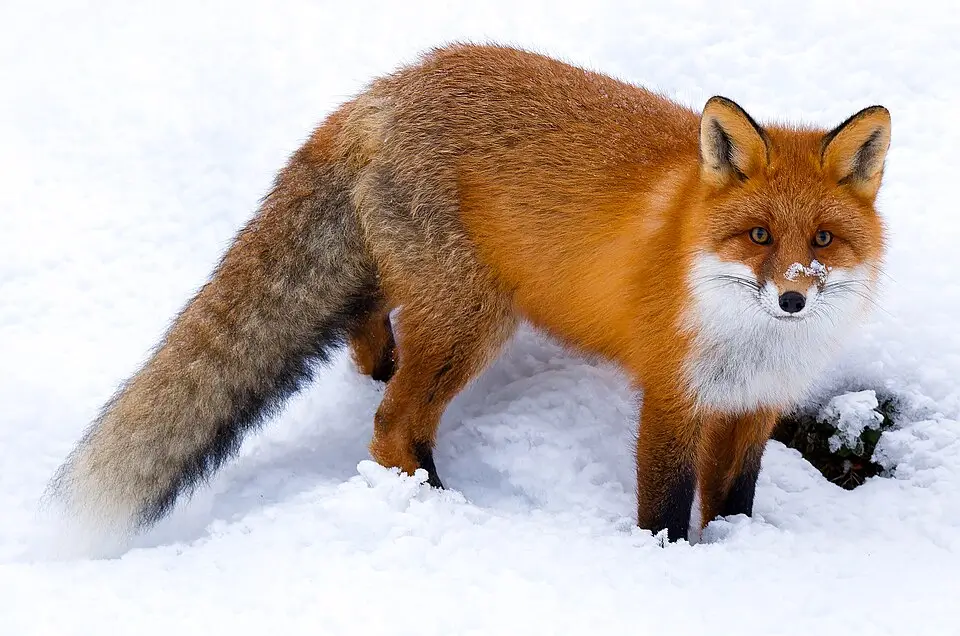
The red fox (Vulpes vulpes) is a medium-sized canid, typically smaller than a coyote but larger than most people expect when they see one in the wild for the first time. Its most iconic feature is its dense, reddish-orange fur, which covers much of its body and gives the species its common name. However, color variation is common. Melanistic (black or silver) individuals and "cross foxes," which display a dark stripe across the shoulders and down the spine, can also be found in wild populations. All color forms, however, share the red fox's most distinctive field mark: a long, bushy tail — often called a "brush" — tipped in white.
The red fox has a slender, elegant build with long legs relative to its body size, a pointed muzzle, and large, triangular ears that are capable of detecting the faint sounds of prey moving beneath snow or underground. Its eyes feature vertically elliptical pupils, an adaptation that improves depth perception in low-light conditions and distinguishes it from the domestic dog at a glance.
Red foxes are primarily crepuscular and nocturnal, meaning they are most active at dawn, dusk, and during the night. During the day, they typically rest in dens or sheltered areas, though it is not uncommon to spot them during daylight hours, especially in spring when food demands from growing pups are highest. Their diet is famously omnivorous and opportunistic. Rabbits, mice, voles, squirrels, birds, eggs, insects, fruits, and carrion all feature prominently in a red fox's menu. This dietary flexibility is one of the key reasons Vulpes vulpes has thrived in environments ranging from the Arctic tundra to subtropical regions.
Red foxes are solitary hunters, relying on stealth, speed, and acute senses of hearing and smell to locate and capture prey. One of the most celebrated hunting behaviors of the red fox is its "mousing jump," in which it leaps high into the air and pounces nose-first onto prey hidden beneath snow or grass. This precise technique demonstrates the animal's extraordinary hearing ability and spatial awareness.
Reproduction in red foxes follows a seasonal pattern. Breeding typically occurs in late winter — January through March in most of North America — and after a gestation period of approximately 52 days, a litter of pups is born in an underground den. Litter sizes generally range from two to twelve pups, though four to six is most common. Both parents participate in raising the young. The male, called a "dog fox," brings food to the nursing female, called a "vixen," and both adults teach the pups hunting skills as the season progresses. By autumn, most young foxes disperse to establish their own territories.
Red foxes are capable of living up to 14 years in captivity, though wild individuals typically live far shorter lives — often just two to four years — due to disease, predation, and human-related mortality. Natural predators include coyotes, wolves, eagles, and large owls. In areas where coyotes are abundant, red fox populations are often suppressed, as coyotes will actively kill and displace foxes from preferred habitats, a relationship known as intraguild predation.
Habitat & Range
Vulpes vulpes holds the distinction of having the widest natural range of any terrestrial carnivore. The species is native to much of the Northern Hemisphere, including North America, Europe, Asia, and North Africa, and has been introduced to Australia, where it has unfortunately become an invasive species. Within North America, red foxes are found from Alaska and northern Canada southward through most of the contiguous United States.
Red foxes are highly adaptable in their habitat preferences. They occupy boreal forests, mixed woodlands, grasslands, agricultural fields, wetlands, and suburban neighborhoods with equal ease. They tend to prefer edge habitats — areas where different types of vegetation meet, such as the border between a forest and an open field. These transition zones provide both cover and hunting opportunities, making them ideal red fox territory.
In Minnesota, the red fox is distributed broadly across the state. The patchwork of forests, lakes, farmland, and wetlands in Minnesota creates excellent edge habitat that red foxes exploit with skill. From the northern lake country to the prairie regions of the west and south, red foxes are a common and familiar sight. They are also increasingly present in suburban and even urban environments, where they have learned to exploit human food sources and the abundant populations of small mammals that inhabit parks, golf courses, and residential areas.
Red foxes establish home ranges that vary in size depending on habitat quality and food availability, typically ranging from a few square miles to over twenty square miles. They mark these territories with urine and feces, leaving scent messages for neighboring individuals. While not strictly territorial, red foxes will generally avoid the core areas of neighboring foxes, especially during the breeding season.
Hunting Information
The red fox has a long and storied history as a game animal, valued both for its beautiful fur and as a quarry for hunters pursuing a challenging and rewarding experience. Traditionally, fox hunting was conducted on horseback with hounds in the English style, a tradition that influenced early American hunting culture. Today, fox hunting in the United States is pursued in a variety of ways, including calling, trapping, and hunting with dogs.
For hunters interested in pursuing red fox in Minnesota, it is important to consult the Minnesota Department of Natural Resources (DNR) for the most current and accurate licensing and season information. Specific season dates and license requirements were not available in the source data consulted for this article, and regulations can change from year to year. Hunters are always encouraged to visit the official Minnesota DNR website or contact a local DNR office directly to obtain up-to-date legal requirements before heading afield.
Generally speaking, red fox hunting and trapping is regulated across most states, with defined seasons designed to protect populations during sensitive periods such as denning and pup-rearing. In many states, fox hunting overlaps with the late fall and winter months, when fur quality is at its peak and the animals are more actively traveling their territories in search of food.
Electronic calls and predator calls that mimic the sounds of distressed rabbits or other prey are widely used and effective methods for attracting red foxes within range. Hunters typically set up downwind of likely travel corridors and use camouflage to blend into the environment. Patient and stealthy hunters who understand red fox behavior — particularly their tendency to circle downwind before committing to a call — will consistently enjoy more success.
Red fox fur remains prized among trappers and fur buyers for its warmth, softness, and striking appearance. The winter pelt, taken from late fall through early winter when the coat is fullest, commands the best prices on the fur market. For those interested in the trapping tradition, Minnesota has a long history of furbearer trapping that is deeply connected to the state's outdoor heritage.
Conservation
The red fox is currently classified as a species of Least Concern on the IUCN Red List, reflecting its robust global population and extraordinary adaptability. Unlike many wildlife species that have struggled under the pressure of habitat loss and human expansion, Vulpes vulpes has in many ways benefited from changes to the landscape. Agricultural development, suburban sprawl, and the associated increase in edge habitat have all expanded the red fox's available range in North America.
That said, red foxes are not without conservation challenges. In some parts of North America, red fox populations face pressure from competition with the coyote, which has expanded its range dramatically over the past century. Disease — particularly mange, caused by the mite Sarcoptes scabiei, and rabies — can cause significant local population declines. Responsible wildlife management, including monitoring disease outbreaks and maintaining regulated hunting and trapping seasons, helps ensure that red fox populations remain healthy and balanced within their ecosystems.
In Minnesota, the red fox is part of a broader predator-prey ecosystem that includes deer, rabbits, rodents, coyotes, and wolves. Maintaining this ecological balance through science-based wildlife management is a priority for the Minnesota DNR and conservation organizations operating throughout the state. Hunters and trappers who participate in legal, regulated harvest contribute meaningful data to wildlife management efforts and play an active role in conservation.
The red fox is also a species of significant cultural and educational value. Its presence in suburban and rural landscapes across Minnesota provides residents with regular opportunities to observe and appreciate wild predator behavior. Responsible coexistence — including not feeding wild foxes and securing garbage and pet food — helps ensure that red fox populations remain wild, healthy, and behaviorally natural.