Overview
Few small mammals are as deeply intertwined with the wetlands of North America as the muskrat. Known to scientists as Ondatra zibethicus, this semi-aquatic rodent is a familiar sight along the edges of marshes, ponds, lakes, and slow-moving rivers across much of the continent. With its rich, water-resistant fur, rudder-like tail, and remarkable ability to thrive in environments where many other mammals cannot, the muskrat occupies a unique ecological niche.
In Minnesota — the "Land of 10,000 Lakes" — the muskrat is more than just a charismatic wetland resident. It is woven into the state's trapping heritage, its wildlife management traditions, and the everyday experiences of paddlers, anglers, hunters, and birdwatchers who frequent its sprawling lake country. With more than 14,000 lakes, vast expanses of marsh, and countless miles of river and stream habitat, Minnesota offers some of the most productive muskrat country in the United States.
This article explores the biology, habitat, behavior, conservation, and recreational significance of the muskrat, with a particular focus on the species in the context of Minnesota's outdoors.
Biological Traits
The muskrat is the largest member of the subfamily Arvicolinae, the group that includes voles and lemmings. Despite a superficial resemblance to a small beaver — and the fact that both share aquatic habitats — the muskrat is not closely related to beavers. It is, in fact, a true rodent more closely related to voles than to any other North American mammal.
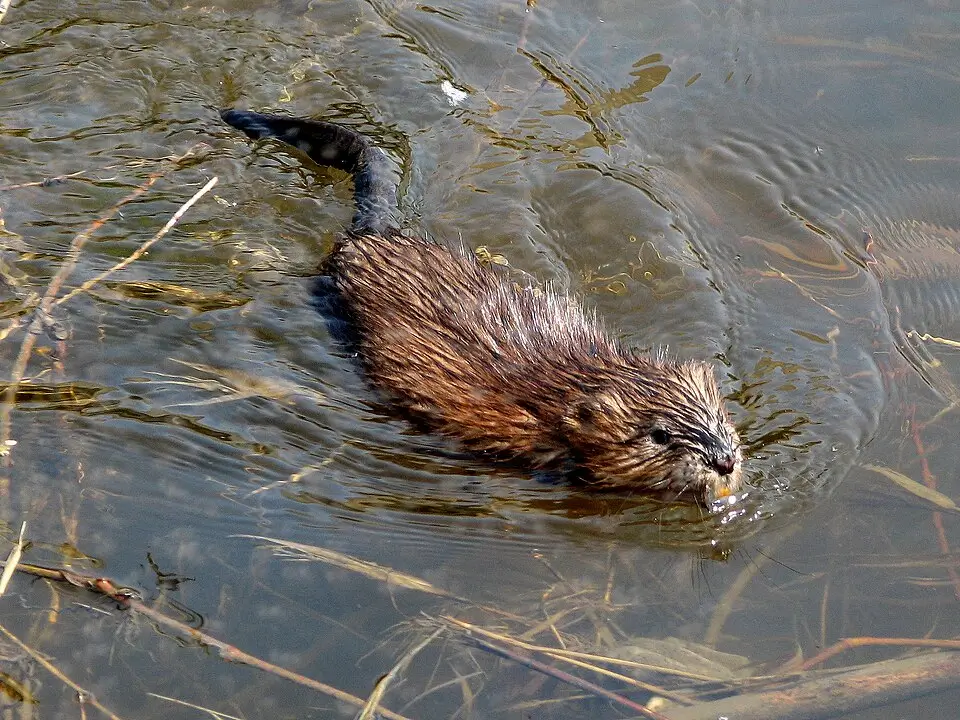
Size and Appearance. Adult muskrats typically weigh between two and four pounds, with stocky bodies that measure roughly 16 to 24 inches in length, including the tail. The tail itself is one of the species' most distinctive features: long, scaly, and laterally flattened. Unlike the broad, paddle-like tail of the beaver, the muskrat's tail acts more like a vertical rudder, sculling side-to-side to steer the animal through the water.
The muskrat's fur is a defining trait. It consists of two layers: a dense, soft underfur that traps air and provides insulation, and a longer layer of glossy guard hairs that repel water. The coat is typically dark brown on the back, with lighter, often grayish or cinnamon-tinged fur on the belly. This double-layered pelage has long made the muskrat one of the most important fur-bearing animals in North America.
Adaptations for Aquatic Life. The muskrat is exquisitely adapted to life in the water. Its hind feet are partially webbed and fringed with stiff hairs that increase surface area for swimming. The animal can close its lips behind its prominent incisors, allowing it to gnaw on submerged vegetation without taking in water. Muskrats are also capable of holding their breath for extended periods — often well over ten minutes — enabling them to forage, evade predators, and travel between burrow entrances entirely underwater.
Diet. Muskrats are primarily herbivorous. Cattails, bulrushes, sedges, water lilies, arrowhead, and other emergent and submergent aquatic plants make up the bulk of their diet. They will also feed on roots, tubers, and agricultural crops near water. When plant food is scarce, particularly in winter, muskrats will supplement their diet with mussels, frogs, crayfish, small fish, and carrion. This dietary flexibility helps them survive the long, cold Minnesota winters when fresh greenery is locked beneath the ice.
Reproduction. Muskrats are notably prolific. Females can produce multiple litters in a single year, with each litter typically containing several young. The breeding season in northern climates such as Minnesota generally runs from spring through summer, with population densities sometimes climbing dramatically in years with abundant habitat and forage. The young are born helpless but grow rapidly, becoming independent within about a month and capable of breeding the following year.
Lifespan and Behavior. In the wild, muskrats generally live only a few years, with high mortality from predators, harsh winters, disease, and habitat changes. They are most active at dusk, during the night, and in the early morning. While they can be territorial, particularly during the breeding season, family groups often share lodges and burrow systems.
Habitat & Range
The muskrat enjoys one of the broadest ranges of any North American mammal. It is native across most of Canada and the United States, with the exception of parts of the extreme South and the very driest areas of the Southwest. The species has also been introduced to parts of Europe, Asia, and South America, where it has established populations.
Preferred Habitat. Muskrats thrive in freshwater wetlands of nearly every description: marshes, swamps, beaver ponds, drainage ditches, slow rivers, lake margins, and prairie potholes. The single most important habitat requirement is the presence of water that does not freeze to the bottom in winter, along with sufficient emergent vegetation — particularly cattails and bulrushes — for both food and lodge construction. They also tolerate brackish coastal marshes in some parts of their range.
There are two main shelter types used by muskrats. In marshes with abundant vegetation, they construct dome-shaped lodges by piling cattails, reeds, mud, and other plant material into mounds that rise above the waterline. These structures have one or more underwater entrances and a dry living chamber inside. In banks of rivers and lakes where the substrate is firm enough, muskrats dig bank burrows with underwater entry holes that lead to dry chambers above the waterline.
Muskrats in Minnesota. Minnesota's geography is essentially custom-built for muskrats. The state's glacial landscape produced an extraordinary abundance of lakes, ponds, and wetlands — the famous 14,000+ lakes, plus vast tracts of marsh in the prairie pothole region of the west and the boreal wetlands of the north. The cattail-fringed shallows of these wetlands offer the food, cover, and water depth that muskrats require. In a healthy Minnesota marsh, muskrat lodges can be a common sight, especially as autumn vegetation dies back and pushes the dark mounds into view.
Muskrats also serve as a kind of ecological engineer in Minnesota wetlands. By feeding heavily on cattails and other emergent vegetation, they help open up dense stands, creating patches of open water that benefit waterfowl, marsh birds, amphibians, and a host of invertebrates. This relationship between muskrats and ducks has been documented for generations and is one reason the species is often called "the marsh's gardener."
Hunting Information
The muskrat has a long history as a furbearer in North America, and it remains a culturally and economically significant species in many states, including Minnesota. While much of the harvest is conducted through regulated trapping rather than firearms hunting, in some jurisdictions limited hunting opportunities also exist, particularly along open water during certain seasons.
General Considerations for Minnesota. Specific season dates, license requirements, bag limits, and legal methods for taking muskrats in Minnesota are set and updated by the Minnesota Department of Natural Resources (DNR). Because regulations can change from year to year, anyone interested in pursuing muskrats — whether by trapping or, where allowed, hunting — should consult the most current Minnesota DNR hunting and trapping regulations handbook or the agency's official website before heading afield. A valid Minnesota license appropriate to the activity is required, and trappers must comply with rules regarding trap types, placement, tagging, and reporting.
Best Practices. Successful muskrat pursuit relies heavily on understanding the animal's habits. Look for active lodges with fresh vegetation on top, slide marks on muddy banks, feeding platforms (small floating mats of cut vegetation), and runways through the cattails. Scouting before the season — especially in late summer and early fall — helps identify productive locations. Ethical practitioners take care to use appropriate equipment, dispatch animals quickly, and make full use of the harvest, including the pelt and, in many traditional households, the meat.
Value of the Harvest. Muskrat pelts have historically been one of the staples of the North American fur trade and continue to enter the global fur market. The meat, often referred to in some regions as "marsh rabbit," has a long culinary history among Indigenous peoples and rural communities, and is considered a wholesome, lean game protein.
Conservation
The muskrat is one of the most abundant and widely distributed mammals in North America and is generally considered to be in good conservation standing across its native range. It is classified as a species of "Least Concern" by the International Union for Conservation of Nature (IUCN), reflecting its broad distribution, large population, and adaptability.
That said, muskrat populations are not uniformly stable. Local declines have been documented in various parts of North America, sometimes tied to wetland loss, water quality issues, disease, changes in water levels, and the effects of large-scale habitat alteration. Because muskrats depend so heavily on healthy wetlands, they serve as a useful indicator species: where muskrats thrive, marsh ecosystems are typically functioning well; where muskrats decline, wetland managers often have reason to take a closer look.
In Minnesota, wetland conservation efforts — including those targeted at waterfowl, prairie pothole restoration, and shoreline protection — benefit muskrats directly. Regulated trapping is itself an important conservation tool, helping to balance muskrat populations with available habitat and reducing the boom-and-bust cycles that can otherwise damage marsh vegetation. Hunters, trappers, anglers, and conservation organizations all play a role in maintaining the wetland habitats on which the muskrat depends.
Looking after Minnesota's marshes — by supporting habitat conservation, respecting regulations, and practicing ethical outdoor recreation — ensures that the muskrat will continue to swim its quiet wakes through cattail country for generations to come.