Overview
Few animals capture the spirit of the American West quite like the mule deer (Odocoileus hemionus). With its towering ears, distinctive bounding gait, and rugged preference for sagebrush flats, rocky foothills, and high-country alpine meadows, the mule deer stands as one of the most recognizable big game animals on the continent. Named for the large, mule-like ears that dominate its profile, this species has long been a favorite of hunters, wildlife photographers, and naturalists who venture into the open landscapes west of the Mississippi River.
The mule deer is more than just a hunting trophy or a roadside curiosity. It is a keystone species in many western ecosystems, a barometer of habitat health, and a creature woven deeply into the cultural fabric of the western United States and Canada. From the deserts of the American Southwest to the boreal fringe of western Canada, mule deer have adapted to a remarkable range of environments. This article explores the biology, range, hunting tradition, and conservation status of the mule deer, while also addressing the species' relevance — or lack thereof — to states like Minnesota, where its close cousin, the white-tailed deer, dominates the landscape.
Biological Traits
The mule deer belongs to the family Cervidae, the same family that includes elk, moose, caribou, and the closely related white-tailed deer. Its scientific name, Odocoileus hemionus, reflects its kinship with the white-tailed deer (Odocoileus virginianus), with the species name "hemionus" derived from the Greek word for "half-mule" — a nod to the animal's outsized ears.
Physical Appearance
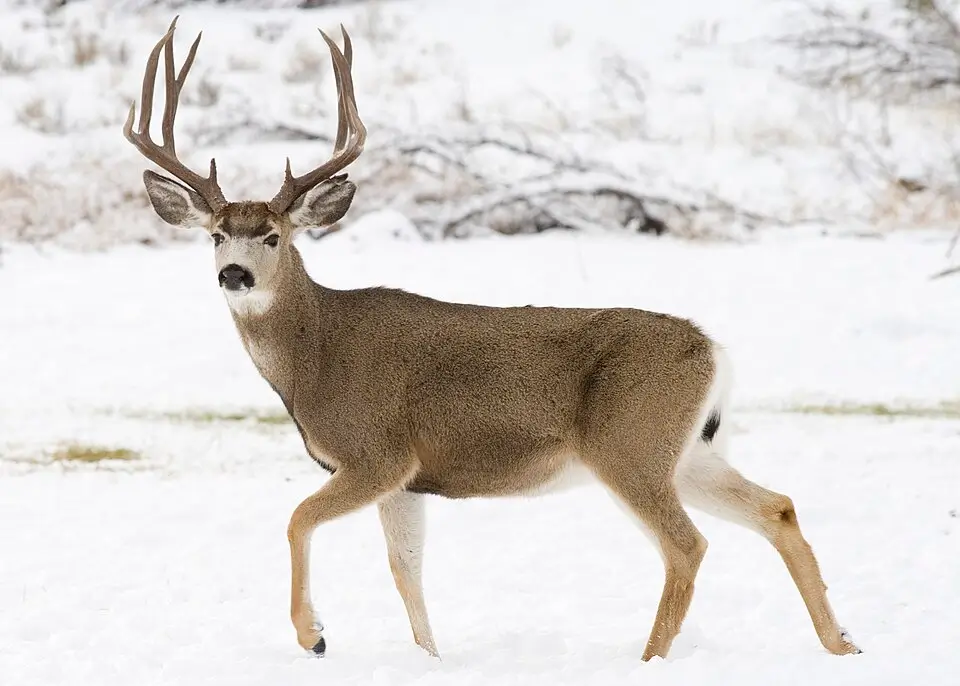
Mule deer are medium-to-large deer with a stocky build that distinguishes them from the leaner white-tailed deer. Adult bucks typically weigh significantly more than does, and mature males can grow impressive antlers that fork and re-fork as they branch, rather than rising from a single main beam as in white-tailed deer. This bifurcated antler structure is one of the most reliable visual cues for identifying the species.
The coat of the mule deer changes with the seasons. In summer, it tends toward a reddish or tawny brown, while winter brings a heavier, grayer pelage that provides insulation against harsh cold. A distinctive white rump patch surrounds a narrow, rope-like tail that is typically tipped with black — another quick identifier separating mule deer from their white-tailed relatives, whose broad tails flash white on the underside when alarmed.
The Famous Stot
Perhaps the most iconic behavior of the mule deer is its unique escape gait, known as "stotting" or "pronking." Rather than running in the smooth, flowing stride typical of most deer, an alarmed mule deer bounds away on all four legs simultaneously, springing off the ground like a four-legged pogo stick. This unusual locomotion is well-suited to the broken, rocky terrain of the West, allowing the animal to change direction sharply and clear obstacles with ease.
Senses and Behavior
The mule deer's enormous ears are not just decorative; they grant the animal exceptional hearing, capable of detecting subtle sounds across vast open country. Combined with keen eyesight tuned for movement and a powerful sense of smell, these senses make mule deer notoriously challenging to approach. They are crepuscular by nature, most active during the dawn and dusk hours, though they may feed throughout the day in colder months or in remote, undisturbed areas.
Mule deer are primarily herbivorous browsers, feeding on a wide variety of shrubs, forbs, grasses, and woody plants. Sagebrush, bitterbrush, mountain mahogany, and various oak species are common dietary staples depending on the region. Their digestive systems, like those of all cervids, rely on a four-chambered stomach that allows them to extract nutrients from fibrous plant matter through rumination.
Reproduction and Life Cycle
The mule deer's annual cycle is governed by the rut, an autumn breeding season during which bucks compete for access to does. Mature bucks may spar with rivals, displaying their antlers and engaging in pushing matches that establish dominance. Following a gestation period of roughly six and a half to seven months, does give birth in late spring or early summer, often producing twins when habitat conditions are favorable. Fawns are born with white spots that help camouflage them in dappled cover, and they remain hidden for much of their first weeks of life while their mothers forage nearby.
Habitat & Range
Mule deer are quintessentially western animals. Their range stretches from the Yukon and western Canadian provinces southward through the Rocky Mountains, Great Basin, Pacific Coast, and into northern Mexico. They occupy a remarkable diversity of habitats, including high alpine basins, coniferous forests, aspen parklands, sagebrush steppe, juniper woodlands, desert canyons, and agricultural edges.
Many mule deer populations are migratory, moving seasonally between high-elevation summer ranges and lower-elevation winter ranges. These migrations can span dozens or even hundreds of miles and are among the most spectacular wildlife movements remaining in North America. Winter range — typically lower, south-facing slopes with accessible forage beneath the snow — is often the limiting factor for population health, making winter habitat conservation a top priority for wildlife managers.
Mule Deer and Minnesota: A Note on Geography
It is important to point out that mule deer are not a species native to Minnesota. The "Land of 10,000 Lakes," bordered by Manitoba and Ontario to the north and surrounded by the Upper Midwestern states, lies well east of the mule deer's natural range. Minnesota's forests, lakes, and agricultural lands are dominated by the white-tailed deer, which thrives in the state's mosaic of woodland edges, wetlands, and farmland. Hunters in Minnesota seeking mule deer typically travel west to states such as Montana, Wyoming, Colorado, Idaho, Utah, the Dakotas, or New Mexico, where established mule deer populations support regulated hunting seasons.
Hunting Information
Mule deer hunting is a cherished tradition across the western United States and Canada. The species is pursued with rifles, muzzleloaders, and archery equipment, and hunts range from backcountry pack trips in remote wilderness to spot-and-stalk hunts in rolling sagebrush country.
Because mule deer occupy open terrain, hunting strategies often differ from those used for white-tailed deer. Glassing — patiently scanning the landscape with binoculars or a spotting scope — is a foundational technique. Once a buck is located, hunters typically plan a stalk that uses terrain, wind, and cover to close the distance. In timbered or broken country, still-hunting and tracking are also productive approaches.
Regulations and Licensing
Mule deer hunting is regulated at the state and provincial level. Seasons, bag limits, weapon restrictions, and license allocation vary widely across the species' range. Many western states use a draw or lottery system for premium hunting units, while others offer over-the-counter licenses in less heavily managed areas. Non-resident hunters generally pay higher license fees than residents, and tag availability may be limited.
Because Minnesota does not host a native mule deer population, the state does not offer a mule deer hunting season. Hunters from Minnesota interested in pursuing mule deer should consult the wildlife agency of the specific western state or province where they plan to hunt, as regulations, application deadlines, and tag availability differ significantly from one jurisdiction to another. It is always essential to obtain current, official information directly from the relevant wildlife management authority before planning a hunt.
Ethics and Fair Chase
The hunting community has long emphasized fair chase principles in pursuit of mule deer. These principles — including respect for the animal, adherence to law, and self-restraint in the field — help ensure that hunting remains a sustainable activity that contributes to conservation rather than detracting from it.
Conservation
Mule deer populations have experienced fluctuations over the decades, with some regions reporting long-term declines linked to habitat loss, fragmentation of migration corridors, invasive plant species displacing native forage, severe winter weather events, drought, and disease. Conversely, other regions have seen stable or rebounding populations thanks to active habitat management and conservation investment.
Conservation organizations and state wildlife agencies have responded with a range of initiatives. Migration corridor mapping, the construction of wildlife-friendly fencing and highway crossings, the restoration of sagebrush and aspen habitats, and the management of invasive species such as cheatgrass are all part of the modern mule deer conservation toolkit. Hunter-paid license fees and excise taxes on hunting equipment continue to provide a primary source of funding for these efforts, exemplifying the user-pays, public-benefit model of North American wildlife conservation.
Disease monitoring is another important component of mule deer management. Chronic wasting disease (CWD), in particular, has emerged as a serious concern for cervid populations across North America, and wildlife managers continue to study its spread and impact while encouraging hunters to follow carcass-handling guidelines and participate in testing programs where available.
The mule deer's future depends on the continued cooperation of state and federal agencies, private landowners, conservation nonprofits, hunters, and the broader public. As long as the open spaces of the West remain healthy and connected, the bounding stot of a mule deer on a sage-covered hillside will continue to be one of the great sights of the American outdoors.