Overview
Few birds capture the spirit of the American prairie quite like the Greater prairie-chicken (Tympanuchus cupido). With its dramatic booming calls, elaborate courtship displays, and deep ties to the native grassland ecosystems of the central United States, this remarkable bird has long fascinated naturalists, birdwatchers, hunters, and conservationists alike. Once one of the most abundant upland game birds on the continent, the Greater prairie-chicken has experienced dramatic population changes over the centuries, making it both a celebrated icon of America's wild interior and a compelling conservation story that continues to unfold today.
For hunters and wildlife enthusiasts in states like Minnesota, the Greater prairie-chicken holds a special place in the outdoor tradition. Minnesota sits at the northern edge of the species' historical range, and the Upper Midwestern landscape — with its sweeping grasslands, agricultural fields, and open wetland complexes — has long provided habitat for this distinctive grouse. Understanding the biology, behavior, and ecology of this bird enriches any encounter with it, whether you're scanning the horizon with binoculars or heading afield with a dog and a shotgun.
Biological Traits
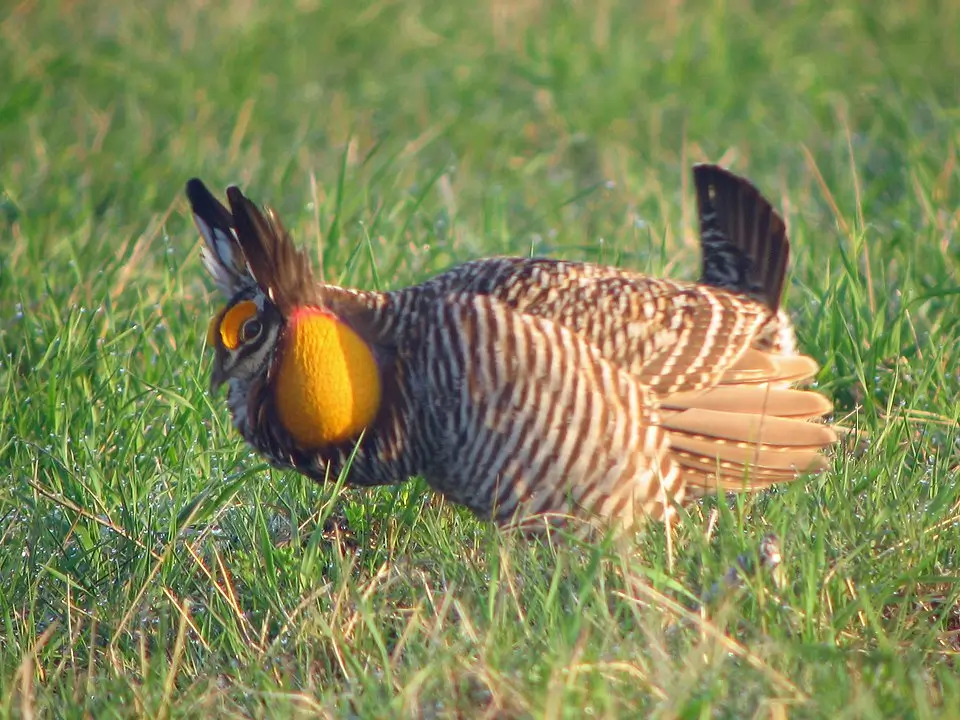
The Greater prairie-chicken is a medium-to-large grouse belonging to the family Phasianidae. Its scientific name, Tympanuchus cupido, is especially evocative: Tympanuchus derives from the Greek words for "drum" and "to hold," a direct reference to the inflatable air sacs on the sides of the male's neck that produce the species' legendary booming vocalizations. Cupido — Latin for Cupid — alludes to the wing-like tufts of feathers on either side of the neck, which are raised during courtship displays and bear a fanciful resemblance to the wings of the Roman god of love.
Both males and females display the characteristic barred plumage of the prairie-chicken — alternating bands of brown, buff, and white that provide excellent camouflage among grasses and stubble fields. Males are distinguished by several prominent features. They possess elongated, dark pinnae feathers on either side of the neck, which are erected during booming displays. The brightly colored, orange-yellow eye combs above the eyes become particularly vivid and enlarged when males are displaying or agitated. Males also have inflatable orange-yellow air sacs called tympani on their necks, which they use to produce the deep, resonant booming sound that carries remarkably far across open prairie landscapes.
Like other grouse species, Greater prairie-chickens are built for life on and near the ground. Their feet are adapted for walking and scratching through vegetation and snow, and they have the strong, broad wings typical of grouse — capable of explosive bursts of flight but not sustained long-distance travel. Their digestive systems are well-suited to a diet that shifts with the seasons, moving from insects and green plant material in warm months to seeds, waste grain, and plant buds during winter.
One of the most iconic behaviors of this species is the lek — a communal courtship arena where males gather at dawn each spring to compete for the attention of females. At the lek, males stamp their feet rapidly, drop their wings, erect their pinnae, inflate their tympanic sacs, and produce the haunting booming calls that define the prairie-chicken experience. This behavior has been observed and celebrated by naturalists for centuries, and witnessing an active lek at dawn remains one of the most extraordinary wildlife spectacles in North America.
Habitat and Range
The Greater prairie-chicken is, as its name suggests, a creature of the prairie. Historically, the species ranged across an enormous swath of North America's interior, following the distribution of the tall-grass and mixed-grass prairie biomes. At its population peak — which coincided roughly with the early settlement period of the 19th century — the species benefited from the clearing of forests and the expansion of agriculture, which temporarily created favorable open-country habitats. However, as agricultural practices intensified and native grasslands were plowed under, populations declined sharply.
Today, the Greater prairie-chicken is found in a fragmented range across the central United States, with strongholds in states such as Kansas, Nebraska, and South Dakota. Smaller, more isolated populations persist in states including Minnesota, Wisconsin, and Illinois, often requiring active management and conservation to survive.
In Minnesota, the Greater prairie-chicken is closely associated with the northwestern and west-central regions of the state, where remnant native prairies, managed grasslands, and agricultural landscapes still provide suitable habitat. Minnesota's identity as the "Land of 10,000 Lakes" speaks to its rich and varied landscape, and that same diversity of open wetlands, grasslands, and agricultural fields creates habitat complexity that can support prairie-chicken populations when managed appropriately.
Prairie-chickens require large, open grassland tracts for nesting and brood-rearing, with areas of taller, denser grass providing cover for nesting hens. They use a combination of native and non-native grasses, hayfields, and cropland edges throughout the year. Connectivity between grassland patches is especially important, as it allows birds to move between seasonal habitats and maintains genetic exchange between local populations.
Hunting Information
The Greater prairie-chicken has a long and storied history as an upland game bird. During the 19th and early 20th centuries, it was hunted extensively across its range, and the species was historically considered among the finest table birds available to prairie hunters. The sporting traditions built around prairie-chicken hunting — working pointing dogs through vast open grasslands, executing long shots on flushing birds against wide-open skies — remain cherished by a dedicated community of upland hunters.
Hunting Greater prairie-chickens typically involves covering ground, as the birds can hold tight for dogs in good grass cover but also have a tendency to flush wild in open terrain. Pointing breeds, flushing spaniels, and retrievers are all used effectively, and the open landscapes frequented by prairie-chickens reward hunters who are comfortable with longer shots.
For hunters interested in pursuing Greater prairie-chickens in Minnesota specifically, it is important to consult the Minnesota Department of Natural Resources (DNR) directly for current regulations, season dates, license requirements, and any area-specific restrictions. Prairie-chicken populations in Minnesota are carefully monitored, and hunting regulations reflect current population status. Because official season information was not available at the time this article was prepared, prospective hunters should verify the most up-to-date regulatory information directly through official Minnesota DNR channels before planning any hunt. Regulations can change from year to year based on population surveys, habitat conditions, and conservation priorities.
When regulations do permit hunting, hunters should pay particular attention to habitat access, as much prime prairie-chicken range in Minnesota falls on private agricultural land. Building relationships with landowners and seeking out public Wildlife Management Areas (WMAs) with documented prairie-chicken populations can help hunters find legal and productive access.
Conservation
The conservation story of the Greater prairie-chicken is one of the most instructive in North American wildlife management. The species' dramatic decline from historically abundant levels illustrates the profound impact of large-scale habitat loss on grassland-dependent wildlife, while ongoing recovery efforts demonstrate what is possible when landowners, agencies, and conservation organizations work together.
The primary driver of prairie-chicken decline has been the conversion of native grasslands to row-crop agriculture. As tall-grass prairie was plowed under across the central United States and Midwest, the birds lost not only nesting and brood-rearing habitat but also the structural diversity of the grassland landscape they depend on throughout the year. Predator pressure, invasive plant species, and fragmentation of remaining grassland patches have compounded these challenges.
In Minnesota, conservation efforts have focused on restoring and managing native grasslands, supporting working lands programs that incentivize farmers and ranchers to maintain grass cover, and conducting population monitoring through lek counts and other survey methods. State and federal programs — including the Conservation Reserve Program (CRP), which pays agricultural landowners to take marginal cropland out of production and establish grass cover — have played important roles in maintaining and restoring habitat for prairie-chickens and other grassland birds.
Organizations such as Pheasants Forever, the Prairie Chicken Society, and various state and federal wildlife agencies have invested significantly in prairie-chicken conservation, recognizing the bird as a valuable indicator species for the health of grassland ecosystems more broadly.
The Greater prairie-chicken's fate is intertwined with the fate of North America's remaining grasslands — an ecosystem that has been called one of the most endangered on the continent. Protecting and restoring these landscapes benefits not only prairie-chickens but also a diverse community of wildlife, from meadowlarks and bobolinks to white-tailed deer and pollinators.
Conclusion
The Greater prairie-chicken (Tympanuchus cupido) is far more than a game bird or a conservation subject — it is a living symbol of the American prairie, a bird whose booming calls at dawn connect us to a wilder, more open landscape that once stretched from horizon to horizon across the heart of a continent. For Minnesotans and all who value the outdoors, understanding and supporting this species is both a privilege and a responsibility. Whether you encounter a prairie-chicken through a spotting scope at a spring lek, through the barrel of a shotgun on a crisp autumn morning, or simply through the pages of a natural history book, the experience is one that deepens appreciation for the remarkable wildlife heritage of the Upper Midwest.