Overview
Few animals capture the imagination of wildlife enthusiasts and hunters quite like the gray fox (Urocyon cinereoargenteus). Stealthy, adaptable, and possessing a suite of remarkable biological traits, the gray fox occupies a unique ecological niche across much of North America. Unlike its more famous cousin, the red fox, the gray fox tends to prefer the shadows of dense woodland and brushy terrain, making it a genuinely exciting quarry for those who pursue it and a fascinating subject for naturalists. In Minnesota — a state celebrated for its extraordinary natural diversity, from the boreal forests of the north to the rolling prairies and farmland of the south — the gray fox represents one of the more intriguing members of the state's rich canid community.
Minnesota, known as the "Land of 10,000 Lakes" and actually home to an astonishing 14,420 lakes, provides a mosaic of landscapes that can support a wide variety of wildlife species. The gray fox, a creature of forest edges, thickets, and mixed woodland, finds much of the state's southern and central regions particularly hospitable. Understanding this animal — its biology, behavior, and relationship to hunting and conservation — gives both hunters and wildlife lovers a deeper appreciation for one of North America's most distinctive wild canines.
Biological Traits
The gray fox (Urocyon cinereoargenteus) belongs to the family Canidae and is placed in the genus Urocyon, which is considered one of the most primitive of the living canid genera in North America. This ancient lineage is reflected in several of the gray fox's most extraordinary biological characteristics, setting it apart from virtually every other member of the dog family.
Perhaps the most celebrated trait of the gray fox is its ability to climb trees. Unlike nearly all other members of the Canidae family, the gray fox possesses semi-retractable claws and strong, rotating forelimbs that allow it to scale trees with surprising agility. This skill serves multiple purposes: escaping from predators, accessing fruit and bird nests in the canopy, and even resting in elevated positions. Witnessing a gray fox shimmy up the trunk of a tree is one of the more startling sights in North American wildlife, and it is a behavior that has earned the species a measure of legendary status among wildlife observers.
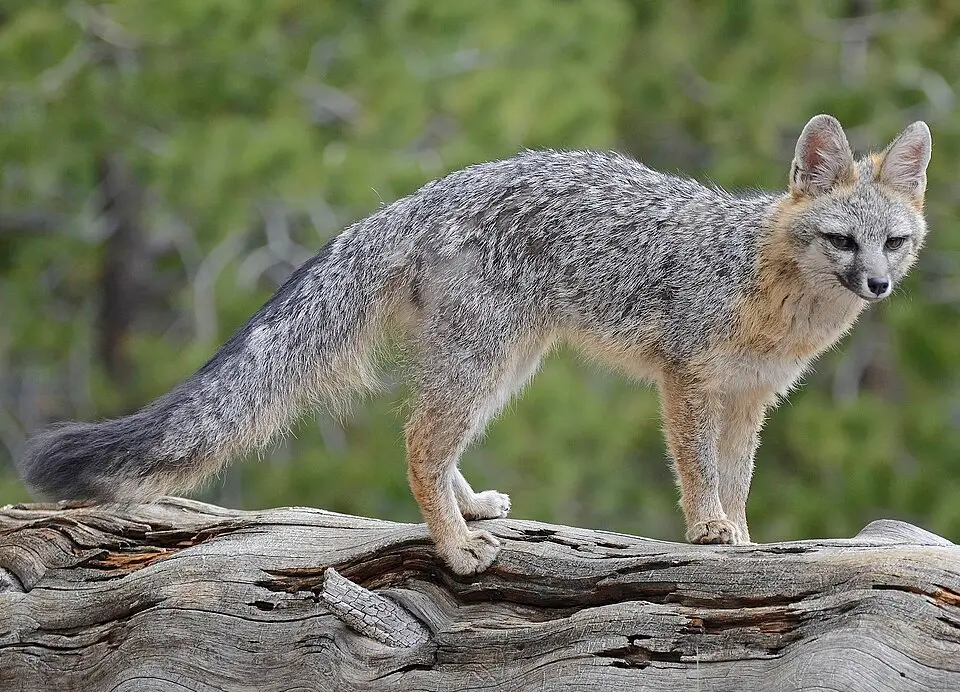
In terms of physical appearance, the gray fox is a medium-sized canid. Its coat is a salt-and-pepper grizzled gray across much of the back and sides, while the flanks, neck, and legs often display warm rufous (reddish-orange) tones. The underside is typically pale or white. A distinctive black stripe runs along the top of the tail, ending in a black tip — a feature that helps distinguish it from the red fox, which has a white-tipped tail. The face is a study in contrasts, with a rusty-red coloring around the ears and cheeks, set against the grayish tones of the forehead and a characteristic dark "moustache" mark on the muzzle.
Gray foxes are omnivores with a flexible diet that shifts with the seasons and local food availability. Small mammals such as cottontail rabbits, mice, and voles make up a significant portion of their diet, but they also consume birds, insects, fruits, and berries with equal enthusiasm. This dietary flexibility is one of the key reasons for the gray fox's success as a species. In autumn and winter, fruits and mast crops such as wild grapes, persimmons, and berries can become a surprisingly important food source. This omnivorous tendency makes the gray fox somewhat different in ecological role from the more carnivorous coyote or wolf.
Gray foxes are typically monogamous and breed in late winter, generally from January through March across much of their range. After a gestation period of approximately 53 days, females give birth to litters typically ranging from three to seven pups, though litter sizes can vary. Pups are born in a den that may be located in a hollow log, a rock crevice, a brushy thicket, or even a burrow. Both parents participate in raising the young, with the male providing food for the female and pups during the early weeks. By late summer, the young foxes are largely independent.
The gray fox is primarily nocturnal and crepuscular — most active at dawn, dusk, and through the night — though it is not unusual to observe individuals during daylight hours, especially in areas with lower human disturbance. Its senses of smell and hearing are acute, making it a highly effective predator of small prey and a remarkably difficult animal to approach closely in the wild.
Habitat and Range
The gray fox boasts one of the broadest geographic ranges of any North American canid. It is found from southern Canada through much of the continental United States, Central America, and into the northern portions of South America. Within the United States, gray foxes are particularly associated with the eastern half of the country, though significant populations also exist across the West, particularly in areas of brushy chaparral and wooded canyon country.
The species shows a strong preference for mixed hardwood forests, brushy fields, forest edges, and areas where dense cover is readily available. Rocky terrain and areas with an abundance of logs, brush piles, and dense undergrowth are especially attractive. This preference for heavy cover differentiates the gray fox ecologically from the red fox, which tends to favor more open country and is often associated with agricultural landscapes and suburban edges.
In Minnesota, the gray fox is generally more common in the southern and central portions of the state, where mixed deciduous and transitional forest habitats predominate. The state's extraordinary ecological diversity — shaped by its position at the intersection of the eastern deciduous forest, the northern boreal zone, and the western grassland biome — creates patchwork habitats that can support gray fox populations where brushy woodland and forest-edge habitats occur. The dense forests of the Boundary Waters region in northeastern Minnesota are less typical gray fox country, favoring instead the red fox and other species better adapted to boreal conditions.
Hunting Information
Hunting the gray fox is a tradition with deep roots in North American outdoor culture. Across much of its range, the gray fox is a legal game animal, pursued by hunters using a variety of methods including calling, trapping, and hunting with hounds. Its wariness, keen senses, and preference for dense cover make it a challenging and rewarding pursuit.
For hunters in Minnesota interested in pursuing gray fox, it is important to consult the Minnesota Department of Natural Resources (DNR) directly for the most current and accurate season dates, licensing requirements, and regulations. Hunting regulations for furbearing animals like the gray fox can change from year to year, and specific information about season dates and licensing requirements for Minnesota was not available in the source data for this article. Reaching out to the Minnesota DNR or visiting their official website is always the best course of action before heading into the field.
Generally speaking, gray fox hunting and trapping are most productive in the early morning and evening hours when the animals are naturally most active. Electronic and mouth calls that mimic the distress cries of rabbits or mice can be highly effective, drawing curious foxes into shooting range. The gray fox's tendency to circle downwind before approaching a call means that careful attention to wind direction is essential for success. Hunting over bait or near known travel corridors and den sites can also yield results.
Because of its preference for dense cover and brushy habitat, hunting gray fox often requires patience and a willingness to work thick terrain that other hunters might pass by. Dogs bred for fox hunting — including various hound breeds — have traditionally been used to pursue gray fox, and this style of hunting has a long and storied tradition in American outdoor culture.
Conservation
The gray fox is currently listed as a species of Least Concern by the International Union for Conservation of Nature (IUCN), reflecting its broad range and generally stable populations across much of its habitat. While local populations can fluctuate due to factors such as disease (including mange and canine distemper), habitat loss, and changes in prey availability, the species as a whole remains resilient and adaptable.
Habitat conservation is the cornerstone of ensuring healthy gray fox populations into the future. Preserving and managing brushy woodlands, forest edges, and areas of mixed cover benefits not only gray foxes but a wide community of wildlife species that depend on similar habitats. In Minnesota, ongoing conservation efforts focused on maintaining the state's remarkable diversity of natural landscapes — from its wetlands and forests to its prairies and river corridors — provide a strong foundation for sustaining populations of gray fox and other native wildlife.
Responsible hunting and trapping, guided by sound wildlife management principles and regulated by state agencies like the Minnesota DNR, play a positive role in maintaining balanced wildlife populations. Hunters and trappers have historically been among the most ardent supporters of wildlife conservation, contributing both financially and practically to habitat preservation and management efforts.
The gray fox's future in North America appears bright. Its adaptability, wide-ranging diet, and willingness to occupy a variety of habitats give it a degree of resilience that many more specialized species lack. For those who share the forests and brushy hillsides with this remarkable animal — whether as hunters, trappers, or simply passionate observers of the natural world — the gray fox remains one of North America's most captivating wild creatures.