Overview
Few birds in the wetland world inspire as much fascination among hunters, birders, and naturalists as the common snipe (Gallinago gallinago). With its impossibly long bill, cryptic plumage, and explosive zigzagging flight, this small shorebird has earned a special place in outdoor lore. In fact, the very word "sniper" — used today for marksmen of exceptional skill — was coined in the 18th century to describe hunters capable of bagging this elusive bird. That linguistic legacy alone speaks volumes about the snipe's reputation as a challenging quarry.
The common snipe is widely distributed across the Northern Hemisphere, occupying marshes, bogs, and wet meadows throughout Europe and Asia. In North America, its close cousin, the Wilson's snipe (Gallinago delicata), was once considered a subspecies of the common snipe and is so similar in appearance and behavior that the two are often discussed interchangeably. Whether encountered along a European fen or while exploring the wetlands of the Upper Midwest, the snipe remains a small bird with an outsized presence.
This article explores the biology, habitat, hunting tradition, and conservation status of the common snipe, with particular attention to how outdoor enthusiasts in places like Minnesota — the legendary "Land of 10,000 Lakes" — might encounter and appreciate these remarkable shorebirds.
Biological Traits
The common snipe is a medium-small shorebird belonging to the family Scolopacidae, the sandpiper family. It is classified in the genus Gallinago, which encompasses about 17 species of similar wetland-dwelling birds worldwide. Its scientific name, Gallinago gallinago, is a tautonym — the genus and species names are identical — a naming convention used for species considered the "typical" or nominal member of their group.
Physical Appearance
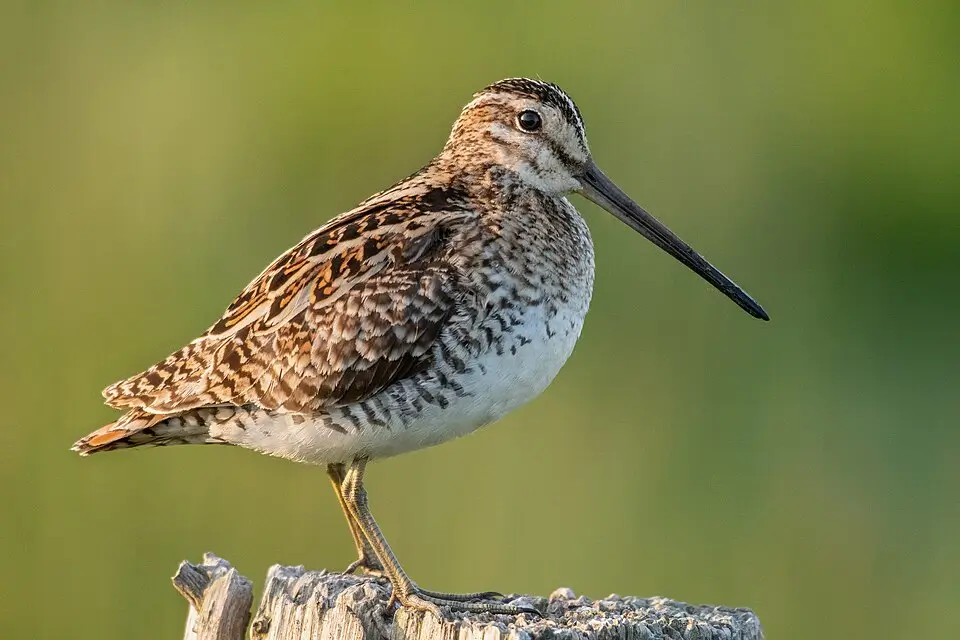
Adult common snipes typically measure around 25 to 27 centimeters (roughly 10 to 11 inches) in length, with a wingspan ranging from about 39 to 45 centimeters. They weigh approximately 80 to 140 grams. Their compact, stocky bodies are supported by relatively short legs, but the most distinctive feature is the bird's extraordinarily long, straight bill — typically 6 to 7 centimeters in length, or about a quarter of the bird's total body length.
The snipe's plumage is a masterclass in camouflage. Its back features intricate patterns of brown, black, buff, and cream, arranged in longitudinal streaks that closely mimic the appearance of dried reeds and marsh vegetation. The head is striped with dark and pale bands, and the underparts are paler with barring on the flanks. Both sexes look nearly identical, though females tend to be slightly larger on average.
Behavior and Diet
Snipes are primarily crepuscular, meaning they are most active during the dawn and dusk hours. During daylight, they often crouch motionless among reeds, relying on their cryptic coloration to avoid detection. When flushed, they erupt from cover in a startling, twisting flight pattern accompanied by a sharp, raspy "scaipe" call.
Their diet consists almost entirely of invertebrates — earthworms, insect larvae, small crustaceans, and mollusks. The long bill is a precision instrument: flexible at the tip and packed with sensory nerve endings, it allows the snipe to probe deep into soft mud and locate prey by touch. The bird can open just the tip of its bill while underground, grasping prey without having to extract its entire beak.
The Famous "Winnowing" Display
During the breeding season, male snipes perform a remarkable aerial display known as "winnowing" or "drumming." Flying high in circles above their territory, the male periodically dives at steep angles. As he dives, air rushes through his stiff, outer tail feathers, producing a haunting, vibrating sound often compared to the bleating of a distant goat or sheep. This non-vocal sound, produced entirely by feathers, is one of the most distinctive auditory experiences of springtime wetlands.
Habitat and Range
The common snipe inhabits a wide variety of freshwater wetlands across temperate and subarctic regions. Preferred habitats include marshes, bogs, wet meadows, fens, the muddy edges of ponds and lakes, flooded agricultural fields, and slow-moving streams with vegetated banks. The key requirements are soft, wet soil — necessary for probing — and dense low vegetation that provides concealment.
Across its global range, the common snipe breeds throughout much of northern and central Europe and across the boreal zones of Asia. It is a strong migrant, with northern populations wintering as far south as Africa, the Mediterranean, the Middle East, southern Asia, and even parts of equatorial regions.
In North America, the closely related Wilson's snipe occupies similar wetland habitats throughout Canada and much of the United States. In Minnesota — a state defined by water, with more than 14,000 lakes and vast tracts of marsh, peatland, and bog — snipe habitat is abundant. The state's location along major continental flyways means it sees significant snipe activity during both spring and fall migrations. The northern boreal regions of Minnesota provide important breeding habitat, while the state's countless smaller wetlands and flooded meadows serve as critical stopover points.
Hunting Information
Snipe hunting has a long and storied tradition that stretches back centuries in Europe and North America. The bird's small size, lightning-fast erratic flight, and tendency to hold tight until almost stepped upon make it one of the most challenging wingshooting targets in the upland and wetland world.
The Challenge of Snipe Hunting
Unlike larger waterfowl, snipe rarely offer the steady, predictable flight paths that allow easy shotgunning. When flushed, they typically jet off in a series of unpredictable zigzags before settling into a steadier flight at distance. Successful snipe hunters often emphasize quick reflexes, fast gun-mounting technique, and the ability to shoot instinctively rather than carefully aim.
Gear and Approach
Traditionally, hunters pursue snipe by walking slowly through suitable wet habitat, often with a flushing dog such as a spaniel or pointer. Light, open-choked shotguns — typically 20 or 28 gauge — and small shot sizes (such as #8 or #9) are commonly favored for clean, ethical harvests. Waders or waterproof boots are essential, given the marshy terrain.
Hunting in Minnesota
Specific season dates, license requirements, and bag limits for snipe hunting were not available in the source material referenced for this article. Hunters interested in pursuing snipe in Minnesota should consult the Minnesota Department of Natural Resources (DNR) directly for current regulations, which typically classify snipe as migratory game birds subject to federal frameworks under the Migratory Bird Treaty Act. A Minnesota small game license, along with applicable migratory bird stamps and Harvest Information Program (HIP) registration, is generally required. Always verify current rules before heading afield.
Minnesota's countless wet meadows, the edges of its prairie potholes, and the wetlands of its agricultural and boreal regions make it an excellent state for snipe enthusiasts. Early to mid-fall, when migrating birds concentrate in stopover habitat, is traditionally a productive time for those familiar with snipe behavior.
Conservation
The common snipe is currently classified as a species of "Least Concern" by the International Union for Conservation of Nature (IUCN), reflecting its very large global range and substantial population. Globally, populations are considered stable in many regions, though local declines have been documented in areas where wetland habitats have been drained for agriculture or development.
The greatest long-term threat to snipe populations — both common snipe in Eurasia and Wilson's snipe in North America — is the loss and degradation of wetland habitat. Drainage of marshes and wet meadows, agricultural intensification, and alterations to natural hydrology all reduce the soft-soil habitats snipe require. Climate change also poses uncertainties, particularly for breeding populations in northern bogs and peatlands.
Fortunately, wetland conservation has emerged as a major priority across both Europe and North America. Organizations such as Ducks Unlimited, the U.S. Fish and Wildlife Service, and various state wildlife agencies — including the Minnesota DNR — have invested heavily in wetland restoration and protection. The Wetlands Reserve Program and similar initiatives benefit snipe along with countless other species. Hunters themselves have historically been among the strongest financial contributors to wetland conservation through license fees, duck stamp purchases, and excise taxes on hunting equipment under the Pittman-Robertson Act.
Responsible, regulated hunting has not been identified as a significant pressure on snipe populations. Indeed, the snipe-hunting community has long been part of the constituency advocating for the wetland conservation that benefits the species and the broader ecosystems it depends upon.