Overview
Few game birds are as instantly recognizable—or as celebrated by hunters, naturalists, and rural communities—as the common pheasant (Phasianus colchicus). With its iridescent plumage, long sweeping tail, and distinctive crowing call echoing across autumn farmlands, the common pheasant has secured a special place in both wildlife traditions and upland hunting culture worldwide. Although native to Asia, this striking bird has been successfully introduced across Europe, North America, and parts of Australasia, where it has become one of the most popular and widely pursued upland game species.
In the United States, particularly in the agricultural heartland of the Upper Midwest, the common pheasant—often called the ring-necked pheasant—has become an iconic symbol of the prairie countryside. States like Minnesota, with its expansive farmland, grasslands, and wetland edges, provide excellent habitat for these birds and a longstanding tradition of pheasant hunting that draws thousands of sportsmen and women each fall.
This article offers a comprehensive look at the common pheasant, exploring its biology, preferred habitats, hunting heritage, and conservation status, with particular attention to its presence in Minnesota.
Biological Traits
The common pheasant belongs to the family Phasianidae, which also includes grouse, partridges, quail, and turkeys. Its scientific name, Phasianus colchicus, reflects its ancient origins—"Phasianus" derives from the Phasis River (modern-day Rioni River in the country of Georgia), where Greek travelers reportedly first encountered the bird, while "colchicus" refers to the historical region of Colchis in the Caucasus.
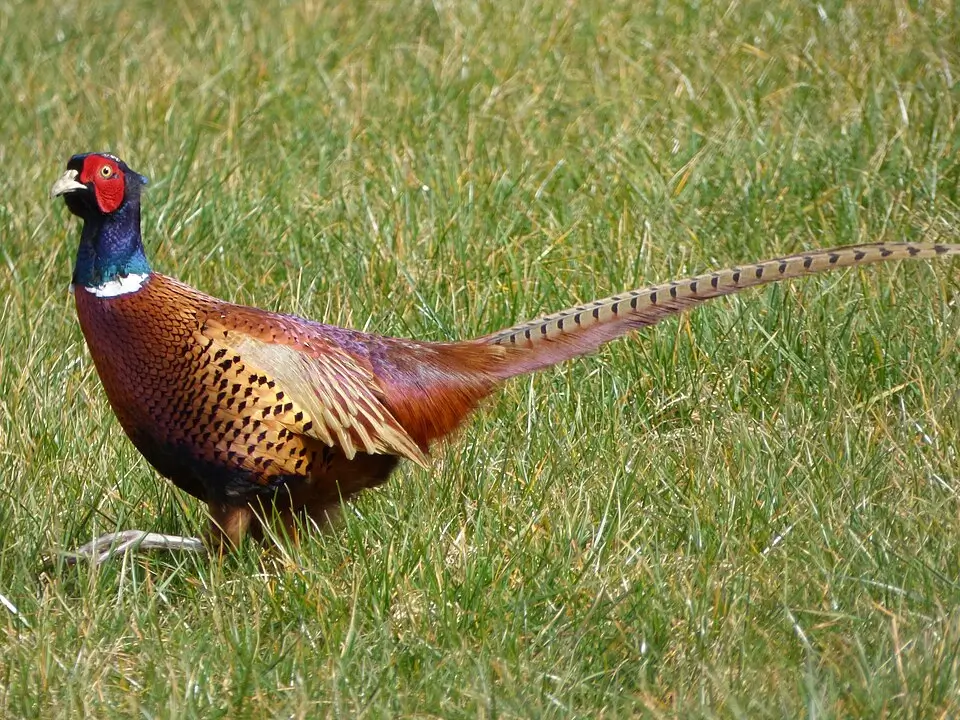
Pheasants are medium-to-large game birds with pronounced sexual dimorphism, meaning males and females look strikingly different. The male, or "rooster" (also called a "cock"), is unmistakable: he sports brilliant copper, gold, and chestnut body plumage punctuated by iridescent green and purple sheens on the head and neck. A bold white neck ring, bare scarlet facial wattles, and small ear tufts complete his showy appearance. His tail is long, pointed, and barred with black, often making up a substantial portion of his overall body length.
In contrast, the female, or "hen," wears a far more subdued palette of mottled brown, buff, and black. This cryptic coloration provides excellent camouflage as she incubates eggs on the ground, where nests are vulnerable to predators. Hens are smaller than roosters and have shorter tails.
Pheasants are strong runners and prefer to escape danger on foot, often sprinting through cover before resorting to flight. When flushed, however, they erupt from cover with a startling burst of wingbeats and a loud cackling call, capable of rapid flight over short distances. Their diet is omnivorous and opportunistic, consisting of seeds, grains, berries, leaves, insects, and small invertebrates. In agricultural landscapes, waste grain from corn, soybeans, wheat, and sunflowers provides a vital food source, particularly during harsh winters.
The breeding season typically begins in spring, when males establish territories and crow loudly to attract hens and warn rival males. A single male may mate with several females, and hens lay clutches of pale olive or buff eggs in shallow ground nests hidden among tall grasses or crops. Chicks are precocial—they hatch fully feathered, eyes open, and capable of leaving the nest within hours—and follow the hen as she leads them to food.
Habitat & Range
The common pheasant is native to a vast region of Asia, ranging historically from the Caucasus and Black Sea region across Central Asia to China, Korea, and parts of Southeast Asia. Numerous subspecies and regional variants exist throughout this native range, exhibiting differences in plumage detail, particularly in the presence or absence of the white neck ring.
Through centuries of intentional introductions—often for hunting and aesthetic reasons—the species has spread far beyond its native range. Pheasants were brought to Europe as early as Roman times and to North America in the late 19th century. The introduced North American population is generally referred to as the "ring-necked pheasant," reflecting one of the dominant subspecies released across the continent.
Pheasants thrive in mixed agricultural and grassland habitats. Ideal pheasant country combines several features:
- Grain-producing croplands that supply abundant food, especially in fall and winter.
- Tall grass cover for nesting and brood-rearing—ideally undisturbed prairie, conservation grasslands, or weedy field edges.
- Wetland fringes and cattail sloughs, which provide critical winter cover during heavy snow and cold.
- Shelterbelts and brushy fence lines, offering loafing and escape cover.
In Minnesota, these habitat conditions are common across the southern and western portions of the state. The agricultural mosaic of corn and soybean fields interspersed with prairie potholes, wetlands, and grassland set-asides creates classic pheasant country. The state's Conservation Reserve Program (CRP) lands, Wildlife Management Areas, and federal Waterfowl Production Areas have all played significant roles in supporting pheasant populations. Although the rugged forests of northeastern Minnesota are unsuitable for pheasants, the open landscapes of the south and west host robust populations and a longstanding hunting tradition.
Hunting Information
The common pheasant is among the most widely hunted upland game birds in the world. In Minnesota and across the United States, pheasant hunting traditionally opens in autumn and continues into early winter, with regulations generally limiting harvest to roosters only, in order to protect breeding hens and maintain healthy populations. Specific season dates, bag limits, license requirements, and shooting hours vary by state and year, and hunters should always consult the Minnesota Department of Natural Resources (DNR) for the most current regulations before heading afield.
Pheasant hunting is a classic upland pursuit, often conducted with the help of well-trained bird dogs. Flushing breeds such as Labrador retrievers, springer spaniels, and golden retrievers excel at pushing birds out of dense cover, while pointing breeds such as German shorthaired pointers, English setters, and Brittanys locate birds and hold them until the hunter approaches. A skilled dog dramatically increases both success and the recovery of downed birds.
Typical pheasant hunts unfold across grasslands, weedy field edges, picked corn rows, cattail sloughs, and CRP fields. Hunters often walk in small groups, with some serving as "blockers" at the end of a field while "drivers" push through cover. Roosters frequently run ahead of approaching hunters before flushing in a loud, dramatic burst—an experience that defines the sport for many enthusiasts.
A 12- or 20-gauge shotgun loaded with appropriate upland loads is the standard firearm. Blaze orange clothing is typically required for safety, and ethical hunters take care to identify roosters clearly before shooting, as hens are protected.
Minnesota's pheasant hunting tradition is deeply woven into the state's outdoor heritage. The opening weekend of pheasant season is a much-anticipated event in many rural communities, with hunters traveling from across the region to enjoy the landscape, the camaraderie, and the challenge of pursuing this wily bird. Public hunting opportunities are extensive on Wildlife Management Areas, Waterfowl Production Areas, and lands enrolled in walk-in access programs.
Conservation
The common pheasant, when viewed across its global range, is considered a species of Least Concern by the International Union for Conservation of Nature (IUCN), thanks largely to its enormous worldwide distribution and abundant introduced populations. However, regional populations can fluctuate significantly in response to habitat conditions, weather, and land-use practices.
In North America, pheasant numbers are closely tied to the availability of nesting and winter cover. The loss of grasslands to intensified row-crop agriculture, drainage of wetlands, removal of shelterbelts, and reductions in conservation set-aside programs have all contributed to long-term declines in some regions. Severe winters with prolonged deep snow can also cause significant local mortality.
Conservation efforts to support pheasants are well-established and largely habitat-driven. Programs such as the federal Conservation Reserve Program (CRP), state habitat initiatives, and the work of organizations like Pheasants Forever have contributed enormously to grassland restoration, wetland protection, and the creation of nesting habitat. Pheasants Forever, founded in Minnesota in 1982, has become one of the most influential upland habitat conservation organizations in North America, with chapters across the country working to restore and protect prairie ecosystems.
Hunter-generated revenue—through license fees, excise taxes on firearms and ammunition (the Pittman-Robertson Act), and habitat stamps—continues to fund wildlife management, public land acquisition, and habitat improvement projects that benefit not only pheasants but a wide range of grassland species including songbirds, pollinators, and waterfowl.
The future of the common pheasant in places like Minnesota depends on continued investment in working-lands conservation, the protection of grasslands and wetlands, and the engagement of hunters, farmers, and communities in stewardship of the landscape. With sustained effort, the cackling crow of a rooster pheasant rising from a frosty prairie will remain a defining sound of the Upper Midwest for generations to come.