Overview
Few sights in nature are as stirring as a V-formation of Canada geese cutting across an autumn sky, their resonant honking carrying across fields, marshes, and open water. The Canada goose (Branta canadensis) is one of the most recognizable and beloved waterfowl species in North America, a bird so deeply woven into the cultural and ecological fabric of the continent that its image has become synonymous with the changing of seasons. From the vast wetlands of the Canadian boreal forest to the urban parks and farm ponds of the American Midwest, this remarkable bird has demonstrated an extraordinary ability to thrive across a diverse range of environments.
In Minnesota — a state celebrated as the "Land of 10,000 Lakes" and home to an astonishing 14,420 lakes — the Canada goose holds a place of special prominence. The state's rich mosaic of wetlands, prairies, agricultural fields, and forested corridors provides ideal habitat for these birds, making Minnesota one of the premier destinations in the country for waterfowl enthusiasts, wildlife observers, and hunters alike. Whether you are a seasoned hunter waiting in a blind at dawn, a birdwatcher scanning a lakeshore with binoculars, or simply someone who pauses to watch a family of geese cross a quiet suburban pond, the Canada goose is a species that demands attention and commands respect.
This article explores the biology, behavior, habitat, hunting traditions, and conservation story of the Canada goose — a bird that is, in every sense, a symbol of wild North America.
Biological Traits
The Canada goose, Branta canadensis, belongs to the family Anatidae, which includes all ducks, geese, and swans. It is the largest goose native to North America and one of the most variable, with multiple recognized subspecies ranging considerably in size and plumage across their geographic range.
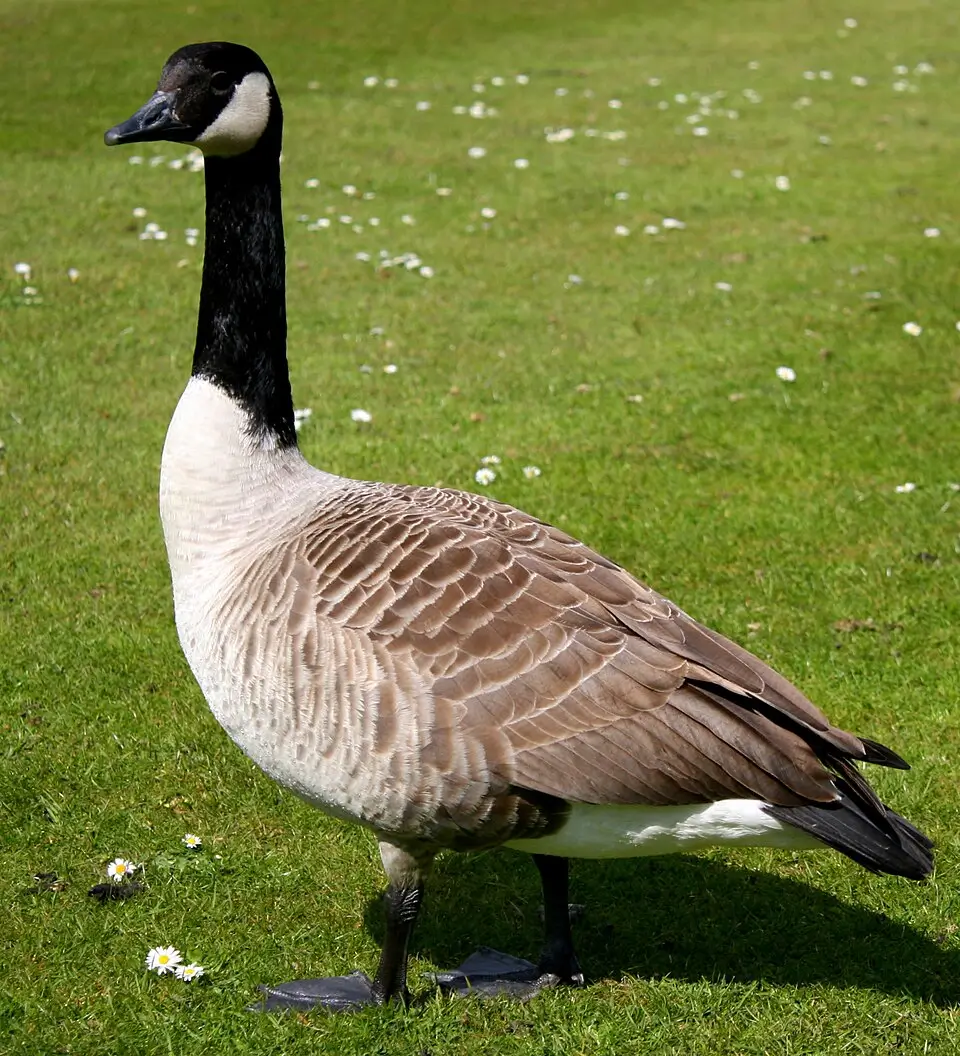
Perhaps the most immediately recognizable feature of the Canada goose is its distinctive coloration: a black head and long black neck sharply contrasted by a white chin strap or "chinstrap" patch that wraps beneath the bill and across the cheeks. The body is generally brownish-gray on the back and sides, with a pale, often whitish breast and belly. The tail and flight feathers are dark, and the bill, legs, and feet are black. This bold pattern makes the Canada goose virtually unmistakable in the field, even at considerable distance.
Canada geese are highly social birds. They form strong pair bonds that often last for life, and family groups remain together through migration and into the following breeding season. Both parents participate actively in raising their young, known as goslings, with the male (gander) taking on an aggressive protective role while the female (goose) incubates the eggs. Goslings are precocial — meaning they are born covered in down and capable of walking, swimming, and feeding within hours of hatching. This early independence gives them a significant survival advantage.
The species is well known for its V-formation flight pattern, a behavior rooted in aerodynamic efficiency. Birds flying behind and slightly to the side of the leader benefit from reduced air resistance, allowing the flock to cover vast distances with less energy expenditure. Individuals rotate the lead position so that no single bird bears the full burden of breaking the wind for extended periods. This cooperative behavior is a compelling example of instinctive social coordination in the animal kingdom.
Canada geese are primarily herbivores, feeding on grasses, sedges, aquatic vegetation, grains, and agricultural crops. Their broad dietary flexibility is one of the key factors behind their remarkable adaptability. In agricultural landscapes like those found throughout Minnesota and the broader Midwest, geese readily exploit harvested corn and soybean fields, often concentrating in enormous numbers during migration.
The vocal repertoire of the Canada goose is varied and expressive. The familiar loud, resonant honk — often rendered as a-honk — is used in a wide array of social contexts, including pair bonding, flock coordination during flight, and territorial defense. Softer clucking notes are used in close social interactions, particularly between parents and goslings.
Habitat & Range
The Canada goose is among the most widely distributed waterfowl in North America. Its breeding range extends from the Arctic tundra of northern Canada and Alaska southward into the northern contiguous United States. Populations winter across a broad swath of the continent, from the Pacific and Atlantic coasts to the interior south, depending on available open water and food resources.
Historically, Canada geese were migratory birds that nested in remote northern wilderness and moved south in large numbers each autumn. Today, however, a significant portion of the population consists of resident birds — geese that have established year-round populations in locations where food and open water are reliably available. Urban and suburban environments, with their manicured lawns, golf courses, park ponds, and retention basins, have proven surprisingly hospitable to Canada geese, leading to large resident populations in many cities and towns across the United States and southern Canada.
In Minnesota, the Canada goose is both a breeding resident and a migratory visitor. The state's extraordinary abundance of lakes, rivers, wetlands, and agricultural land provides an ideal combination of nesting habitat, brood-rearing areas, and foraging grounds. During spring and fall migration, Minnesota serves as a crucial stopover and staging area for geese moving along the Mississippi and Central flyways — two of the major waterfowl migration corridors in North America. Vast flocks can be observed gathering on large lakes and in harvested grain fields throughout the state during these peak migration periods.
Nesting habitat for Canada geese typically includes areas near water — lakeshores, riverbanks, marsh edges, and islands — where females can build ground nests with good visibility of approaching predators. The nest is a shallow depression lined with plant material and down feathers, usually positioned in elevated or open ground to provide sight lines in multiple directions.
Hunting Information
Canada goose hunting is a cherished tradition across North America, and Minnesota offers some outstanding opportunities for waterfowlers pursuing this species. The state's position along major migration flyways, combined with its abundant wetlands and agricultural landscapes, creates exceptional conditions for goose hunting throughout the season.
Hunters typically pursue Canada geese using a combination of decoys, calls, and concealment. Large spreads of full-body or shell decoys are arranged in open fields or along water edges to simulate feeding or resting flocks, while hunters use calls to mimic the honking and clucking vocalizations that geese use to communicate. Concealment in layout blinds, pit blinds, or natural vegetation is essential, as Canada geese have sharp eyesight and are quick to detect anything that appears out of the ordinary in their surroundings.
Jump shooting — approaching geese quietly along waterways and taking birds as they flush — is another effective and exciting method, particularly for hunters working smaller water bodies or creek corridors.
Because hunting regulations, season dates, and bag limits for Canada geese in Minnesota are set annually by the Minnesota Department of Natural Resources (DNR) in coordination with the U.S. Fish & Wildlife Service and can change from year to year, hunters are strongly encouraged to consult the current Minnesota Waterfowl Hunting Regulations published by the Minnesota DNR before heading afield. Regulations may vary by zone, and specific seasons for resident Canada geese may differ from seasons for migratory populations. A valid Minnesota hunting license and a federal duck stamp are standard requirements for waterfowl hunting, but hunters should verify all current licensing requirements directly with the Minnesota DNR.
Conservation
The conservation story of the Canada goose is one of the great wildlife management success stories of the 20th century. By the early to mid-1900s, market hunting, habitat loss, and other pressures had significantly reduced Canada goose populations across much of their range. Conservation efforts — including the establishment of federal and state wildlife refuges, the passage of the Migratory Bird Treaty Act, and carefully managed hunting seasons — enabled populations to recover substantially over subsequent decades.
Today, Canada goose populations are robust and in many areas thriving. Sustainable hunting continues to serve as both a population management tool and a vital source of funding for conservation programs through mechanisms such as the Federal Duck Stamp program and excise taxes on hunting equipment under the Pittman-Robertson Act. These resources fund habitat acquisition, wetland restoration, and wildlife research that benefit not only waterfowl but a broad spectrum of wildlife species.
In Minnesota, conservation of wetland habitats remains a priority for the long-term health of Canada goose populations and the many other species that depend on these ecosystems. Organizations such as Ducks Unlimited, the Minnesota Waterfowl Association, and various state and federal agencies continue to work collaboratively to protect and restore critical wetland acres across the state.
The Canada goose stands as a living testament to what thoughtful, science-based wildlife management can achieve. From the brink of serious decline to one of the continent's most abundant large waterfowl species, its story is one of resilience, adaptability, and the enduring value of conservation.