Overview
Few birds inspire as much affection among hunters and wildlife enthusiasts alike as the American woodcock (Scolopax minor). This compact, peculiar shorebird — often found far from any shore — occupies a unique niche in both the natural world and the hearts of those who pursue it through the autumn forests of North America. Known by a colorful variety of nicknames including "timberdoodle," "bogsucker," "mud snipe," and "Labrador twister," the American woodcock is a bird that defies easy categorization and rewards patient observation.
Unlike many game birds that inhabit open prairies or high-altitude fields, the woodcock is a creature of the forest floor, probing soft earth with its remarkable bill in search of earthworms and other invertebrates. Its preference for dense, young-growth thickets and alder-lined stream corridors makes it an elusive quarry and a fascinating subject for naturalists. In a state like Minnesota — with its extraordinary mosaic of forests, wetlands, and river bottoms — the American woodcock finds some of its finest habitat in North America.
Whether you are a seasoned wingshooter who has chased timberdoodles for decades, or a newcomer simply curious about this extraordinary bird, this guide offers a thorough look at the biology, habits, range, and hunting traditions surrounding Scolopax minor.
Biological Traits
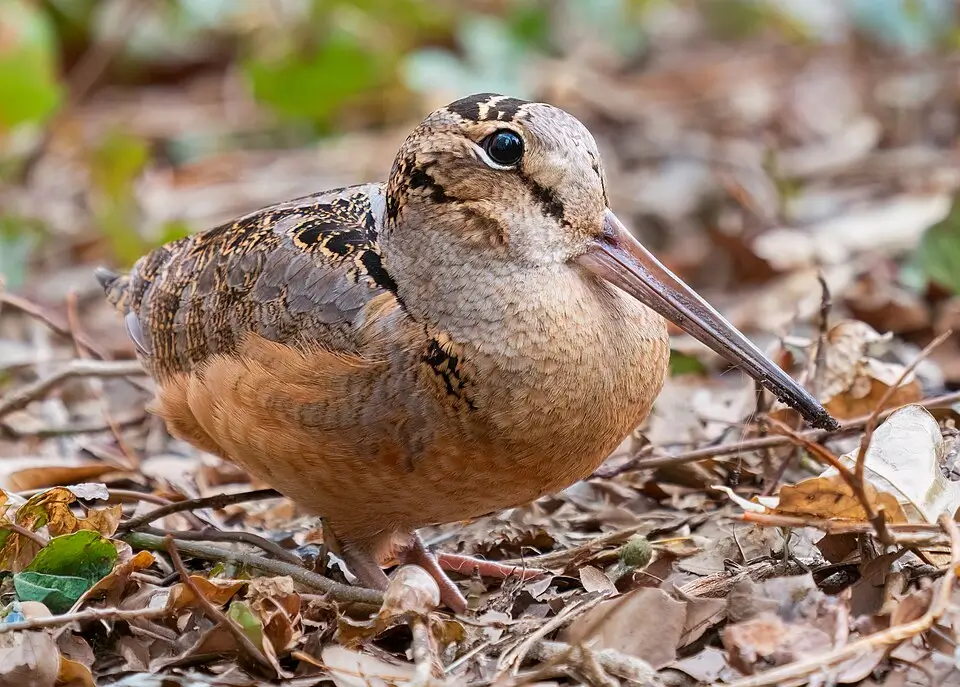
The American woodcock is a member of the family Scolopacidae, the sandpipers and allies, though its lifestyle bears little resemblance to the shorebirds that wade tidal flats and sandy beaches. It is a stocky, compact bird with short legs, a very long bill, large eyes positioned high and far back on its rounded head, and cryptically patterned brown, buff, and black plumage that renders it nearly invisible against a backdrop of dead leaves.
One of the woodcock's most celebrated anatomical features is its bill. Measuring roughly 2.5 to 2.8 inches in length, the bill is long, flexible, and uniquely adapted for probing moist soil. The tip of the upper mandible is prehensile — meaning the bird can flex the tip independently to grasp earthworms underground without fully opening its bill. This extraordinary adaptation allows the woodcock to feed efficiently beneath the surface of the soil, locating prey by touch and tactile sensation rather than sight.
The woodcock's eyes are equally remarkable. Set far back and high on the skull, they provide an almost 360-degree field of vision, allowing the bird to watch for predators even while its bill is buried in the soil. This wide field of view is complemented by a brain structure that is somewhat unusual among birds — the cerebellum, which controls motor function, is positioned toward the front of the skull, while the brain's visual centers are oriented toward the back.
Adult woodcock are relatively small, typically weighing between 5 and 8 ounces. Females are generally larger than males, a pattern of reversed sexual size dimorphism that is common among shorebirds. Both sexes share the same cryptic, leaf-litter plumage, making them extraordinarily difficult to spot when sitting still on the forest floor.
Perhaps the most captivating aspect of woodcock biology is the male's elaborate spring courtship display, known colloquially as the "sky dance." At dawn and dusk during the breeding season, male woodcock gather in open clearings and forest edges to perform a remarkable aerial display. The performance begins with a series of distinctive nasal "peent" calls delivered from the ground, followed by a spiraling, chirping flight high into the twilight sky. The male then descends in a tumbling, musical glide, producing a liquid, warbling song with his wings, before landing near his departure point to begin the sequence again. This sky dance is one of the most captivating wildlife spectacles in North American forests, drawing birdwatchers and nature enthusiasts to forest clearings on spring evenings from the eastern United States to Canada.
Habitat & Range
The American woodcock is endemic to eastern North America. Its breeding range extends from the Canadian Maritime provinces westward through Quebec, Ontario, and into the Great Lakes region, including Minnesota, Wisconsin, and Michigan, and south through the Appalachians and mid-Atlantic states. The species winters primarily in the southeastern United States, from the Gulf Coast states through the Carolinas and up into parts of the mid-Atlantic region.
The woodcock is a migratory bird, moving southward in autumn as the ground freezes and earthworms become inaccessible. Migration typically occurs at night, with birds traveling individually rather than in flocks. During migration, woodcock can appear in surprising locations — suburban backyards, city parks, and manicured lawns — wherever moist soil and earthworms can be found.
In terms of habitat preference, the American woodcock has a strong affinity for young, regenerating forest stands. Early successional habitats — those recovering from logging, fire, or other disturbances — are particularly attractive, as they provide the combination of dense cover for roosting and nesting alongside open soil for foraging. Alder thickets, aspen stands, and brushy young forests near streams and wetlands represent prime woodcock country. The species tends to avoid mature, closed-canopy forests where the soil is too hard and root-bound for effective bill-probing.
Minnesota's landscape is remarkably well-suited to woodcock. The state's vast forests of aspen, birch, and alder, particularly across the northern and northeastern regions, provide ideal breeding habitat. The abundance of lakes, rivers, and wetlands — Minnesota boasts more than 14,000 lakes — creates a patchwork of moist, invertebrate-rich soils that woodcock depend upon for food. River bottoms, alder-choked creek corridors, and the edges where young forests meet wetlands are classic places to find woodcock in the Land of 10,000 Lakes.
Hunting Information
Woodcock hunting occupies a cherished place in North American upland hunting tradition. The pursuit of timberdoodles has inspired some of the finest prose in hunting literature, and for good reason — hunting woodcock combines the pleasures of forest walking, dog work, and wingshooting in a uniquely intimate setting.
Hunting woodcock typically involves walking slowly through dense alder thickets, young aspen, and brushy river bottoms, often behind a pointing or flushing dog. When a woodcock is pushed from its hiding place in the leaf litter, it rises steeply through the branches with a distinctive twittering sound produced by its wings, offering a challenging and unpredictable shot. The bird's irregular, twisting flight through dense vegetation is what has earned it nicknames like "Labrador twister" and made it a prized test of a hunter's reflexes and gun handling.
Dogs are an important part of the woodcock hunting tradition. Breeds with a good nose and the patience to work dense cover — English setters, Brittanys, and various pointing breeds — are particularly well-suited to the task. A well-trained bird dog's ability to locate and hold woodcock in thick cover is a significant advantage and adds immeasurably to the experience.
In Minnesota, the woodcock hunting season is part of the broader fall upland game season, offering hunters the opportunity to pursue timberdoodles across the state's forested north country alongside ruffed grouse. Prospective hunters should always consult the Minnesota Department of Natural Resources (DNR) for current season dates, bag limits, and licensing requirements, as these regulations can change from year to year. Because the American woodcock is a migratory bird, it falls under the jurisdiction of the U.S. Fish & Wildlife Service as well as state authorities, meaning both state and federal regulations apply.
Woodcock are best pursued in the early part of the season, before the leaves have fully dropped, when local birds are still present. As autumn progresses, migrating birds from further north pass through, sometimes providing exceptional hunting for a brief window before cold weather pushes them south. Hunters familiar with the landscape learn to read the subtle signs of woodcock presence — probing marks in the soft earth, white chalky droppings called "chalk" or "splash," and the distinctive shuffling footprints of a bird that rocks gently back and forth while walking to help detect earthworm movement underfoot.
Conservation
The American woodcock is classified as a species of conservation concern across much of its range. While it is not currently listed as threatened or endangered, populations have experienced long-term declines attributed primarily to the loss and succession of early successional forest habitats. As forests mature and young-growth stands become scarcer across the eastern United States and Canada, the specialized habitat that woodcock depend upon is diminishing.
Conservation efforts for woodcock focus heavily on habitat management. Organizations such as the American Woodcock Society and various state wildlife agencies work to promote active forest management practices — including timber harvesting, prescribed fire, and habitat restoration — that create and maintain the young-growth forests woodcock need. Hunters and conservation groups have also been instrumental in supporting woodcock research, including the long-running singing ground surveys conducted by the U.S. Fish & Wildlife Service each spring, which track population trends by monitoring the frequency of male woodcock sky dance displays.
Minnesota's diverse forest landscape and strong conservation culture position the state as an important contributor to woodcock conservation in the Great Lakes region. Maintaining healthy, diverse forests with a mix of age classes and early successional stands is essential not only for woodcock but for the many other species — from ruffed grouse to snowshoe hare — that share this dynamic habitat.
For those who walk the alders in the golden light of a Minnesota October, the flush of a woodcock and the whistle of its wings through the branches is a sound that resonates long after the season closes. The timberdoodle is more than a game bird — it is a symbol of wild, healthy forests and the enduring richness of North America's natural heritage.