Overview
Few birds in North America command as much admiration and wonder as the wood duck (Aix sponsa). Known widely as one of the most visually stunning waterfowl on the continent, the wood duck has captured the imagination of hunters, birdwatchers, naturalists, and wildlife enthusiasts for generations. With its jewel-toned plumage, distinctive crested head, and remarkable behavioral adaptations, this species stands apart from virtually every other duck found on the continent. Whether you're a seasoned waterfowl hunter, a casual birder, or simply someone who appreciates the remarkable diversity of North American wildlife, the wood duck offers something truly extraordinary to observe and appreciate.
The wood duck's scientific name, Aix sponsa, offers a poetic clue to its appearance. The Latin word sponsa translates roughly to "bride" or "betrothed," a nod to the bird's almost ornate, wedding-finery-like plumage — particularly evident in the resplendent male during breeding season. The genus name Aix comes from ancient Greek, referring to a type of diving bird. Together, the name paints a picture of elegance and beauty that the bird more than lives up to in the wild.
The wood duck holds a special place in American conservation history as well. Once pushed to the brink of collapse by overhunting and habitat loss in the late 19th and early 20th centuries, the species staged one of the most celebrated wildlife recoveries in North American history. Today, it is a thriving symbol of what dedicated conservation efforts and sound wildlife management can achieve. In states across the country — including Wyoming, where waterfowl habitat exists along river corridors and wetland systems — the wood duck remains a beloved and iconic species.
Biological Traits
The wood duck is a member of the family Anatidae, the large and diverse family of birds that includes ducks, geese, and swans. Within this family, it belongs to the subfamily Cairininae, a group commonly referred to as the perching ducks — a classification that reflects one of the wood duck's most fascinating behavioral traits: its ability and preference for roosting and nesting in trees.
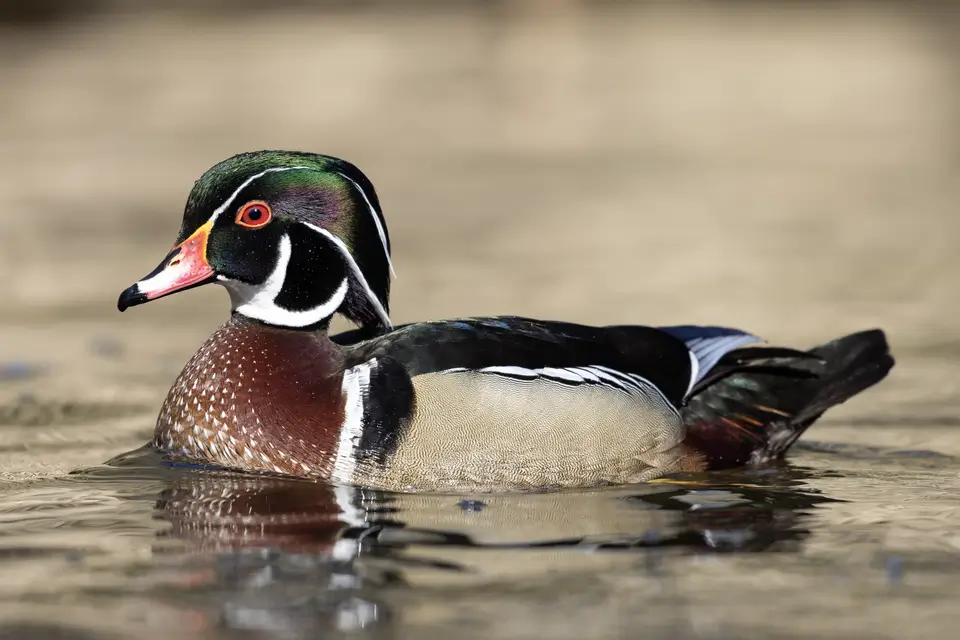
The male wood duck in breeding plumage is, by nearly any measure, one of the most visually spectacular birds in North America. His head is adorned with an iridescent green and purple crested helmet, accented by bold white stripes that trace the contours of his face and neck. His chest is a rich chestnut-burgundy, speckled with small white spots, and his flanks display a warm golden-tan hue separated from the breast by bold black and white vertical bars. His bill is a striking mosaic of red, white, and black, and his eyes glow a vivid red. The tail and back shimmer with metallic blues, greens, and purples in the right light, giving the entire bird an almost iridescent, jewel-encrusted appearance.
The female, while more subdued in coloration as is common among many duck species, is nonetheless a handsome bird. She sports a grayish-brown body with a distinctive white teardrop-shaped eye patch — a reliable field identification mark — and subtle iridescence on her wings. Her more cryptic coloring serves an important purpose: camouflage while nesting and brooding young.
Wood ducks are medium-sized ducks, smaller than mallards but larger than teal. They are agile fliers capable of navigating through dense woodland at impressive speeds — another adaptation tied to their forested habitat. Their broad, rounded wings and long tail give them precise maneuverability that allows them to weave between tree trunks and branches with ease.
One of the wood duck's most remarkable biological traits involves its nesting behavior. Unlike most ducks, which nest on the ground, wood ducks nest in tree cavities — either natural hollows or artificial nest boxes. The female lines the cavity with her own down feathers to create a warm, insulated nest. Clutch sizes are typically large, often ranging from 10 to 15 eggs, and incubation lasts approximately 30 days.
What happens after hatching is perhaps the most dramatic event in the wood duck's life cycle. Within 24 hours of hatching, the downy ducklings must leap from the nest cavity — sometimes from heights of 50 feet or more — to the forest floor below. Protected by their light body weight and fluffy down, they survive the fall largely unharmed and follow their mother immediately to water. This extraordinary behavior has fascinated biologists and wildlife observers for centuries and remains one of the most remarkable spectacles in all of North American wildlife.
Wood ducks are omnivores with a diverse diet that shifts seasonally. They feed on a wide variety of plant material including acorns, seeds, berries, aquatic vegetation, and agricultural grains. They also consume insects, small crustaceans, and other invertebrates, particularly during the breeding season when protein demands are high. Acorns are a particularly important food source in autumn, and wood ducks are well adapted to foraging in flooded bottomland hardwood forests where acorns fall into shallow water.
Habitat & Range
The wood duck is primarily a bird of the eastern United States and Pacific Coast, though its range extends across much of North America. It is strongly associated with wooded wetlands, swamps, flooded bottomland forests, beaver ponds, slow-moving rivers and streams with adjacent woodland, and marshes bordered by mature trees. The species' dependence on tree cavities for nesting ties it fundamentally to forested landscapes with large, mature trees.
In the eastern United States, wood ducks are abundant and widely distributed, thriving in the forested river valleys and wetland complexes of the Southeast and Midwest. On the West Coast, a distinct population inhabits the Pacific states from California northward. Throughout the interior West, including states like Wyoming, wood ducks are less common but certainly present, particularly along wooded river corridors and in riparian zones where mature cottonwood and other hardwood trees provide nesting habitat adjacent to water.
In Wyoming specifically, wood ducks can be found along the state's major river systems and in riparian areas where suitable habitat exists. Wyoming's varied landscape — encompassing the high plains of the east, the Rocky Mountain ranges of the west, and the river valleys that thread through both — provides pockets of appropriate habitat. The presence of beaver-influenced wetlands and mature riparian woodland in select areas makes it possible for wood ducks to breed and reside in the Cowboy State, though they are not as abundant here as in the wetter, more densely forested regions of the country.
Hunting Information
The wood duck is a highly regarded game bird among North American waterfowl hunters, prized not only for its exceptional beauty but also for its challenging hunting characteristics. Wood ducks are fast, agile fliers that favor tight, wooded cover, making them a favorite quarry for hunters who enjoy working small beaver ponds, flooded timber, and heavily wooded creek bottoms rather than open water.
Wood duck hunting typically involves pass-shooting or decoying birds during their morning and evening flight patterns to and from roosting and feeding areas. Hunting wooded swamps and flooded timber at first light is a classic technique, as wood ducks often move actively during the low-light periods of dawn and dusk.
For hunters in Wyoming, waterfowl hunting — including hunting for wood ducks — falls under federal and state migratory bird regulations. The U.S. Fish and Wildlife Service sets overall season frameworks, and individual states establish their specific season dates and bag limits within those frameworks. Because regulations change from year to year and vary by zone, hunters in Wyoming should always consult the current Wyoming Game and Fish Department regulations and the U.S. Fish and Wildlife Service migratory bird hunting guidelines for the most up-to-date and accurate information on season dates, bag limits, and licensing requirements before heading afield.
Hunters pursuing wood ducks should be aware that positive species identification is essential, as wood ducks share habitat with other duck species. Familiarizing yourself with the field marks of both male and female wood ducks — including the female's distinctive white eye patch and the male's unmistakable crested profile — is an important part of responsible and ethical waterfowl hunting.
Conservation
The conservation story of the wood duck is one of the great success narratives in American wildlife management. By the early 20th century, the species had been dramatically reduced across its range due to unregulated market hunting and the widespread destruction of old-growth forests that provided nesting cavities. Conservationists and early wildlife managers recognized the urgent need for action.
The Migratory Bird Treaty Act of 1918 was a landmark moment in wood duck conservation, establishing federal protections for migratory birds including wood ducks and ending the era of unregulated commercial hunting. This legislative achievement helped stabilize and eventually reverse the wood duck's population decline.
Equally important was the widespread deployment of artificial nest boxes — wooden boxes designed to mimic natural tree cavities and provide nesting sites in areas where natural cavities had become scarce. Installed by conservation organizations, wildlife agencies, and individual landowners across the country, these nest boxes proved enormously successful and are widely credited with fueling the wood duck's dramatic population recovery. Today, installing and monitoring wood duck nest boxes remains a popular conservation activity and a tangible way for individuals to contribute to the species' welfare.
Habitat conservation and restoration continue to play a central role in maintaining healthy wood duck populations. Protecting and restoring wooded wetlands, riparian corridors, and bottomland hardwood forests benefits not only wood ducks but also a broad array of other wildlife species.
The wood duck's recovery stands as a testament to what science-based wildlife management, protective legislation, and the active involvement of hunters, conservationists, and landowners can accomplish when working together. It is a species that continues to thrive today, bringing beauty and vitality to North American wetlands — from the cypress swamps of the Deep South to the cottonwood-lined river valleys of Wyoming and beyond.