Overview
Few birds in North America inspire as much affection and intrigue among naturalists, birdwatchers, and hunters alike as the American woodcock (Scolopax minor). This compact, cryptically patterned shorebird-turned-upland-dweller has carved out a unique ecological niche across the eastern half of the continent, captivating anyone lucky enough to witness its legendary sky dance or flush one unexpectedly from the forest floor. Known by a delightful array of colloquial nicknames — timberdoodle, bogsucker, mud snipe, and Labrador twister among them — the American woodcock is truly one of North America's most distinctive and beloved birds.
Despite its classification within the order Charadriiformes, which includes sandpipers, plovers, and other shorebirds, the American woodcock has long since abandoned the open coastlines typical of its relatives. Instead, it has made its home in moist, young forests and brushy thickets, where its remarkable camouflage, quirky behavior, and specialized feeding adaptations allow it to thrive. For hunters and wildlife enthusiasts in states across the eastern United States and portions of the central flyway, the woodcock represents a cherished tradition that connects people to some of the most productive and biologically rich habitats in North America.
Biological Traits
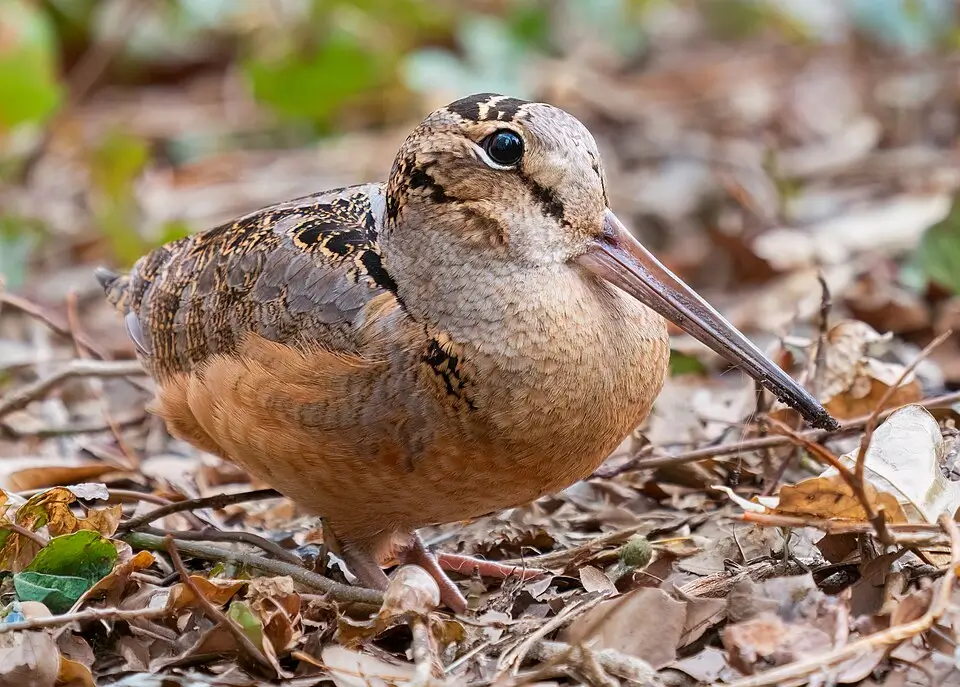
The American woodcock (Scolopax minor) is a stocky, medium-sized bird with one of the most recognizable body plans in the avian world. Its rounded body, extremely short neck, and disproportionately long bill give it an almost comical silhouette that is instantly identifiable once you know what you are looking for. Adults typically measure between 10 and 12 inches in length, with females generally being larger than males — a reversal of the typical size dimorphism seen in many bird species.
Perhaps the woodcock's most celebrated anatomical feature is its extraordinarily long bill, which can measure up to 2.75 inches in length. This specialized tool is perfectly adapted for probing moist soil in search of earthworms, which constitute the primary component of the bird's diet. The bill's flexible, prehensile tip allows the woodcock to grasp and extract worms from deep in the ground without withdrawing its bill entirely — a remarkable feeding adaptation. Sensory pits near the bill's tip are packed with nerve endings that help the bird detect the subtle movements of prey underground.
The woodcock's eyes are positioned high and far back on its head, providing an almost 360-degree field of vision — a feature that helps the bird detect approaching predators while it feeds with its head pointed toward the ground. Its plumage is a masterpiece of natural camouflage, featuring intricate patterns of brown, buff, black, and gray that blend seamlessly with the leaf litter of the forest floor. When a woodcock freezes in place, it becomes virtually invisible, even to trained eyes just a few feet away.
One of the woodcock's most celebrated behaviors is the male's elaborate courtship display, known as the "sky dance." Performed primarily at dawn and dusk from late winter through spring, this display begins on the ground, where the male produces a distinctive nasal "peent" call from an open singing ground. He then launches into a spiraling aerial display, climbing hundreds of feet into the air while producing a melodious, twittering sound created by air rushing through specialized outer wing feathers. At the apex of his flight, he begins a descending spiral back to the ground, singing a liquid, chirping song as he falls. This performance is repeated for hours each evening and morning, and observing it is considered one of the true highlights of the North American wildlife watching calendar.
Habitat and Range
The American woodcock is native to the eastern half of North America, breeding across a broad swath of the continent from the Atlantic Coast westward through the Great Plains, and from southern Canada south to the Gulf Coast states. Its breeding range is closely tied to the distribution of young, mixed deciduous forests and thicket habitats that provide both suitable nesting cover and access to moist, earthworm-rich soils.
The species shows a strong preference for early successional forest habitats — areas where forest has been recently disturbed by logging, fire, or natural processes and is regenerating through the thicket stage. Young stands of alder, aspen, and other fast-growing hardwoods are particularly favored. These habitats provide both the dense overhead cover that woodcock require for nesting and daytime roosting, and proximity to the moist, open ground where they feed most effectively. Forest edges, stream corridors, wet meadows adjacent to woodlands, and shrubby wetland borders all provide valuable woodcock habitat.
During migration, woodcock travel along established routes through the interior of the continent, moving southward in autumn and northward in spring. Their migration tends to be loosely correlated with the arrival of cold fronts, and large concentrations of birds can appear in suitable stopover habitat almost overnight during peak migration periods. Wintering birds concentrate in the Gulf Coast states and parts of the Deep South, where mild temperatures keep soils soft and accessible.
Hunting Information
The American woodcock holds a cherished place in the upland hunting tradition, particularly across the eastern and midwestern United States. Woodcock hunting is widely regarded as one of the most enjoyable and challenging forms of bird hunting, combining the pleasures of walking through beautiful autumn woods with the demanding shooting skills required to intercept a flushing woodcock in dense cover. The birds are typically hunted over pointing breeds or flushing spaniels, and their habit of holding tight before flushing makes them excellent training birds for young gun dogs.
Woodcock are managed as a migratory game bird under the jurisdiction of the U.S. Fish and Wildlife Service, with seasons and bag limits established annually in coordination with the Canadian Wildlife Service. Seasons are typically structured around the autumn migration, when birds are moving through huntable areas. Regulations vary by state and management zone, and hunters are always advised to consult the most current information from their state wildlife agency and the U.S. Fish and Wildlife Service before heading afield.
For hunters and outdoor enthusiasts in Wyoming specifically, it is important to understand the geographic context of this species. Wyoming is a landlocked Mountain West state bordered by Montana, South Dakota, Nebraska, Idaho, Utah, and Colorado. The American woodcock's primary range does not include Wyoming as a regular breeding or wintering area, as the species is most strongly associated with the moist, young deciduous forests of the eastern and central United States. However, during migration, vagrant or occasionally wandering birds may appear in unexpected locations, and woodcock have been recorded as rare visitors in portions of the western United States.
Because Wyoming's official hunting regulations for woodcock are not currently available in published state-specific guidance, prospective hunters in Wyoming should contact the Wyoming Game and Fish Department directly for the most up-to-date information regarding any applicable seasons, licensing requirements, or harvest opportunities. Given that woodcock are managed federally as a migratory game bird, federal frameworks would also apply.
Conservation
The American woodcock has faced gradual population pressures over recent decades, largely driven by changes in forest age structure and land use patterns across its breeding range. As eastern forests have matured past the early successional stage preferred by woodcock, and as agricultural abandonment and suburban development have altered habitat availability, long-term population trend data collected through the U.S. Fish and Wildlife Service's Singing Ground Survey has suggested gradual declines in portions of the breeding range.
Conservation efforts focused on the American woodcock have centered on habitat management — specifically, the creation and maintenance of early successional forest habitats through strategic timber harvests, prescribed fire, and other disturbance tools. Organizations including the American Woodcock Society and various state wildlife agencies have developed and promoted habitat management guidelines for private and public landowners, with the goal of maintaining a mosaic of young forest and brushy habitats across the landscape.
The woodcock's role in healthy forest ecosystems is significant. As a major consumer of earthworms and other soil invertebrates, it contributes to nutrient cycling and soil health. Its presence in a landscape is often a reliable indicator of high-quality, structurally diverse forest habitat — making it a valuable umbrella species for broader habitat conservation efforts.