Overview
Few creatures capture the rugged spirit of the American West quite like the bighorn sheep (Ovis canadensis). With their massive, curling horns and seemingly effortless ability to navigate sheer cliff faces and rocky mountain terrain, these animals have become one of the most recognizable and celebrated symbols of wild North America. From the jagged peaks of Wyoming's mountain ranges to the sun-scorched desert canyons of the Southwest, bighorn sheep embody a kind of wild resilience that has fascinated naturalists, hunters, and wildlife enthusiasts for centuries.
Wyoming, in particular, serves as prime territory for this magnificent animal. As one of the least populous states in the nation — home to just an estimated 587,618 people as of 2024 — Wyoming offers vast expanses of undisturbed wilderness that provide ideal conditions for bighorn sheep to thrive. The state's sprawling mountain ranges, rocky outcroppings, and high-altitude meadows create a landscape that seems almost purpose-built for a species that has evolved over millennia to master some of North America's most challenging terrain.
Whether you are a wildlife photographer hoping to catch the drama of the rut, a hiker who has been stopped in their tracks by a magnificent ram on a ridgeline, or a hunter pursuing one of the most coveted and challenging big game trophies in North America, the bighorn sheep commands attention, respect, and admiration.
Biological Traits
The bighorn sheep, Ovis canadensis, belongs to the family Bovidae and is one of three species of mountain sheep found in North America, alongside the Dall sheep (Ovis dalli) and the Stone sheep (Ovis dalli stonei). The species name canadensis reflects the fact that early scientific specimens were collected in the Canadian Rockies, though the animal's range extends far into the United States and even into northern Mexico.
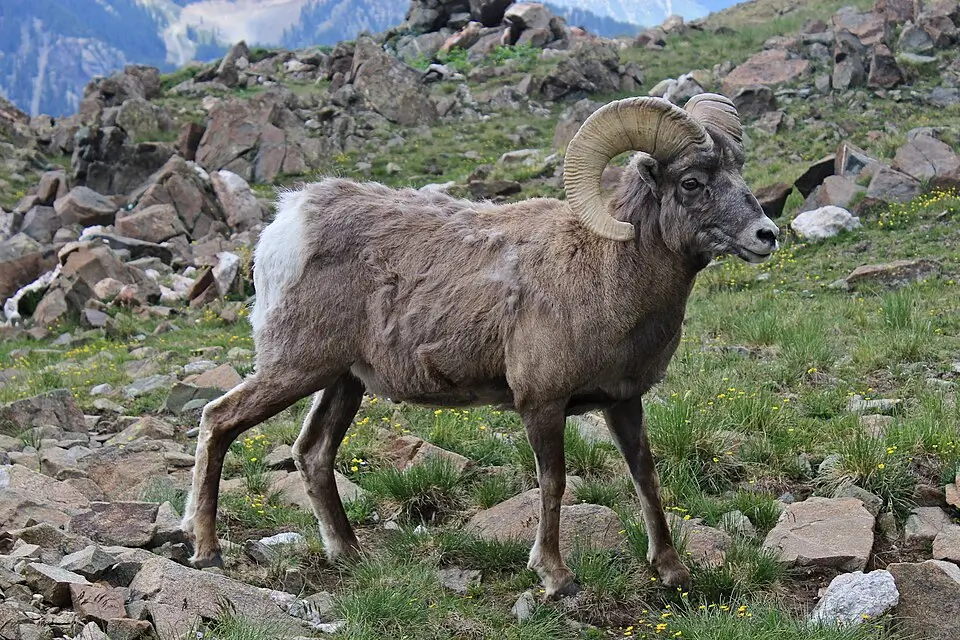
Perhaps the most iconic feature of the bighorn sheep is, unsurprisingly, its horns. In mature rams, these horns are massive, curling structures that can complete a near-full curl — sometimes called a "full curl" — and weigh as much as 30 pounds or more. Remarkably, the horns themselves can weigh more than all the bones in the ram's body combined. These horns are composed of a keratin sheath over a bony core and are permanent structures, never shed like the antlers of deer or elk. Rings on the horn surface correspond to periods of slower growth, typically in winter, and can be used to estimate an animal's age — much like the rings of a tree.
Ewes also carry horns, though theirs are much shorter, lighter, and only slightly curved. The horn difference between sexes is one of the most dramatic examples of sexual dimorphism found in North American ungulates.
Bighorn sheep are heavily built, stocky animals with a compact, muscular body that serves them well in their challenging environment. Adult rams typically weigh between 125 and 315 pounds, with ewes being considerably smaller. Their coat is typically a brown to gray-tan color with a distinctive cream-white rump patch and lighter coloring on the muzzle and back of the legs. This coloration provides effective camouflage against the rocky, earthy tones of their mountain habitat.
One of the most extraordinary biological adaptations of the bighorn sheep is its hooves. Each hoof has a hard outer edge that grips rock surfaces like a climbing shoe, while the softer, concave inner pad provides additional traction. This combination allows bighorn sheep to traverse near-vertical cliff faces and leap between rocky outcroppings with remarkable precision and confidence — a critical survival advantage that helps them escape predators such as mountain lions, wolves, coyotes, and golden eagles.
Bighorn sheep are highly social animals. Rams and ewes generally live in separate groups for most of the year, coming together primarily during the breeding season, known as the rut. The rut typically occurs in the late fall, during which rams engage in spectacular and dramatic battles for dominance and mating rights. Two rams will square off and charge at each other at speeds that can exceed 20 miles per hour, their massive horns colliding with a crack that can be heard from great distances. Specialized skull structures — including a double-layered cranium and thick, tendon-like connective tissue — help absorb these tremendous impacts without causing serious injury to the animals.
Ewes give birth to one lamb — occasionally two — in the spring, typically in isolated, rocky terrain that offers protection from predators. Lambs are born precocial, meaning they are relatively mature and mobile almost from birth, and they must be capable of following their mothers across difficult terrain within hours of being born.
The lifespan of bighorn sheep in the wild is generally between 10 and 15 years, with rams often having shorter lifespans than ewes due to the physical demands of competition during the rut and their greater exposure to predators.
Habitat & Range
Bighorn sheep are found throughout western North America, ranging from southern Canada through much of the Rocky Mountain region of the United States and into the desert regions of the Southwest and northern Mexico. Within the United States, significant populations exist in states including Wyoming, Montana, Idaho, Colorado, Utah, Nevada, Arizona, and California, among others.
The species demonstrates impressive ecological flexibility, inhabiting two broadly distinct environments: the high alpine and subalpine zones of the Rocky Mountains, and the lower-elevation desert terrain of the Great Basin and Sonoran Desert regions. These two ecological forms are sometimes informally referred to as "Rocky Mountain bighorn sheep" and "desert bighorn sheep," though they remain members of the same species, Ovis canadensis.
In Wyoming, bighorn sheep are associated with the state's iconic mountain ranges, including the Wind River Range, the Absaroka Range, the Teton Range, and others. Wyoming's geography — characterized by high-altitude terrain, rocky cliff faces, alpine meadows, and mineral licks — provides the key habitat components that bighorn sheep require.
Bighorn sheep are highly dependent on open, rugged terrain with good visibility. This visibility serves a critical predator-detection function; unlike prey species in forested environments that rely on concealment, bighorn sheep rely on their sharp eyesight and their ability to rapidly escape to steep, rocky terrain that most predators cannot follow them into. Their eyes are positioned on the sides of their head, giving them a wide field of vision that helps them detect threats at great distances.
Seasonal movements are a characteristic feature of bighorn sheep behavior. In summer, herds typically move to higher elevations where cooler temperatures, abundant forage, and reduced parasite loads make conditions favorable. As winter approaches and snow begins to accumulate, sheep move to lower elevations where wind-swept slopes and south-facing aspects keep forage accessible even in harsh conditions.
Hunting Information
Bighorn sheep hunting is widely regarded as one of the most prestigious and challenging pursuits available to North American hunters. The combination of remote wilderness terrain, the physical demands of mountain hunting, and the extreme rarity of tags and licenses makes a bighorn sheep hunt a once-in-a-lifetime experience for most hunters.
In Wyoming, bighorn sheep hunting opportunities do exist, though specific season dates, tag numbers, and licensing details were not available in the source data consulted for this article. Prospective hunters are strongly encouraged to consult the Wyoming Game and Fish Department directly for the most current and accurate information regarding bighorn sheep hunting regulations, license availability, and application deadlines. Because tag numbers for bighorn sheep are typically very limited, most states — including Wyoming — operate a draw system, meaning hunters must apply for tags and may wait many years before being drawn.
The hunt itself is physically demanding. Bighorn sheep country is, by definition, steep, remote, and often at high elevation. Hunters pursuing bighorn sheep should be in excellent physical condition and well-prepared for multi-day backcountry expeditions. The reward, however, is extraordinary — both the trophy and the experience of hunting one of North America's most spectacular big game animals in some of its most breathtaking wilderness.
Conservation
The conservation story of the bighorn sheep is one of both challenge and meaningful recovery. Historically, bighorn sheep populations across North America suffered dramatic declines due to habitat loss, competition with domestic livestock for forage and range, the introduction of diseases to which bighorns had little natural immunity, and unregulated hunting in the 19th and early 20th centuries.
Today, bighorn sheep populations have recovered significantly in many areas, thanks in large part to concerted conservation efforts by state wildlife agencies, federal land management agencies, tribal nations, and organizations such as the Foundation for North American Wild Sheep (FNAWS). Transplanting programs, habitat management, disease monitoring, and carefully regulated hunting — which generates funding for conservation through license sales and taxes under the North American Model of Wildlife Conservation — have all contributed to healthier bighorn populations across the West.
Despite this progress, bighorn sheep remain vulnerable, particularly to respiratory diseases caused by pathogens such as Mycoplasma ovipneumoniae, often introduced through contact with domestic sheep. Ongoing research and management efforts continue to address this challenge, and the bighorn sheep remains a conservation priority for wildlife managers across its range.