Overview
Few animals on the planet have demonstrated the remarkable adaptability and tenacity of the wild boar. Known scientifically as Sus scrofa, the wild boar is one of the most widely distributed large mammals in the world, occupying an extraordinary range of ecosystems across multiple continents. From the dense forests of Europe and Asia to the scrublands of North Africa and the introduced ranges of the Americas and Australia, this powerful and intelligent animal has proven itself capable of surviving — and thriving — in environments that would challenge far less resilient species.
The wild boar holds a unique place in both natural history and human culture. It is the direct ancestor of the domestic pig, a relationship that has shaped agriculture and civilization for thousands of years. Yet despite this close connection to domesticated life, the wild boar remains a creature of impressive wildness and strength. It is a sought-after quarry for hunters around the globe, a subject of scientific fascination, and in many regions, a significant wildlife management challenge. Understanding this animal fully — its biology, its habits, its relationship with human landscapes — is the first step toward appreciating just how remarkable Sus scrofa truly is.
Biological Traits
The wild boar is a robust, powerfully built animal belonging to the family Suidae, the even-toed ungulates commonly known as pigs. As a member of the order Artiodactyla, it shares distant evolutionary relationships with deer, elk, and bison — though its lifestyle and physical adaptations set it apart dramatically from its hoofed relatives.
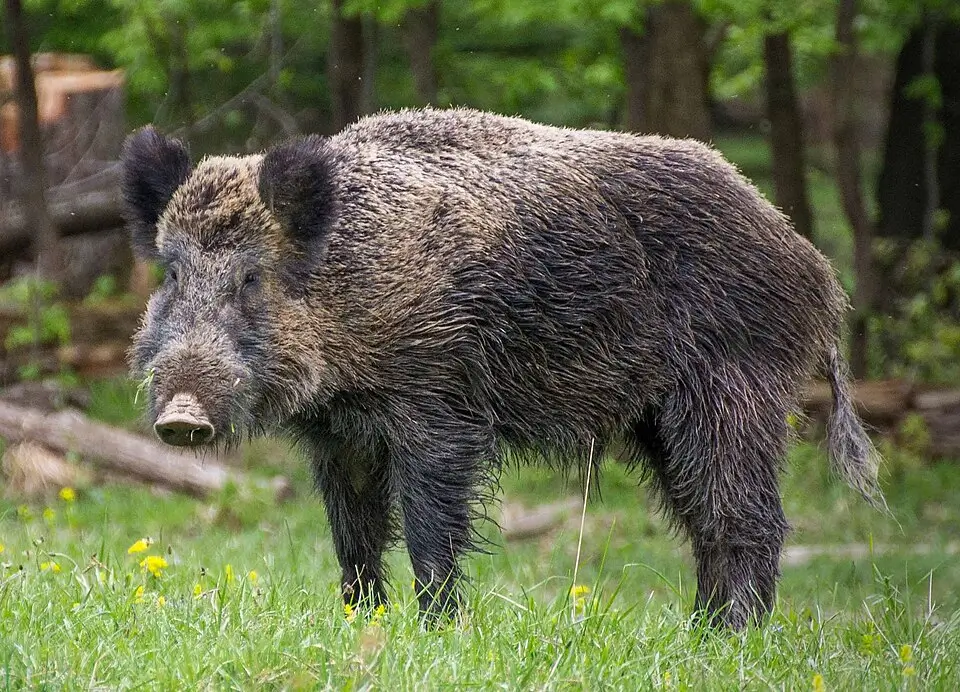
In terms of physical appearance, the wild boar is built for strength and endurance. Adults are typically covered in coarse, bristly hair that ranges in color from dark brown and gray to nearly black, depending on the geographic population and individual variation. The hair is often thicker along the back, forming a distinctive ridge or mane that can rise when the animal is agitated or alarmed — a behavioral signal that serves as both a warning to rivals and a threat display to potential predators.
The head of the wild boar is large and elongated, featuring a highly mobile, disc-shaped snout tipped with a cartilaginous pad that functions as an extraordinarily sensitive and durable digging instrument. This snout allows the boar to root through soil, leaf litter, and even compacted ground in search of food. The animal's sense of smell is exceptional, widely regarded as one of the keenest in the animal kingdom, and it plays a central role in foraging, social communication, and predator detection.
Both male and female wild boars possess tusks, though those of the males — called boars — are considerably larger and more prominent. In males, the lower canine teeth grow upward and outward into curved tusks that can reach impressive lengths. These tusks serve multiple purposes: they are used in combat between rival males during breeding season, in defense against predators, and as tools for rooting and digging. The upper canines, known as whetters, grow downward and act to sharpen the lower tusks through constant contact.
Wild boars are omnivores with a remarkably diverse diet. They will consume roots, tubers, nuts, berries, fungi, insects, worms, eggs, small vertebrates, and carrion. This dietary flexibility is a key component of the species' extraordinary adaptability. The wild boar's digestive system can process a wide variety of organic material, giving it a competitive advantage in almost any environment where food resources exist.
Reproduction in wild boars follows a seasonal pattern, with breeding typically occurring in autumn and winter in temperate regions. Females, called sows, give birth to litters of piglets after a gestation period of approximately 115 days. Litter sizes can vary widely but commonly range from four to six piglets, though larger litters are not uncommon. Piglets are born with distinctive striped coats — horizontal bands of lighter and darker brown — that provide effective camouflage in dappled forest light. These stripes fade as the young boars mature into their adult coloration.
Wild boars are social animals that live in groups known as sounders. A typical sounder consists of related females and their young offspring. Mature males tend to live more solitary lives outside of the breeding season, joining sounders temporarily during the rut. The social structure of the sounder provides collective protection for the young and facilitates cooperative foraging behavior.
The wild boar is also a notably intelligent animal. Research has demonstrated cognitive abilities that compare favorably with other large mammals, including problem-solving skills, memory, and adaptable behavioral responses to novel challenges. This intelligence contributes significantly to the species' success as both a wild animal and, in its domestic form, an agricultural staple.
Habitat & Range
The natural range of Sus scrofa is among the broadest of any large terrestrial mammal. The species is native to much of Europe, Asia, and North Africa, occupying habitats that span from boreal forests in Scandinavia and Siberia to tropical jungles in Southeast Asia and the semi-arid scrublands of the Mediterranean basin. This breadth of habitat use is a direct reflection of the animal's dietary flexibility and physiological resilience.
Wild boars tend to favor environments that offer a combination of dense cover for shelter and resting, access to water, and abundant food resources. Deciduous and mixed forests are classic wild boar habitat, particularly where oak, beech, or chestnut trees provide rich mast crops in autumn. However, wild boars are equally at home in agricultural landscapes, wetlands, grasslands, and even mountainous terrain at considerable elevation.
In the Americas, wild boars are not native but have been introduced through various means, including deliberate releases for sport hunting and the escape or release of domestic pigs that have subsequently gone feral. The resulting populations — often referred to as feral hogs, feral pigs, or wild hogs — are now established across large portions of the United States and other parts of the Western Hemisphere. These populations represent a complex wildlife management situation, as feral and wild hog populations can have significant ecological impacts on native plant and animal communities.
Hunting Information
Wild boar hunting is one of the oldest and most storied traditions in human history. Archaeological evidence suggests that humans have been hunting wild boars for tens of thousands of years, and the hunt has featured prominently in the mythology, literature, and cultural traditions of civilizations across Europe and Asia. Today, boar hunting remains a popular pursuit for hunters in many parts of the world, valued for its challenging nature, the quality of the quarry, and the excellent table fare that wild boar meat provides.
For hunters in Wyoming, the situation regarding wild boar is shaped by the state's particular geographic and wildlife context. Wyoming is a spectacular state for outdoor pursuits, known for its vast public lands, diverse big game populations, and rugged Mountain West landscape. The state borders Montana, South Dakota, Nebraska, Idaho, Utah, and Colorado, and contains some of the most iconic wild country in North America.
However, prospective hunters should be aware that wild boar are not a native species to Wyoming, and as of the available information for this article, no specific official wild boar hunting season or licensing framework has been published through state wildlife authorities. Hunters interested in pursuing wild boar in or near Wyoming are strongly encouraged to contact the Wyoming Game and Fish Department directly to obtain the most current and accurate information regarding regulations, seasons, and any applicable licensing requirements.
It is worth noting that in many western states, feral hog populations — close relatives and descendants of the wild boar — are managed as an invasive species rather than a game animal, which can affect the regulatory framework around hunting them. In some jurisdictions, feral hogs may be harvested year-round without a traditional hunting license, while in others, standard hunting regulations apply. Always verify current regulations with state authorities before pursuing any wild pig species.
When hunting wild boar in any setting, appropriate equipment, awareness of the animal's intelligence and sensory abilities, and respect for the quarry are essential. A mature boar is a formidable animal capable of defending itself vigorously, and hunters are well advised to approach the pursuit with care and preparation.
Conservation
Globally, the wild boar (Sus scrofa) is classified by the International Union for Conservation of Nature (IUCN) as a species of Least Concern, reflecting its wide distribution, large total population, and demonstrated ability to adapt to changing environments. In many parts of its native range, wild boar populations are stable or growing, aided by the species' high reproductive rate and dietary flexibility.
In regions where wild boar or feral pig populations have been introduced outside their native range, conservation considerations take on a different character. Feral populations can have significant impacts on native ecosystems, including rooting damage to native plant communities, predation on ground-nesting birds and other small animals, competition with native wildlife for food resources, and transmission of disease. Wildlife managers in affected regions work to balance the interests of hunters, landowners, and conservation goals in managing these introduced populations.
The wild boar also plays an ecological role in its native habitats that is worth acknowledging. Through its rooting behavior, the wild boar disturbs soil and creates microhabitats that can benefit certain plant species and small animals. It serves as prey for large predators such as wolves, bears, and large cats in ecosystems where these predators remain present. And as a seed disperser — consuming and later depositing the seeds of various plants — the wild boar contributes to forest regeneration and plant community dynamics.
Responsible hunting, when properly regulated and managed, can serve as a meaningful conservation tool for wild boar and feral pig populations alike, providing population control, funding for wildlife management through license fees, and engagement of the hunting community in broader conservation goals.