Overview
Few birds command the attention and admiration of wildlife enthusiasts, birdwatchers, and hunters quite like the Sandhill crane (Grus canadensis). Standing tall on long, elegant legs with a wingspan that can stretch impressively wide, these ancient birds have graced the skies and wetlands of North America for millions of years. They are, in every sense, a living link to a prehistoric world — fossil records suggest that cranes closely resembling today's Sandhill crane have existed for an estimated ten million years, making them one of the oldest known bird species still alive on Earth.
For residents and visitors of Wyoming, the Sandhill crane represents one of the most spectacular wildlife experiences the Mountain West has to offer. Whether you catch sight of a massive migratory flock descending upon a wetland at dusk, hear the resonant, bugling calls echoing across a sage-flat, or witness a courtship dance that seems almost choreographed in its elegance, encountering a Sandhill crane is an event that leaves a lasting impression. Wyoming, with its vast open landscapes, river systems, and wetland habitats, serves as both a breeding ground and a migratory corridor for these magnificent birds, making the state a significant destination for those who appreciate cranes in any capacity.
This article explores the biology, habitat, behavior, hunting traditions, and conservation status of the Sandhill crane — a bird that has earned its place as one of North America's most iconic and celebrated species.
Biological Traits
The Sandhill crane, Grus canadensis, belongs to the family Gruidae, the true cranes, and is one of only two crane species native to North America — the other being the critically endangered Whooping crane (Grus americana). The Sandhill crane itself is generally divided into several subspecies, which vary somewhat in size and migratory behavior. The most commonly recognized subspecies include the Lesser Sandhill crane, the Greater Sandhill crane, the Canadian Sandhill crane, and several non-migratory populations found in Florida, Mississippi, and Cuba.
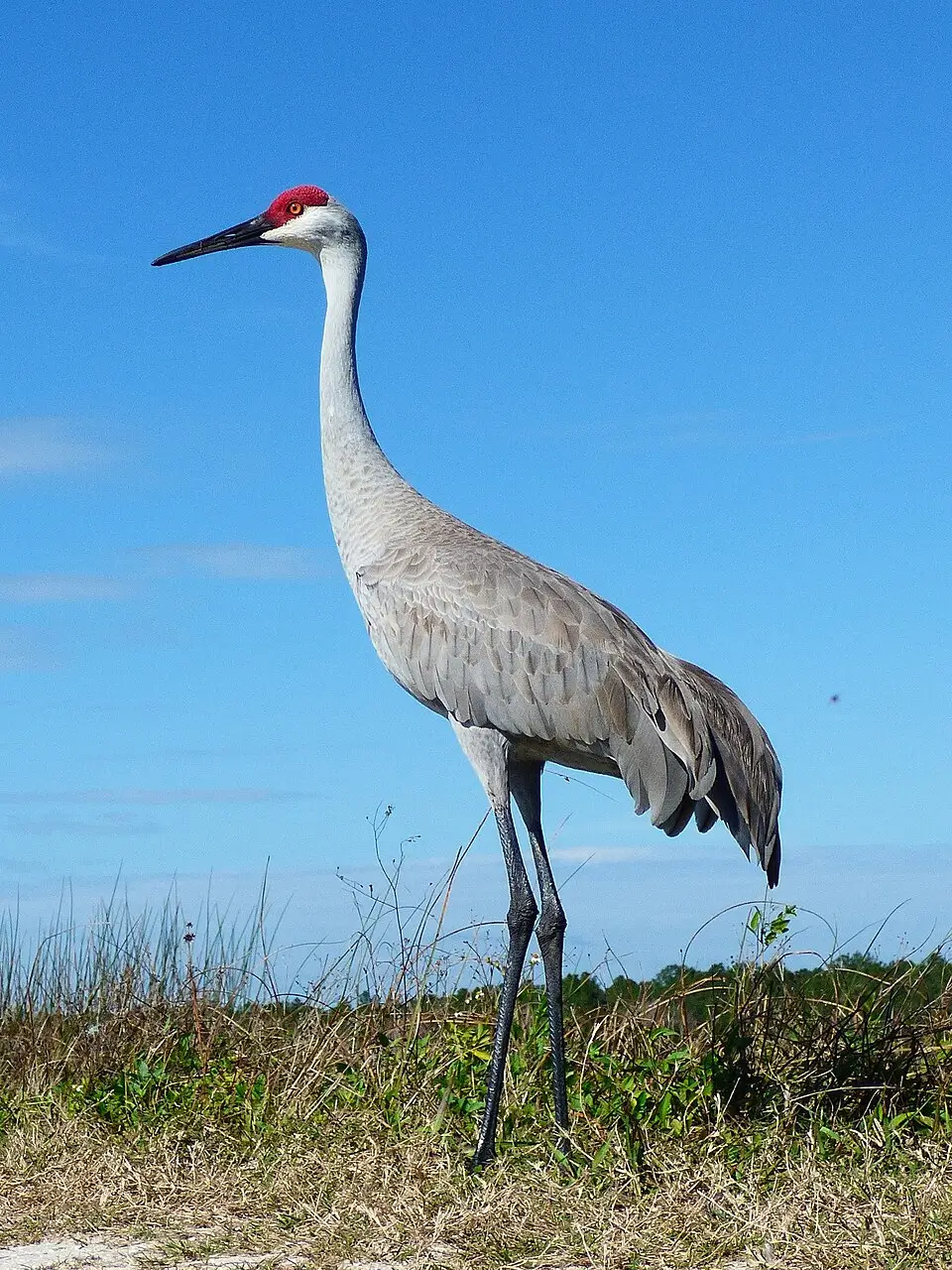
One of the Sandhill crane's most recognizable physical features is its striking red forehead patch, a bare patch of skin that deepens in color during moments of excitement or display. The body plumage is predominantly gray, though wild birds often appear rusty or brownish due to a behavior known as "feather painting" — cranes will preen themselves with mud and iron-rich sediment, staining their feathers a warm reddish-brown as a form of camouflage during the nesting season. Their long, dark legs are perfectly adapted for wading in shallow water and striding across open fields and meadows.
Sandhill cranes are large birds. Adults of the Greater subspecies can stand around four feet tall, with a wingspan that may reach approximately six to seven feet. Despite their size, they are powerful and graceful fliers. During migration, cranes soar on thermal updrafts, often flying at considerable altitudes and covering impressive distances each day.
The voice of the Sandhill crane is one of its most unforgettable characteristics. Their calls are loud, rattling, and bugling — a sound that carries for miles and is often described as prehistoric or primordial. These vocalizations serve a variety of functions, including pair bonding, territorial defense, and maintaining contact with flock members during flight.
Sandhill cranes are long-lived birds. In the wild, individuals can survive for 20 years or more, and captive cranes have lived even longer. They typically mate for life, forming long-term pair bonds reinforced through elaborate courtship dances that involve jumping, wing-spreading, bowing, and calling. These dances are not confined to the breeding season — paired birds will dance throughout the year as a form of social bonding and communication.
Cranes are omnivores. Their diet is broad and opportunistic, including plant material such as grains, roots, berries, and tubers, as well as invertebrates, small mammals, reptiles, amphibians, and insects. This dietary flexibility makes them highly adaptable to a range of environments and seasons. During the fall migration, Sandhill cranes are well known for congregating in agricultural areas to feed on waste grain in harvested fields, a behavior that makes them particularly visible and accessible to wildlife observers and hunters alike.
Nesting typically occurs in wetland environments. A mated pair will build a large nest of plant material on the ground or in shallow water, and the female generally lays two eggs. Both parents share incubation duties, and both are actively involved in raising the young, known as "colts." The colts are precocial — they hatch covered in down and are capable of walking and following their parents within hours of hatching. However, they remain with their parents through the first migration and often into the following year, forming tight family units within the larger flock.
Habitat & Range
The Sandhill crane has one of the broadest ranges of any crane species in the world. Breeding populations can be found from the Arctic tundra of Alaska and northern Canada all the way down through the Rocky Mountain states and into the upper Midwest. Non-migratory populations exist in Florida, Georgia, and parts of Cuba. During migration and in winter, these birds concentrate in large numbers across the Central Flyway — one of North America's great migratory bird highways — with famous staging areas along the Platte River in Nebraska drawing hundreds of thousands of cranes each spring.
Wyoming sits in a particularly important position within this range. The state's diverse geography — including high mountain meadows, river valleys, irrigated agricultural lands, and extensive wetland complexes — provides excellent habitat for both breeding and migratory Sandhill cranes. River systems, marshy areas, and the shallow lakes and reservoirs scattered across Wyoming offer the combination of open water, emergent vegetation, and adjacent upland foraging areas that cranes require. The Greater Sandhill crane subspecies is known to nest in Wyoming, making the state part of the core breeding range for this larger, more southerly subspecies.
During the fall migration, Sandhill cranes move through Wyoming in sometimes spectacular numbers, following traditional routes south toward wintering grounds in the American Southwest and Mexico. This seasonal movement, combined with Wyoming's wide-open character and relatively low human population density, makes it an extraordinary place to experience one of North America's great wildlife migrations.
Hunting Information
Sandhill crane hunting is a tradition with deep roots in the American West, and it has experienced a significant resurgence in popularity over recent decades as hunters have rediscovered these birds both as a challenging quarry and as a surprisingly excellent table bird. Sandhill cranes are sometimes referred to as "the ribeye of the sky" by hunters who prize the dark, flavorful breast meat, which bears little resemblance to typical waterfowl and is more often compared to fine beef.
Hunting Sandhill cranes requires skill, patience, and preparation. Because cranes are large, high-flying birds with exceptional eyesight, hunters typically employ full-body or shell decoys in open fields and rely on calling to attract birds within range. The hunt itself often takes place in harvested grain fields where cranes congregate to feed, requiring hunters to blend into the landscape using layout blinds or natural cover.
Wyoming has historically offered opportunities for Sandhill crane hunting, and the sport is regulated at both the federal and state level through the U.S. Fish and Wildlife Service and the Wyoming Game and Fish Department. However, specific season dates, bag limits, and licensing requirements vary from year to year and are subject to change based on population surveys and management decisions. Hunters interested in pursuing Sandhill cranes in Wyoming are strongly encouraged to consult the most current regulations provided by the Wyoming Game and Fish Department before planning a hunt, as this article does not contain current season-specific regulatory information.
What is consistent is that crane hunting in Wyoming offers a memorable and challenging experience set against some of the most dramatic landscapes in the American West. The combination of wide-open prairies, mountain backdrops, and the spectacle of migrating cranes makes it a pursuit that resonates long after the season ends.
Conservation
The Sandhill crane is considered a conservation success story. After significant population declines in the nineteenth and early twentieth centuries due to hunting pressure and habitat loss, concerted conservation efforts helped populations recover substantially throughout the latter half of the twentieth century. Today, the total Sandhill crane population is estimated to number in the hundreds of thousands, and the species is listed as a species of Least Concern by the International Union for Conservation of Nature (IUCN).
This recovery is a testament to the effectiveness of regulated hunting, wetland conservation programs, and the broader framework of the Migratory Bird Treaty Act, which provides federal protections for migratory birds including cranes. Organizations such as the International Crane Foundation have also played a vital role in researching crane biology, protecting critical habitat, and raising public awareness about the importance of crane conservation worldwide.
In Wyoming, Sandhill crane conservation is supported by efforts to protect and restore wetland habitats, manage water resources in ways that maintain suitable crane habitat, and conduct regular population monitoring. The state's expansive and relatively undeveloped landscapes also provide natural buffers against some of the pressures that affect crane populations in more densely developed regions.
For hunters, conservation and harvest go hand in hand. The regulated hunting of Sandhill cranes contributes both financially and practically to their ongoing management, with license fees and excise taxes on sporting equipment funding wildlife programs that benefit cranes and countless other species. Hunters who pursue Sandhill cranes in Wyoming do so as participants in a carefully managed tradition that balances the sport with the long-term health of the population.