Overview
Few wild animals in North America are as instantly recognizable — or as endlessly fascinating — as the raccoon (Procyon lotor). With its distinctive black facial mask, ringed bushy tail, and dexterous front paws, the raccoon has captured the imagination of generations of wildlife enthusiasts, hunters, and outdoor adventurers alike. This medium-sized mammal is one of the most adaptable creatures on the continent, thriving in environments that range from dense forested wilderness to the edges of bustling cities. From the swamps of the American South to the high-plains landscapes of Wyoming, the raccoon has proven time and again that its resilience and intelligence are among the most impressive traits in the animal kingdom.
Whether you're a wildlife observer hoping to spot one along a creek bed, a trapper with generations of tradition behind you, or simply a curious naturalist, the raccoon deserves a deep and respectful look. This article explores the biology, habitat, hunting traditions, and conservation status of this remarkable animal, with a particular focus on what raccoon life looks like in the rugged and wide-open state of Wyoming.
Biological Traits
The raccoon (Procyon lotor) belongs to the family Procyonidae, a group of mostly New World mammals that also includes coatis, ringtails, and olingos. The scientific name Procyon lotor translates roughly to "washing bear" in Latin — a nod to the raccoon's well-known behavior of manipulating and occasionally dunking its food in water before eating. Scientists believe this behavior, called "dousing," may actually help the animal better examine and feel its food, since water enhances the sensitivity of its highly tactile front paws.
Speaking of those paws — they are truly one of the raccoon's most extraordinary features. Raccoons possess five long, nimble fingers on each front foot, giving them a near-human-like ability to grasp, turn, pull, and open a remarkable variety of objects. This manual dexterity allows raccoons to open latches, jars, garbage cans, and even some door handles, which has contributed enormously to their success living alongside human populations.
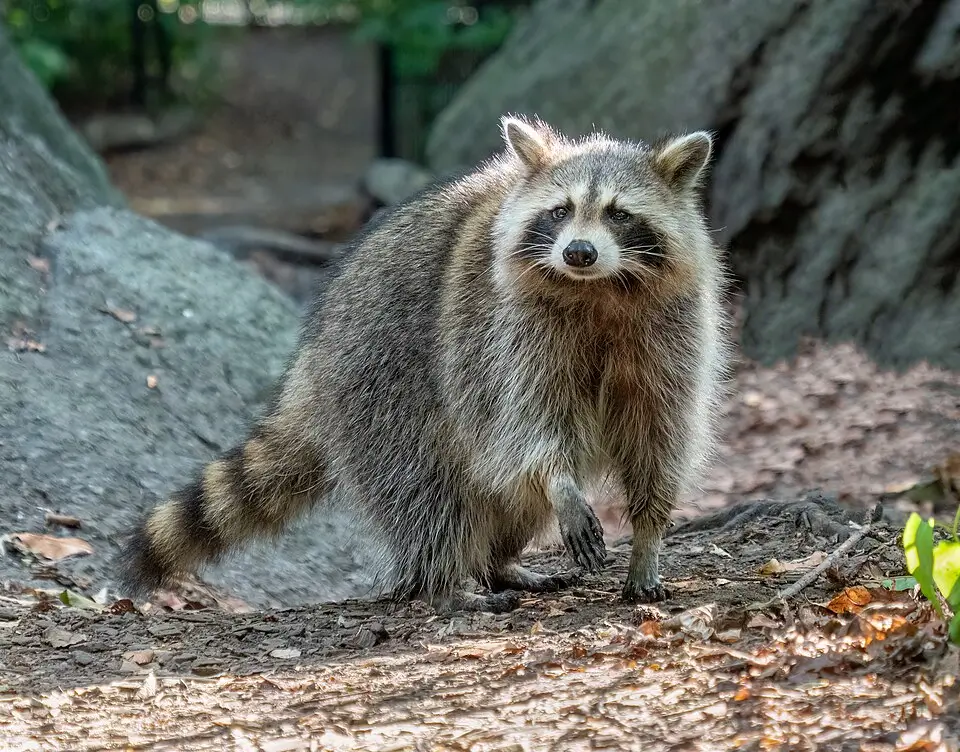
The raccoon's most iconic visual feature is undoubtedly its black facial mask — a band of dark fur surrounding both eyes, set against a lighter face. This mask has inspired countless cultural references, from folklore to cartoons. The ringed tail, typically featuring five to seven alternating light and dark rings, is equally distinctive and serves as an easy field identification marker even at a distance or in low light.
In terms of size, raccoons are robust animals. Adults typically weigh between 8 and 20 pounds, though some individuals — particularly those in northern climates where they bulk up for winter — can reach considerably greater weights. Their coat is a thick, grizzled mix of gray, brown, and black fur, which provides both insulation and camouflage.
Raccoons are omnivores with highly varied diets. They consume fruits, nuts, berries, insects, crayfish, fish, frogs, bird eggs, small mammals, and human refuse. This dietary flexibility is a cornerstone of their ecological success. Their sense of touch is their primary tool for foraging, and they are frequently observed wading in shallow water searching for aquatic prey.
The species is primarily nocturnal, though it is not unusual to observe raccoons during daylight hours, particularly in spring and early summer when mothers are raising young. Raccoons do not truly hibernate, but in colder climates they enter a state of torpor during the harshest winter months, relying on stored fat reserves. During this time they may remain denned for weeks at a time without eating, though they will emerge during warm spells.
Raccoons are capable of living 2 to 3 years in the wild on average, though individuals have been documented surviving much longer in protected environments. They are generally solitary animals outside of the breeding season, though loose social groups — often composed of related females — are sometimes observed sharing den sites and foraging areas.
Habitat & Range
The raccoon is one of the most geographically widespread mammals in North America. Its native range spans from southern Canada through most of the continental United States and into Central America. Over the past century, raccoons have dramatically expanded their range, colonizing new environments and even establishing introduced populations in parts of Europe and Japan.
Raccoons are extraordinarily habitat-flexible. Their ideal environment traditionally includes wooded areas near water — rivers, streams, ponds, marshes, and lake margins. Water provides access to crayfish, frogs, and other aquatic prey, while trees offer denning sites in hollow trunks and escape routes from predators. However, raccoons have proven just as capable of living in agricultural landscapes, suburban neighborhoods, and even urban cores.
In Wyoming specifically, raccoons are found primarily along the state's river corridors, creek bottoms, and riparian zones. Wyoming's geography is dominated by mountain ranges, high plains, sagebrush steppe, and semi-arid basins — landscapes that are less densely forested than the eastern United States and can be challenging for raccoons in some areas. However, wherever water sources and associated vegetation exist, raccoons are likely to be present. Riparian corridors along rivers like the North Platte, the Green River, the Bighorn, and the Belle Fourche provide classic raccoon habitat within the state. Small towns, ranches, and agricultural areas also support local raccoon populations, particularly where grain, livestock feed, and other food sources are available.
Wyoming's status as the least populous state in the nation — with an estimated population of just 587,618 people as of 2024 — means that vast stretches of the state remain relatively undeveloped. This creates both opportunities and limitations for raccoons: vast wilderness areas may lack the water and forest structure that raccoons prefer, but the numerous valleys, river basins, and agricultural pockets scattered across Wyoming's 98,000-square-mile landscape provide plenty of suitable ground.
Hunting Information
Raccoon hunting has a rich and storied tradition in North American outdoor culture. For many hunters — particularly in the Midwest and South — coon hunting with hounds is not merely a method of harvest but a deep cultural heritage passed down through generations. The sport involves specially trained hunting dogs, often breeds like Black and Tan Coonhounds, Bluetick Coonhounds, or Treeing Walker Coonhounds, that are released to track a raccoon's scent trail through the dark. When the dogs tree a raccoon, they bay loudly until the hunter arrives. The nighttime tradition, often conducted in fall and winter, is as much about the experience with dogs and companions as it is about the quarry.
Raccoon fur has historically been a valued commodity in the North American fur trade, and raccoon pelts remain part of the trapping and fur-harvesting tradition today. Raccoon meat is also consumed in many parts of the country and has a long history in rural American cuisine.
In Wyoming, specific season dates, licensing requirements, and regulations for raccoon hunting are best confirmed directly through the Wyoming Game and Fish Department, as official hunting information was not available in the source data consulted for this article. Hunters and trappers in Wyoming are always encouraged to check the most current regulations before heading afield, as rules can change from season to season. Given Wyoming's raccoon populations concentrated in riparian and agricultural zones, hunters in the eastern portions of the state — including areas near the Nebraska and South Dakota borders — and along major river corridors may find the most consistent raccoon activity.
As with all hunting and trapping activities, ethical practice, landowner permission, and compliance with all applicable state and federal regulations are essential.
Conservation
The raccoon (Procyon lotor) is currently listed as a species of Least Concern by international wildlife conservation standards. Its population across North America is considered stable and, in many regions, thriving. The raccoon's adaptability to human-modified landscapes has allowed it to maintain healthy numbers even as many other wildlife species have declined due to habitat loss.
Raccoons play meaningful ecological roles as omnivores within their ecosystems. They help disperse seeds, control populations of invertebrates and small prey, and serve as prey themselves for larger carnivores such as coyotes, bobcats, great horned owls, and mountain lions. Their role in the food web — both as predator and prey — makes them a genuinely important component of the ecosystems they inhabit.
Regulated hunting and trapping have long served as important management tools for raccoon populations, particularly in areas where raccoons come into conflict with agricultural operations or where population densities become very high. Wildlife managers in states across the country, including Wyoming, work to ensure that harvest levels remain sustainable.
Raccoons are also significant from a public health perspective, as they are known carriers of certain diseases including rabies and raccoon roundworm (Baylisascaris procyonis). Responsible wildlife management and public education help mitigate these concerns. Hunters and trappers should always handle harvested raccoons with appropriate care and follow recommended safety guidelines.
Overall, the raccoon's story is one of remarkable success in a changing world — a testament to the power of adaptability, intelligence, and ecological flexibility.