Overview
Few animals capture the spirit of the American West quite like the mule deer (Odocoileus hemionus). With its oversized, mule-like ears, distinctively branched antlers, and characteristic bounding gait, this species has long been a symbol of wide-open spaces, rugged terrain, and the untamed landscapes that stretch across the western half of North America. From the sun-baked desert scrublands of the Southwest to the alpine meadows of the Rocky Mountains, mule deer have carved out a remarkable ecological niche, thriving in some of the most dramatic and demanding environments on the continent.
For hunters, wildlife photographers, and outdoor enthusiasts alike, encountering a mule deer — especially a mature buck with a heavy, symmetrical rack — is an experience that lingers in the memory long after returning home. Wyoming, one of the premier mule deer states in the country, offers some of the most breathtaking backdrops imaginable for pursuing these animals, set against a landscape of sweeping sagebrush flats, towering mountain ranges, and high desert plateaus. Understanding the biology, behavior, and conservation status of the mule deer is essential not only for those who hunt them but for anyone who simply appreciates the richness of North American wildlife.
Biological Traits
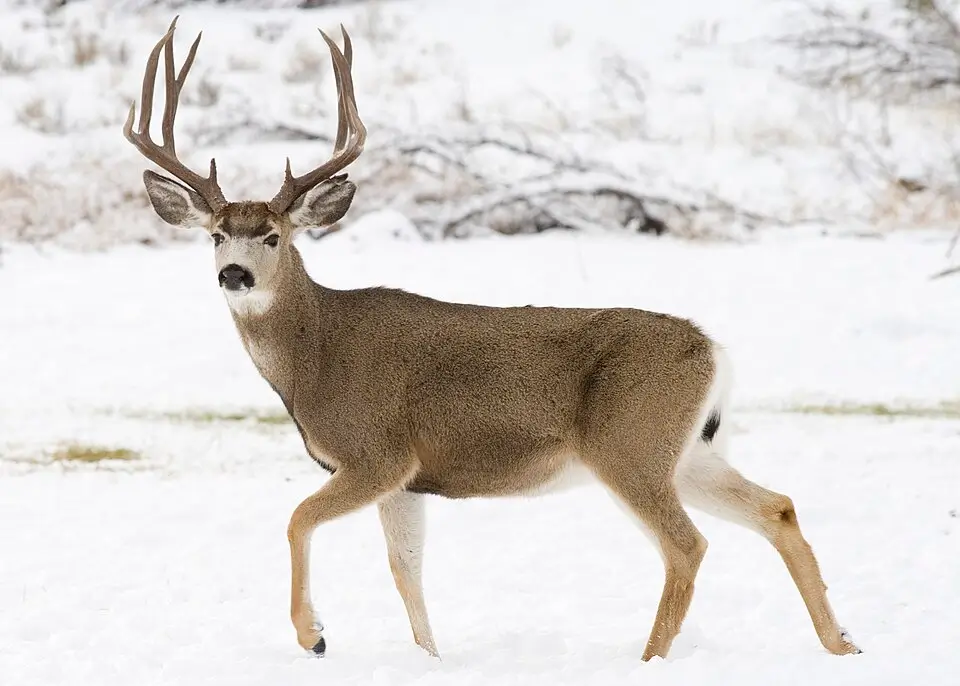
The mule deer (Odocoileus hemionus) belongs to the family Cervidae and is closely related to the white-tailed deer (Odocoileus virginianus), though the two species are quite distinct in appearance and behavior. The mule deer's most immediately recognizable feature is its ears — large, prominent, and constantly in motion, much like those of a mule, which is precisely how the species earned its common name. These oversized ears are not merely aesthetic; they provide the deer with acute hearing, helping it detect predators across open, rocky terrain where cover is often sparse.
Mule deer are medium to large ungulates. Adult bucks typically weigh between 150 and 300 pounds, though particularly large individuals in certain regions can exceed that range. Does are noticeably smaller, generally ranging between 95 and 160 pounds. Body coloration shifts with the seasons — a reddish-brown summer coat gives way to a thicker, grayer winter coat that provides insulation against cold mountain temperatures. The mule deer's rump patch is a distinctive creamy white, and its tail is narrow, rope-like, and tipped in black — a feature that immediately distinguishes it from the white-tailed deer's broad, flag-like tail.
Perhaps the most visually striking characteristic of a mature mule deer buck is its antlers. Unlike the white-tailed deer, whose antlers feature a main beam with tines projecting upward, the mule deer grows antlers that bifurcate, or fork, repeatedly. Each main beam splits into two branches, and those branches split again, creating a distinctive, symmetrical configuration. A fully mature buck in prime condition can carry an impressive, wide-spreading rack that ranks among the most coveted trophies in North American big-game hunting.
Mule deer are highly social animals during certain times of year. Does, fawns, and younger bucks often travel in loose groups, particularly during winter when food resources may concentrate them in lower-elevation valleys and foothills. Mature bucks tend to be more solitary for much of the year, establishing home ranges that can be surprisingly large, especially in populations that undertake seasonal migrations.
The rut — the breeding season — typically occurs in November and into early December across much of the mule deer's range. During this period, bucks become highly active, traveling widely in search of receptive does and engaging in sparring matches to establish dominance. Bucks can lose a substantial portion of their body weight during the rut as they prioritize breeding activity over feeding. Does typically give birth to one or two fawns in late spring or early summer, with twins being common in populations enjoying good habitat conditions.
Habitat & Range
The mule deer's range spans an enormous swath of western North America, from the coastal ranges of British Columbia and Alaska in the north through the Rocky Mountain states, the Great Basin, the Sonoran and Chihuahuan deserts, and into the Baja California Peninsula in the south. Several subspecies have been recognized, each adapted to specific regional environments, with the Rocky Mountain mule deer (Odocoileus hemionus hemionus) being the most widespread and well-known.
Mule deer are quintessential edge-habitat species. They thrive where multiple vegetation types intersect — where sagebrush flats give way to juniper woodlands, or where mountain shrub zones transition into coniferous forests. This preference for diverse, transitional habitat reflects the mule deer's opportunistic feeding strategy; it is a browser and grazer that shifts its diet based on seasonal availability, consuming grasses and forbs in spring and summer and relying more heavily on shrubs such as sagebrush, bitterbrush, and mountain mahogany during fall and winter.
Many mule deer populations are migratory, undertaking seasonal movements between high-elevation summer ranges and lower-elevation winter ranges. These migrations can cover remarkable distances, with some populations traveling dozens of miles between seasonal habitats. Wyoming sits at the heart of some of the most important mule deer migration corridors in all of North America, and the state's diverse topography — from the high peaks of the Wind River Range and the Absaroka Mountains to the broad sagebrush basins of the Green River and Powder River drainages — supports substantial deer populations across a wide variety of habitat types.
For Wyoming's mule deer, the interplay between seasonal migrations and habitat quality is critically important. Animals that successfully move between summer and winter ranges tend to exhibit better overall body condition, reproductive success, and survival rates. The state's vast tracts of public land, including multiple national forests, Bureau of Land Management holdings, and wildlife management areas, provide essential habitat connectivity that allows these migrations to continue.
Hunting Information
Mule deer hunting is one of the most beloved and deeply rooted traditions in Wyoming's outdoor culture. The state is widely regarded as one of the top destinations in the western United States for pursuing trophy-quality mule deer bucks, and hunters travel from across the country — and around the world — to experience Wyoming's mule deer country firsthand.
Hunting mule deer in Wyoming typically requires the purchase of a valid hunting license along with the appropriate deer tag or permit. Tag availability and season structures can vary significantly by hunt area, with some regions operating under general license systems while others require hunters to apply through a limited quota draw process. Given that regulations and season dates can change from year to year, prospective hunters are always encouraged to consult the Wyoming Game and Fish Department directly for the most current and accurate licensing requirements, season dates, and area-specific rules before planning a hunt.
Mule deer hunting strategies in Wyoming are as varied as the terrain itself. Spot-and-stalk hunting is perhaps the most popular approach, with hunters glassing vast expanses of open sagebrush country and mountain terrain from elevated vantage points before closing the distance on a chosen animal. Still-hunting through timbered draws and aspen groves, as well as ambushing deer along well-used migration routes during the autumn movement, are also productive techniques depending on the time of year and location.
The archery season typically opens earliest, giving bowhunters the opportunity to pursue mule deer in the warm days of early fall. Rifle hunters generally take to the field later in the season as temperatures drop and bucks begin to move more actively ahead of and during the rut. Wyoming's high-country mule deer hunts, conducted at elevations that can exceed 10,000 feet, are physically demanding endeavors that reward those who put in the preparation and effort.
Conservation
Mule deer conservation is a topic of genuine importance and ongoing attention throughout the West. Populations can fluctuate in response to a complex web of factors including habitat quality and availability, weather conditions (particularly severe winters), predation pressure, disease, and human development that can fragment or block critical migration corridors.
Wildlife managers, conservation organizations, and state agencies have invested significantly in understanding and protecting mule deer populations. Efforts to maintain and restore sagebrush ecosystems — the backbone of mule deer habitat across much of the Intermountain West — are a central component of these conservation strategies. Protecting migration corridors through land-use planning, wildlife-friendly fencing, and the development of highway crossing structures has also become a priority in states like Wyoming, where major roads can intersect traditional migration routes.
Hunters have historically played a meaningful role in mule deer conservation, contributing funding through license and tag purchases, excise taxes on sporting equipment under the Pittman-Robertson Act, and active participation in habitat improvement projects. Organizations dedicated to mule deer conservation work alongside state and federal agencies to address the challenges facing the species, ensuring that future generations will continue to enjoy healthy, thriving mule deer populations across the American West.