Overview
Few animals capture the spirit of rugged wilderness quite like the mountain goat. Perched on seemingly impossible ledges thousands of feet above sea level, these sure-footed climbers have become one of the most iconic symbols of the American and Canadian West. With their distinctive white coats, calm demeanor, and extraordinary agility, mountain goats (Oreamnos americanus) command admiration from wildlife enthusiasts, photographers, and hunters alike. Whether you spot one through binoculars from a valley floor or earn a rare tag to pursue one across steep alpine terrain, the mountain goat is a creature that leaves a lasting impression on everyone fortunate enough to encounter it.
Despite their common name, mountain goats are not true goats in the traditional sense. They belong to the subfamily Caprinae, which includes goats and antelopes, but they occupy their own unique genus — Oreamnos — placing them taxonomically apart from domestic and wild goats of the Old World. Their closest relatives are the chamois and goral of Europe and Asia. In North America, they stand as a wholly native species, shaped by millions of years of evolution in some of the continent's most extreme environments.
This article explores the biology, habitat, hunting traditions, and conservation status of the mountain goat, with a particular focus on what makes this animal so remarkable and why it continues to be a celebrated species among wildlife managers and sportsmen throughout the Western United States, including Wyoming.
Biological Traits
The mountain goat is a study in evolutionary adaptation. From the tips of its hooves to the ends of its hollow guard hairs, nearly every physical feature of this animal has been refined for life in high-altitude, cold, and precipitous environments.
Physical Appearance
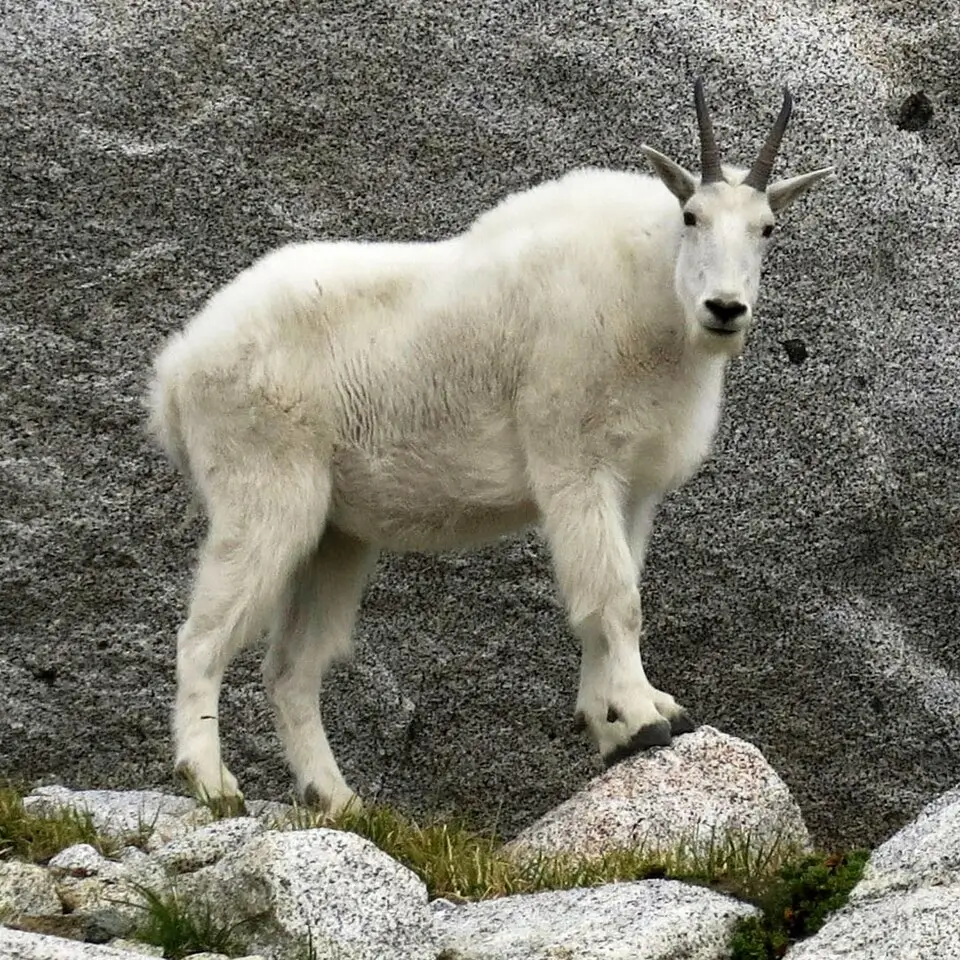
Mountain goats are immediately recognizable by their thick, all-white coats, which provide both insulation against biting cold and a degree of camouflage against snow-covered terrain. Their double-layered coat consists of a dense, woolly undercoat beneath longer, coarser outer guard hairs. This combination allows the animal to withstand temperatures that would be life-threatening to most other ungulates.
Both males (billies) and females (nannies) carry short, sharp, black horns that curve slightly backward. These horns are present in both sexes from a young age and continue to grow throughout the animal's life, though they never reach the dramatic curl seen in bighorn sheep. The horns are used primarily for establishing social hierarchy and defending territory, and serious combat between individuals — though generally brief — can result in injury.
Mountain goats are stocky, muscular animals with a distinctive shoulder hump, short legs relative to their body, and a beard-like tuft of hair beneath the chin. An adult billy typically weighs between 125 and 300 pounds, while nannies are generally smaller and lighter. This sexual dimorphism, though present, is less dramatic than in some other mountain ungulates.
Hooves and Climbing Ability
Perhaps the mountain goat's most extraordinary biological feature is its hooves. Each hoof has a hard outer shell for gripping rock edges and a soft, rubbery inner pad that provides traction on smooth or icy surfaces. Dewclaws located further up the leg provide additional braking ability on steep descents. This remarkable foot architecture allows mountain goats to navigate near-vertical cliff faces with an ease that defies comprehension, often moving across terrain that would be immediately fatal to a human without technical climbing equipment.
Diet and Feeding Behavior
Mountain goats are herbivores and opportunistic grazers and browsers. Their diet varies with the seasons and elevation, typically including grasses, sedges, forbs, mosses, lichens, and the woody twigs and leaves of shrubs. In winter, when food sources are limited by snow and ice, mountain goats are known to dig through snow to access buried vegetation. Their ability to extract nutrition from sparse, high-altitude plant communities is a testament to their efficient digestive systems.
Reproduction and Social Structure
The breeding season, or rut, for mountain goats typically occurs in late autumn. Billies travel widely during this period, seeking out receptive nannies. After a gestation period of approximately 150 to 180 days, nannies give birth to one kid — and occasionally twins — in the spring. Newborn kids are remarkably precocial, able to stand and follow their mothers across rocky terrain within hours of birth.
Mountain goats are generally non-migratory compared to some other alpine species, though they do move to lower elevations during the harshest winter conditions. Nannies tend to form small groups with their offspring, while older billies often live solitary lives outside of the rut. Life expectancy in the wild is typically around 12 to 15 years, though individuals in protected areas may live longer.
Habitat & Range
Mountain goats are native to the rocky mountain ranges of North America. Their natural range extends from southeastern Alaska and the Yukon southward through British Columbia and Alberta, and into the northern and central Rocky Mountains of the United States, including portions of Idaho, Montana, Washington, Oregon, Colorado, and Wyoming.
The species is defined by its preference for steep, rocky, high-altitude terrain. Mountain goats are most commonly found above the tree line in subalpine and alpine zones, where elevations can reach well above 10,000 feet. The combination of near-vertical cliffs, talus slopes, and rocky outcroppings serves a dual purpose: it provides access to the mineral-rich soils and vegetation that mountain goats depend on, and it offers safety from predators. Few predators — including wolves, mountain lions, and bears — are willing or able to pursue mountain goats into their preferred rocky strongholds.
Mineral licks are particularly important habitat features for mountain goats. These natural salt deposits attract goats from considerable distances, especially in late spring and early summer when animals are recovering from the nutritional deprivations of winter. Hunters and wildlife managers alike pay close attention to known mineral lick locations as these sites offer reliable opportunities for observation and population assessment.
Mountain Goats in Wyoming
Wyoming's dramatic landscape — encompassing portions of the Rocky Mountains, the Teton Range, the Wind River Mountains, and the Absaroka Range — provides excellent habitat for mountain goats. The state's rugged, high-elevation terrain offers the steep rocky habitat and alpine vegetation that the species requires. Wyoming is among the states where mountain goats can be found in naturally occurring populations, as well as areas where wildlife managers have worked to establish or support herds.
Hunting Information
Mountain goat hunting is widely regarded as one of the most physically demanding and rewarding pursuits available to big game hunters in North America. The combination of extreme terrain, remote locations, and the rarity of tags makes a mountain goat hunt a once-in-a-lifetime experience for many sportsmen.
Because mountain goat populations are naturally limited by the availability of suitable high-altitude habitat, populations tend to be smaller and more localized than those of more abundant ungulates like elk or mule deer. As a result, wildlife management agencies issue a very limited number of tags each year, ensuring that harvest pressure remains well within sustainable levels.
Hunting Mountain Goats in Wyoming
Wyoming is home to mountain goat populations in several of its major mountain ranges, and the Wyoming Game and Fish Department manages a limited permit system for mountain goat hunting in the state. Given Wyoming's standing as a state with vast and spectacular wild country — bordered by Montana to the north, Idaho to the west, and Colorado to the south — it is well-positioned geographically to support viable mountain goat populations in its high-elevation wilderness areas.
However, because specific season dates, license fees, and draw regulations were not available in the source data consulted for this article, hunters are strongly encouraged to contact the Wyoming Game and Fish Department directly or visit the department's official website for the most current and accurate information regarding mountain goat tags, application deadlines, and legal hunting areas. Regulations for mountain goat hunting can change from year to year as wildlife managers adjust quotas in response to population surveys and habitat assessments.
What is universally consistent across all jurisdictions where mountain goat hunting is permitted is the extraordinary physical preparation required. Successful hunters must be capable of extended backcountry travel at high elevations, often in unpredictable weather conditions. A mountain goat taken on a remote alpine ridge may need to be packed out over miles of difficult terrain, making physical fitness and logistical preparation as important as marksmanship.
Conservation
The mountain goat is currently classified as a species of Least Concern by wildlife conservation authorities, reflecting the fact that the species maintains stable populations across much of its native range. However, this positive overall status does not mean that mountain goat populations are without challenges or that conservation efforts can be relaxed.
Mountain goats are particularly sensitive to habitat disturbance and climate change. As temperatures rise and alpine snowpack diminishes, the delicate plant communities that mountain goats depend upon can shift or decline. Human encroachment into high-altitude areas — whether through recreation, resource extraction, or development — can displace animals from critical habitat, particularly mineral licks and lambing areas.
Wildlife managers in Wyoming and throughout the Western United States continue to monitor mountain goat populations closely through aerial surveys, hunter harvest data, and on-the-ground research. These population assessments inform tag quotas and management strategies designed to ensure that hunting remains a sustainable activity and that mountain goat herds remain healthy for future generations.
The limited nature of mountain goat tags — and the associated prestige of the hunt — means that hunters and conservationists share a powerful common interest in maintaining healthy populations. Organizations dedicated to wild sheep and mountain goat conservation, such as the Foundation for North American Wild Sheep, have contributed significantly to habitat protection, population monitoring, and the promotion of science-based wildlife management for species like the mountain goat.
Mountain goats represent a remarkable success story of evolutionary adaptation and a compelling argument for the value of protecting wild, rugged landscapes. As long as North America's high peaks remain intact, this extraordinary animal will continue to thrive as one of the continent's most awe-inspiring wild residents.