Overview
Few birds capture the imagination of hunters, wildlife enthusiasts, and casual observers quite like the Mallard (Anas platyrhynchos). Recognized the world over by its iridescent green head and characteristic quack, the Mallard stands as perhaps the most iconic waterfowl species in North America — and indeed across much of the Northern Hemisphere. Whether gliding silently across a glassy pond at dawn, tipping tail-up to feed in a shallow marsh, or rocketing skyward at the flush of a hunting dog, the Mallard is a species that resonates deeply with anyone who spends time near water.
For generations of waterfowl hunters, the Mallard has been the benchmark species — the bird by which all others are measured. Its wide distribution, adaptability, and sporting qualities have made it the cornerstone of duck hunting culture across the United States and beyond. In states like Wyoming, where vast wetlands, rivers, and reservoirs dot an otherwise rugged landscape, the Mallard holds a place of special significance for hunters and conservationists alike.
This article explores the biology, behavior, habitat, and hunting heritage of the Mallard, with a particular focus on what makes this remarkable bird such a compelling subject for those who pursue it across Wyoming's extraordinary landscapes.
Biological Traits
The Mallard (Anas platyrhynchos) belongs to the family Anatidae, the large and diverse group that encompasses all ducks, geese, and swans. Within that family, Mallards are classified as dabbling ducks — birds that feed primarily at the water's surface or by tipping forward into shallow water rather than diving beneath the surface like their diving duck counterparts.
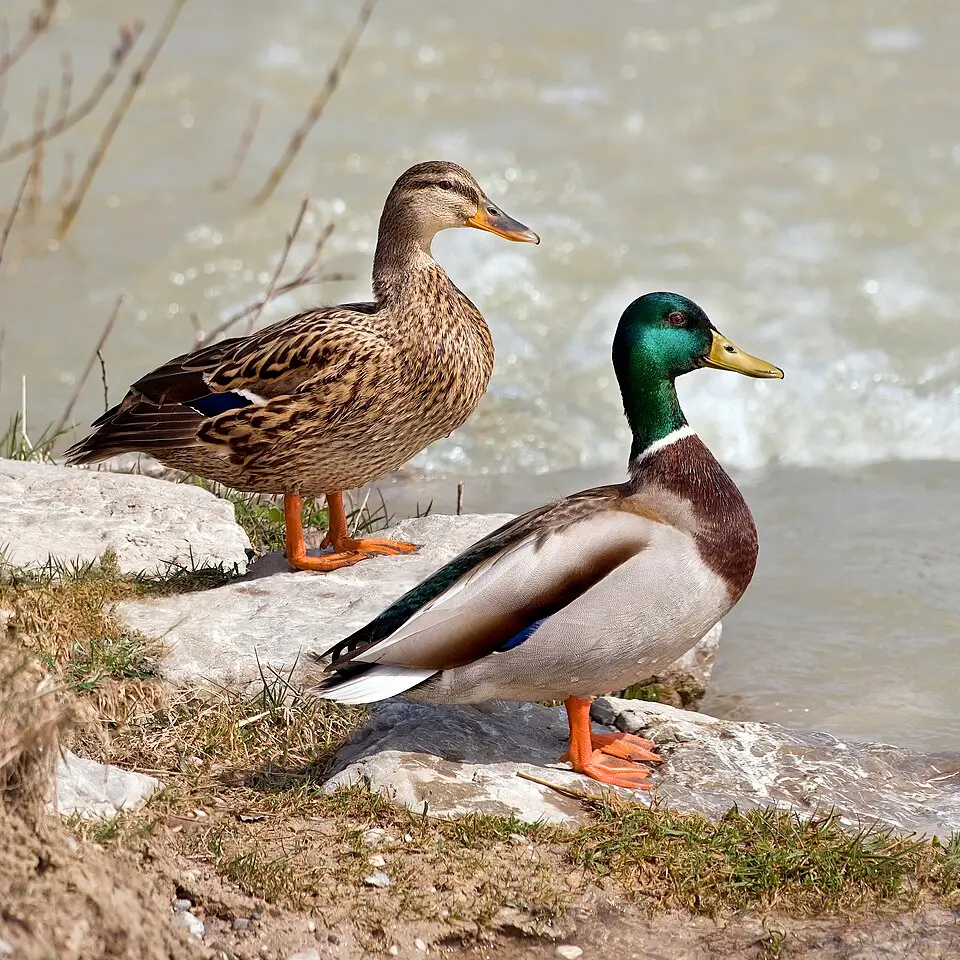
One of the most striking features of the Mallard is the dramatic difference in appearance between the sexes, a phenomenon known as sexual dimorphism. The male, or drake, is arguably one of the most visually stunning of all North American birds during the breeding season. His head gleams with a rich, iridescent green that shifts to purple or blue depending on the angle of light. A crisp white ring encircles his neck just below the green hood, separating it from a warm chestnut-brown chest. The body feathers are pale gray, and the tail features a distinctive curl of feathers — a reliable field identification mark known as the "drake curl." The bill is a clean, waxy yellow.
The female Mallard, or hen, is far more subdued in coloration — a streaky, mottled brown that serves as superb camouflage while she incubates her eggs in the nest. Despite her understated appearance, the hen is identifiable by several features, including an orange-and-brown bill, a dark stripe running through the eye, and the speculum — a patch of iridescent blue-purple feathers bordered by white on the wings — a feature shared with the drake and visible in flight on both sexes.
Mallards are medium-to-large ducks, with adults typically weighing between two and three pounds, though larger individuals are not uncommon, especially late in the season when birds have fattened up on agricultural grains. Their wingspan is broad and powerful, typically spanning around three feet, giving them the lift needed to take off rapidly from the water's surface — a skill that makes them both a challenging and rewarding quarry for hunters.
Vocally, the Mallard is equally well-known. The iconic loud, descending quack most people associate with ducks is, in fact, almost exclusively the call of the hen Mallard. The drake produces a much quieter, raspy sound, often described as a soft rasping or reedy note. This distinction is important for hunters who use calls to attract birds, as the classic duck call is modeled directly on the hen's vocalizations.
Mallards are highly social birds, particularly during migration and the winter months, when they gather in large flocks on open water bodies and flooded agricultural fields. They are also notably omnivorous, consuming a wide variety of foods including aquatic vegetation, seeds, grains, invertebrates, small fish, and amphibians. This dietary flexibility is a key factor in their remarkable success as a species.
Habitat & Range
The Mallard boasts one of the widest distributions of any duck species on Earth. Across North America, Mallards breed throughout Canada and the northern United States, with the highest densities found in the Prairie Pothole Region — a vast area of wetlands spanning the Dakotas, Minnesota, and the Canadian prairies that serves as the continent's most productive waterfowl breeding ground. In winter, Mallards can be found throughout the continental United States, Mexico, and as far south as Central America.
Beyond North America, Mallards are native to Europe, Asia, and parts of North Africa, and have been introduced to Australia, New Zealand, and other regions where they have established feral populations. The Mallard is, without question, one of the most globally widespread of all duck species.
In Wyoming specifically, Mallards are a familiar presence throughout the year. Wyoming's diverse geography — encompassing mountain meadows, sagebrush flats, river valleys, reservoirs, and irrigated agricultural lands — provides a rich mosaic of habitats that supports Mallard populations during both the breeding season and migration. Rivers like the Green, Snake, North Platte, and Bighorn provide important corridors for migrating birds, while the state's numerous reservoirs and wetland complexes serve as critical staging and wintering areas.
The Northern Rocky Mountain flyway that passes through Wyoming channels significant numbers of Mallards southward each autumn as birds move from their Canadian and Alaskan breeding grounds toward wintering areas in the southwestern United States and Mexico. This migration brings waves of fresh birds through Wyoming's hunting grounds each fall, offering hunters exciting opportunities throughout the season.
Hunting Information
Mallard hunting is one of America's great outdoor traditions, and Wyoming provides a compelling stage for waterfowlers to pursue these birds. The state's combination of remote public lands, productive river bottoms, and agricultural areas creates excellent conditions for both pass shooting and decoying birds over spreads of decoys.
Hunting Mallards typically requires a valid Wyoming hunting license and appropriate federal and state duck stamps, as required by law for migratory waterfowl hunting. Hunters should always consult the Wyoming Game and Fish Department's current regulations for precise season dates, bag limits, and any special restrictions that may apply for a given year, as waterfowl regulations are set annually through a cooperative process between the U.S. Fish and Wildlife Service and individual states.
Hunting methods vary widely. Many Wyoming hunters set up along the state's numerous river systems, where Mallards trade back and forth between feeding fields and loafing areas throughout the day. Field hunting over flooded or harvested agricultural areas — particularly corn and grain fields — can be exceptionally productive, as Mallards are highly attracted to food sources. Hunting from a blind on a reservoir or wetland complex with a spread of decoys and skilled calling remains the quintessential Mallard hunting experience.
The right gear makes a significant difference. Camouflage clothing appropriate to Wyoming's varied terrain, quality waders for working in cold water, a reliable shotgun chambered for steel or other non-toxic shot (required for all migratory waterfowl hunting in the United States), and a well-trained retriever are all hallmarks of the prepared Mallard hunter.
Conservation
The conservation story of the Mallard is, by most measures, a positive one. Mallards remain among the most abundant waterfowl species in North America, thanks in large part to decades of cooperative conservation efforts between hunters, wildlife agencies, and organizations like Ducks Unlimited. The Federal Duck Stamp program, which requires waterfowl hunters to purchase an annual stamp, has generated enormous funding for wetland habitat acquisition and restoration — directly benefiting Mallard populations and countless other species that depend on healthy wetland ecosystems.
Population surveys conducted annually through programs like the USFWS Breeding Waterfowl Population and Habitat Survey provide wildlife managers with the data needed to set sustainable harvest regulations each year, ensuring that Mallard populations remain healthy for future generations of hunters and wildlife enthusiasts alike. The Mallard's adaptability — to climate, habitat change, and human-modified landscapes — bodes well for its long-term future.
In Wyoming, habitat conservation on both public and private lands continues to support healthy Mallard populations. Wetland conservation programs, streamside habitat restoration, and working lands initiatives all contribute to a landscape where Mallards and waterfowl hunters can thrive together.