Overview
Few birds capture the spirit of the American Great Plains quite like the Greater prairie-chicken (Tympanuchus cupido). With its dramatic courtship displays, resonant booming calls, and deep ties to the native grassland ecosystems of North America, this remarkable bird has fascinated naturalists, hunters, and wildlife enthusiasts for generations. Once one of the most abundant upland game birds on the continent, the Greater prairie-chicken tells a story that is as much about the history of the American landscape as it is about the biology of a single species. From the rolling prairies of the Midwest to the wide-open spaces of states like Wyoming, this bird remains a symbol of wild, undisturbed grassland habitat — and a compelling reason to protect it.
Understanding the Greater prairie-chicken means understanding the prairie itself. These birds are not merely residents of grassland ecosystems; they are, in many ways, a reflection of the health and integrity of those ecosystems. Where Greater prairie-chickens thrive, the land beneath their feet is typically in excellent condition — diverse, productive, and teeming with life. Their story is therefore not just about a bird, but about an entire world of interconnected species and habitats that depend on one another for survival.
Biological Traits
The Greater prairie-chicken, known scientifically as Tympanuchus cupido, belongs to the family Phasianidae and the order Galliformes, placing it in the same broad taxonomic group as pheasants, quail, and turkeys. It is the largest of the three prairie-chicken species, which also include the Lesser prairie-chicken (Tympanuchus pallidicinctus) and the now-extinct Heath Hen (Tympanuchus cupido cupido), the latter once inhabiting the eastern seaboard before disappearing entirely in 1932.
The Greater prairie-chicken is a medium to large-sized grouse, with a stocky, rounded body profile characteristic of many grouse species. Both males and females display a distinctive barred plumage pattern — alternating brown and buff stripes across the chest, flanks, and back — that provides excellent camouflage against the dried grasses and prairie vegetation they call home. However, it is the male that truly commands attention, particularly during the spring breeding season.
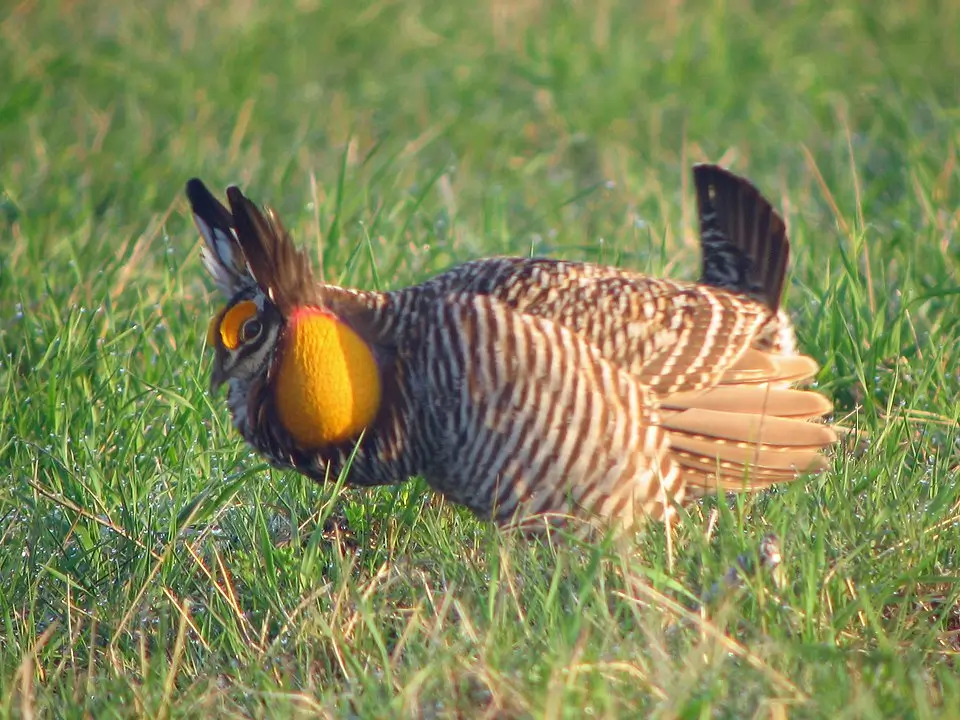
Males possess several striking anatomical features that are used in courtship displays. Perhaps most iconic are the pinnae — long, pointed feathers on either side of the neck that can be raised during display. Males also have brightly colored orange-yellow eyebrow combs (superciliary combs) that become especially vivid during the breeding season. Most dramatically, males inflate large, orange-colored air sacs located on the sides of their necks, producing the deep, resonant booming sound for which the species is so well known. This booming call can carry remarkable distances across open prairie, serving as both a territorial declaration and an invitation to potential mates.
The communal courtship arenas where male prairie-chickens gather to display are known as leks, and visiting a lek at dawn during the spring months is considered by many to be one of the most memorable wildlife-watching experiences available in North America. Males engage in elaborate dances, foot-stamping, wing-drooping, and vocalizations as they compete for the attention of observing females. Dominant males typically occupy the central positions on the lek, which are the most desirable spots and therefore the most hotly contested.
Outside of the breeding season, Greater prairie-chickens are relatively social birds, forming flocks — often called coveys — that forage together across the landscape. Their diet shifts seasonally, encompassing a wide variety of plant materials including seeds, grains, berries, and green vegetation, supplemented by insects, particularly during the summer months when protein demands are higher, especially for growing chicks. In winter, they rely heavily on waste grain from agricultural fields and the seeds of native grasses and forbs.
Like many ground-nesting birds, Greater prairie-chickens are vulnerable to predation throughout their life cycle. Nest success depends heavily on vegetative cover, and chick survival is closely tied to insect availability in the early weeks of life. Hens typically lay clutches of around a dozen eggs, incubating them for approximately three to four weeks before hatching. The precocial chicks are mobile shortly after hatching and follow the hen across the prairie as they learn to feed and avoid predators.
Habitat & Range
The Greater prairie-chicken is a species intimately tied to the tallgrass and mixed-grass prairies of North America. Historically, the species ranged across a vast swath of the continent, from southern Canada southward through the central United States. The conversion of native grasslands to agricultural land over the past two centuries has significantly contracted that range, and today the species is found primarily in pockets of suitable grassland habitat across the central and southern Great Plains.
Core populations exist in states such as Kansas, Nebraska, South Dakota, and Oklahoma, where a combination of native grassland habitat, managed public lands, and conservation programs has helped support viable populations. Smaller, more isolated populations persist in other states as well.
In the context of Wyoming, it is worth noting that the state — while largely defined by its dramatic mountain ranges, high desert basins, and sweeping rangelands — does contain grassland habitats in its eastern regions that border the traditional range of the Greater prairie-chicken. Wyoming's eastern counties, which share ecological characteristics with the mixed-grass prairies of neighboring Nebraska and South Dakota, can provide glimpses into the habitat types that support prairie grouse species. The state's vast, open landscapes and relatively low human population density create conditions that are, in principle, compatible with grassland wildlife.
However, the Greater prairie-chicken's presence in Wyoming is limited and not well-documented as an established, huntable population. The species is far more commonly associated with states to the east and south, where native grassland habitat is more extensive and contiguous.
Hunting Information
The Greater prairie-chicken has a long and storied history as an upland game bird in North America. During the 19th century, it was hunted in extraordinary numbers across the prairie states, and market hunting contributed significantly to early population declines. Today, regulated hunting seasons exist in several states where populations are sufficiently robust to support harvest, with hunters typically pursuing birds over pointing dogs across the open grasslands in the classic upland bird hunting tradition.
Hunting Greater prairie-chickens is widely regarded as one of the most authentic and challenging upland bird hunting experiences available. The wide-open nature of prairie habitat means birds can often be spotted at long distances, and they are known for their ability to flush wild — taking to the air well ahead of hunters and dogs when pressured. Their strong, direct flight and preference for landing in areas of dense grass cover make for a satisfying and demanding hunt.
For hunters interested in pursuing Greater prairie-chickens, the primary destination states have traditionally included Kansas, Nebraska, and South Dakota, where regulated seasons and proper licenses are in place. Hunters should always consult the current regulations of the specific state they intend to hunt, as seasons, bag limits, and licensing requirements can change from year to year based on population surveys and management decisions.
Regarding Wyoming specifically, official hunting information for Greater prairie-chicken is not currently available through the state's wildlife management resources. Prospective hunters interested in pursuing prairie-chickens in Wyoming should contact the Wyoming Game and Fish Department directly for the most current and accurate information on whether any seasons or opportunities exist in the state. Given Wyoming's position at the western fringe of prairie-chicken range, any opportunities that may exist would likely be limited and subject to specific regulations.
Conservation
The conservation story of the Greater prairie-chicken is a deeply important one for the future of North American grasslands. Once numbering in the tens of millions, the species experienced dramatic population declines through the 19th and 20th centuries driven primarily by habitat loss, as native grasslands were converted to cropland and other land uses. The extinction of the Heath Hen subspecies in 1932 serves as a sobering reminder of what can happen when grassland birds lose sufficient habitat.
Today, conservation efforts for the Greater prairie-chicken focus primarily on protecting and restoring native grassland habitat. Programs administered through the U.S. Farm Bill, including the Conservation Reserve Program (CRP), have played an important role in providing grassland cover on agricultural lands. State wildlife agencies, non-governmental organizations, and private landowners all contribute to conservation initiatives that benefit not just prairie-chickens, but the entire suite of species that depend on native grassland ecosystems.
Hunters and hunting organizations have also been important contributors to prairie-chicken conservation, supporting habitat programs and advocating for the management of public and private lands in ways that benefit grassland species. In this regard, regulated hunting and conservation are complementary rather than conflicting forces.
The long-term outlook for the Greater prairie-chicken depends on the continued availability of large, contiguous grassland habitats — a goal that requires sustained commitment from governments, landowners, and the public alike. With thoughtful management and broad support, the booming of male prairie-chickens at dawn has every reason to continue echoing across the American prairies for generations to come.