Overview
Few animals in North America capture the imagination quite like the coyote. Known scientifically as Canis latrans — a Latin phrase meaning "barking dog" — the coyote is one of the continent's most recognized, most studied, and most misunderstood wild canids. From the sun-baked deserts of the American Southwest to the wind-swept plains of Wyoming, and even into the urban sprawl of major cities, the coyote has proven itself to be a survivor of extraordinary adaptability. It is a creature that has not only endured human encroachment on the natural landscape but has, in many ways, thrived because of it.
The coyote occupies a unique cultural and ecological space. It plays the role of trickster in numerous Indigenous traditions, a symbol of cunning and resilience. In modern times, it serves as both a subject of scientific fascination and a target of wildlife management efforts. Hunters, ranchers, naturalists, and backyard birdwatchers all have a relationship with the coyote, and that relationship speaks to the animal's remarkable ability to insert itself into virtually every corner of human and natural life. In a state like Wyoming — vast, wild, and defined by open landscapes — the coyote is a fixture of the ecosystem and a compelling subject for anyone interested in the natural world.
Biological Traits
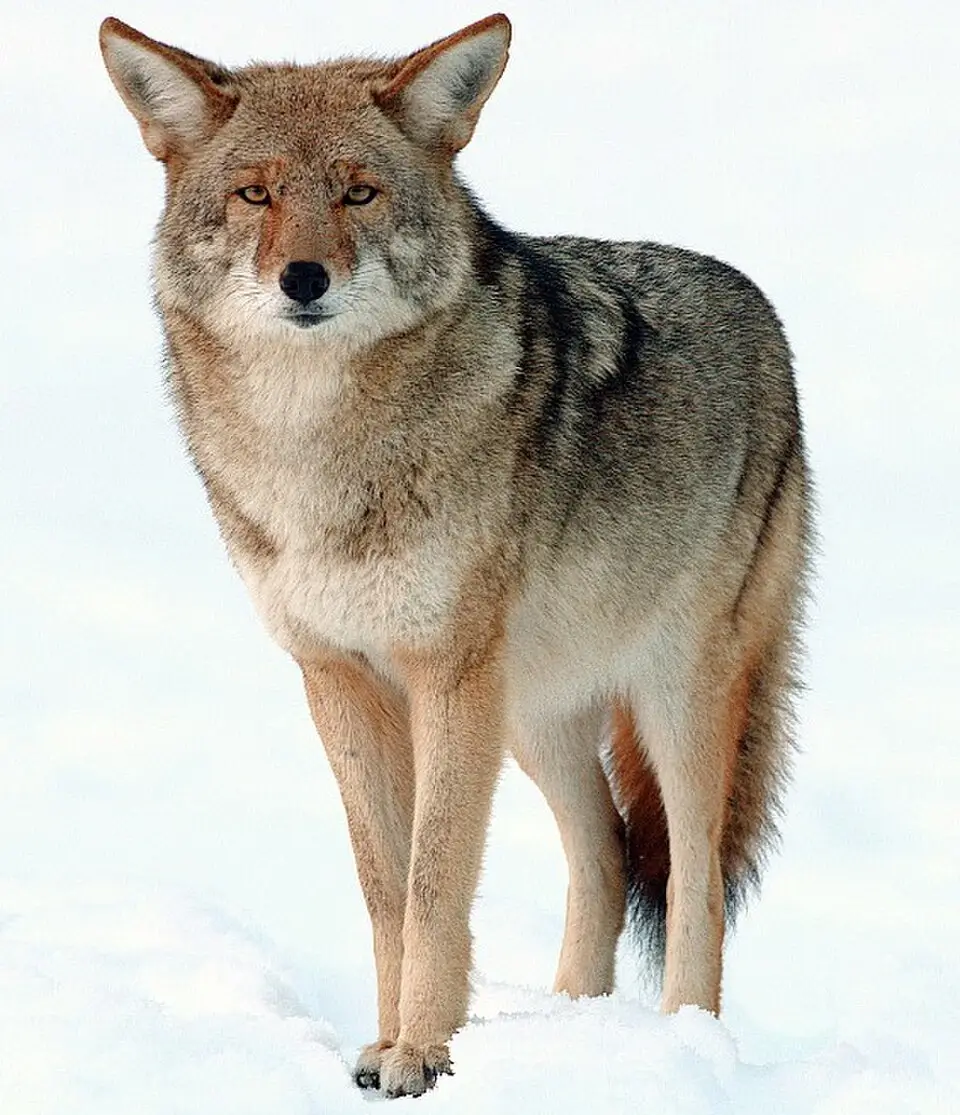
The coyote (Canis latrans) is a member of the family Canidae, which also includes wolves, foxes, jackals, and domestic dogs. It is a medium-sized canid, generally smaller than a gray wolf but larger than most foxes. Its physical appearance is often described as a lean, athletic build with long legs, a pointed muzzle, large upright ears, and a bushy tail that it typically holds low when running — a key behavioral distinction from the domestic dog.
Coyote coloring tends to vary by region, but the most common coat patterns feature a mix of gray, brown, and tawny hues across the back and sides, with a lighter, often white or cream-colored underbelly. The fur is thick and double-layered, providing excellent insulation during cold winters — a feature especially important in northern states like Wyoming, where temperatures can plunge well below freezing.
One of the coyote's most remarkable biological traits is its extraordinary vocal range. Coyotes are highly communicative animals, using a variety of sounds including howls, yips, barks, and whines to communicate with one another. These vocalizations can travel great distances across open landscapes, making the nighttime chorus of coyotes one of the most iconic sounds of the American West. Their vocal communication serves multiple purposes: establishing territory, coordinating with pack members, and maintaining social bonds.
Coyotes are omnivores with a highly opportunistic diet. They consume small mammals such as rabbits, mice, voles, and ground squirrels, as well as birds, reptiles, insects, fruits, berries, and carrion. This dietary flexibility is a cornerstone of their survival success. Unlike more specialized predators, the coyote can shift its feeding habits based on seasonal availability, making it resilient in the face of environmental change.
Socially, coyotes are flexible. They can live as solitary individuals, in mated pairs, or in small family groups. Breeding typically occurs once a year in late winter, with pups born in the spring after a gestation period of roughly 63 days. Litter sizes can vary but commonly range from four to seven pups. Both parents participate in raising the young, which is relatively uncommon among wild canids and speaks to the coyote's strong pair-bonding behavior.
Perhaps the most biologically extraordinary aspect of the coyote is its population resilience. When coyote populations are heavily reduced by hunting or trapping pressure, they have been observed to compensate by producing larger litters and beginning reproduction at an earlier age. This compensatory reproductive response makes the species particularly challenging to manage through conventional population control methods.
Habitat & Range
The coyote's natural range was historically centered in the grasslands, shrublands, and deserts of central and western North America. However, over the past century, as forests were cleared and wolves were extirpated from much of their former territory, the coyote expanded dramatically. Today, Canis latrans is found across virtually the entire North American continent, from Alaska and Canada in the north, throughout the contiguous United States, and into Central America in the south.
Coyotes are habitat generalists, meaning they can thrive in an enormous variety of environments. They inhabit deserts, grasslands, forests, wetlands, agricultural areas, suburban neighborhoods, and even the edges of major metropolitan areas. This habitat flexibility is a direct result of their dietary adaptability and behavioral intelligence. They are capable of learning from experience and modifying their behavior in response to new challenges or opportunities.
In Wyoming, the coyote is very much at home. The state's sweeping open landscapes — including sagebrush steppe, high plains grasslands, mountain meadows, and riparian corridors — provide ideal habitat. Wyoming's relatively low human population density (the lowest of any U.S. state, with an estimated 587,618 residents as of 2024) means that vast stretches of undisturbed wild country remain available for coyotes to roam. The Bighorn Basin, the Red Desert, the Thunder Basin National Grassland, and the foothills of the Rocky Mountains all support healthy coyote populations.
Wyoming's rugged terrain and diverse ecosystems also support the prey species that coyotes depend upon, including jackrabbits, cottontails, prairie dogs, mule deer fawns, and a variety of rodents. In ranching country — which covers much of Wyoming — coyotes sometimes come into conflict with livestock operations, particularly during lambing season, which has historically made them a focal point of predator management efforts in the state.
Hunting Information
Coyote hunting is a well-established tradition across the American West, and Wyoming is no exception. Hunters pursue coyotes for a variety of reasons: the challenge of the hunt itself, the protection of livestock and game herds, the value of coyote fur, and the opportunity to hone calling and shooting skills during seasons when big game hunting is not open.
Coyote hunting is widely regarded as one of the most demanding and rewarding forms of predator hunting. The coyote's keen senses — sharp eyesight, an exceptional sense of smell, and acute hearing — make it a highly alert and cautious quarry. Successful coyote hunters typically rely on a combination of camouflage, scent control, and expert calling techniques using electronic or mouth-blown calls that mimic the sounds of distressed prey animals or coyote vocalizations.
In Wyoming, hunters interested in pursuing coyotes should consult the Wyoming Game and Fish Department directly for the most current and accurate regulations, including any applicable licensing requirements, season dates, and method-of-take restrictions, as these details can change from year to year. Given that official hunting information specific to coyotes was not available in the source data at the time of this writing, it is essential to verify current rules directly with the state wildlife agency before heading afield.
Generally speaking, coyotes in many western states are classified as predatory animals or unprotected species, which often allows for year-round hunting opportunities with relatively accessible licensing structures. However, hunters should never assume — always verify with the Wyoming Game and Fish Department at their official website or by contacting a local game warden.
Common methods used by coyote hunters include rifle hunting from elevated positions or across open fields, shotgun hunting at closer ranges, and archery pursuits for the most dedicated predator hunters. Night hunting with appropriate lighting equipment is also practiced in many states, adding another dimension to the pursuit. Decoys, both visual and mechanical, are frequently used in combination with electronic callers to draw coyotes within range.
Winter is considered by many hunters to be the prime season for coyote hunting in Wyoming. The coyotes' fur is at its thickest and most beautiful during the colder months, and the breeding season — which falls in late winter — makes males more responsive to calling. The open, snow-covered landscape of a Wyoming winter also makes spotting and tracking coyotes considerably easier than during the lush vegetation of summer.
Conservation
From a conservation standpoint, the coyote is listed as a species of Least Concern by the International Union for Conservation of Nature (IUCN), reflecting its wide distribution, large population, and remarkable ability to adapt to changing environments. Unlike many native predators that have suffered dramatic population declines due to habitat loss and human persecution, the coyote has expanded its range and numbers considerably over the last century.
Wildlife biologists recognize the coyote as a keystone species in many ecosystems, playing a vital role in regulating populations of rodents, rabbits, and other small mammals. By keeping prey populations in check, coyotes contribute to the overall health and balance of the ecosystems they inhabit. Their removal or significant reduction from an ecosystem can trigger cascading effects, including population explosions of prey species that can damage vegetation and alter habitat structure.
The coyote's relationship with humans remains complex. While they are sometimes viewed negatively by livestock producers who experience depredation losses, they are appreciated by ecologists and naturalists for their ecological contributions. Non-lethal deterrents, including livestock guardian animals, improved fencing, and range riders, have been shown to effectively reduce coyote-livestock conflicts in many areas, allowing both ranchers and coyotes to coexist more peacefully.
In Wyoming and across the West, ongoing research into coyote behavior, ecology, and population dynamics continues to refine our understanding of this remarkable animal. As human development continues to reshape the natural landscape, the coyote's story serves as both a conservation success and a powerful reminder of nature's capacity for resilience.