Overview
Few birds in the North American outdoors inspire as much fascination — and frustration — among hunters and wildlife enthusiasts alike as the common snipe (Gallinago gallinago). Long the subject of jokes and tall tales, the common snipe is, in fact, a very real and genuinely remarkable bird. Far from being a fictional creature invented to prank gullible campers, this stocky, cryptically patterned shorebird represents one of the most exciting and demanding wingshooting challenges available to upland hunters. Whether you encounter this bird on a misty Wyoming wetland, a flooded meadow, or the boggy margins of a slow-moving river, the common snipe has a way of commanding respect from anyone who has witnessed its explosive, zigzagging flight firsthand.
The common snipe occupies a unique space in the outdoors world. It is simultaneously one of the most widely distributed birds on the planet and one of the least understood by the general public. Its secretive nature, superb camouflage, and preference for remote wetland habitats mean that most people — even those who spend considerable time outdoors — never truly notice it until it bursts from cover in a startling, twisting escape. For hunters, this combination of elusiveness and aerial agility has earned the common snipe a distinguished reputation as a test of marksmanship and field skill. For wildlife watchers and naturalists, it is a bird of quiet wonder, full of biological adaptations that tell the story of millions of years of evolution.
Biological Traits
The common snipe (Gallinago gallinago) belongs to the family Scolopacidae, the large and diverse family of sandpipers and their relatives. Within this family, snipe are placed in the genus Gallinago, a group of medium-sized, long-billed shorebirds found across multiple continents. The common snipe is the most widespread and well-known member of this genus in the Northern Hemisphere.
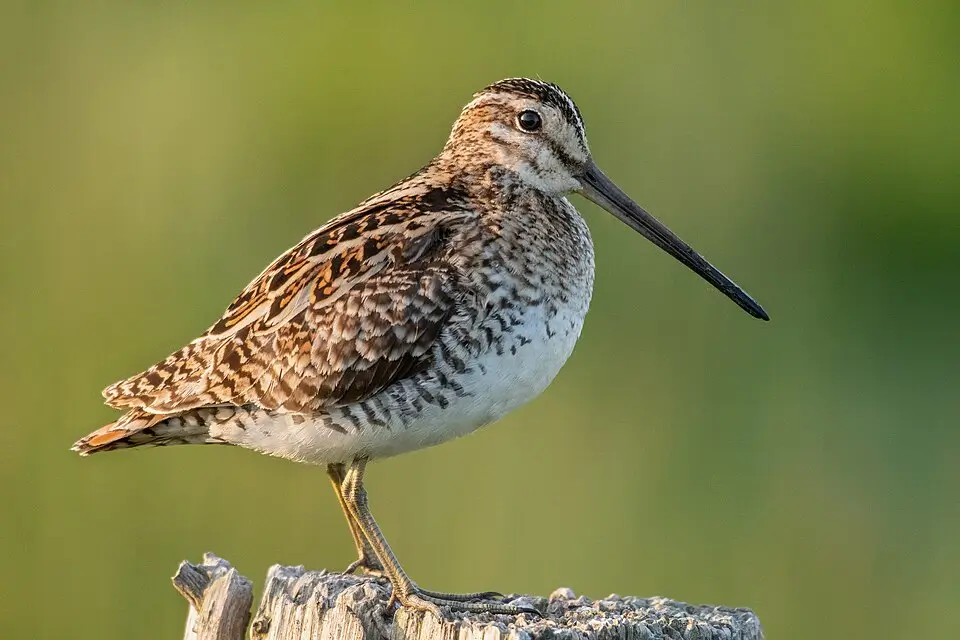
Physically, the common snipe is a stocky, compact bird with proportions that immediately set it apart from most other shorebirds. Its most distinctive feature is its extraordinarily long, straight bill, which can account for a significant portion of the bird's total body length. This bill is a marvel of biological engineering. The tip is highly flexible and packed with sensitive nerve endings, allowing the snipe to probe deep into soft mud and soil and detect invertebrate prey by touch alone — a feeding technique known as "rhynchokinesis." This means the snipe can open just the tip of its bill while it remains buried in mud, grasping worms, insect larvae, and other small creatures without needing to withdraw and reposition its bill.
The plumage of the common snipe is a masterpiece of natural camouflage. The bird's upperparts are a rich mixture of brown, black, buff, and chestnut, patterned with pale streaks that run along the crown and back. This intricate pattern breaks up the bird's outline almost perfectly when it is crouching among dead grasses, sedges, and leaf litter. The underparts are pale and streaked, and the bird has a distinctive pale supercilium — a stripe running above the eye — that helps give it a striped facial appearance. When motionless in appropriate habitat, a common snipe can be virtually invisible even to experienced observers standing only a few feet away.
In terms of size, the common snipe is a medium-small bird, roughly comparable in bulk to a European starling or a small dove, though its elongated bill and somewhat hunched posture can make it appear differently proportioned. Males and females are similar in appearance, making field sexing difficult without careful examination.
The common snipe is perhaps best known for its remarkable aerial displays during the breeding season. Males perform dramatic "drumming" or "winnowing" displays, diving at speed with their outer tail feathers spread. The rushing air over these specialized feathers produces a haunting, tremolo sound that carries across wetlands — a sound that has puzzled and delighted naturalists for centuries. This aerial drumming is a form of territorial advertisement and mate attraction.
Habitat & Range
The common snipe has one of the broadest distributions of any shorebird in the world. It breeds across a vast swath of the Northern Hemisphere, from Iceland and the British Isles eastward across Europe and Asia to the far Pacific. In North America, the subspecies found here (Gallinago gallinago delicata, sometimes split as Wilson's snipe) breeds across Canada, Alaska, and the northern contiguous United States, including portions of the Mountain West.
The common snipe is strongly associated with wetland habitats throughout its range. It shows a pronounced preference for areas where soft, moist soil is accessible for probing — the feeding technique that its extraordinary bill is designed to exploit. Suitable habitats include freshwater marshes, wet meadows, fens, bogs, sedge meadows, flooded agricultural fields, the margins of slow-moving streams and rivers, and irrigated pastures. The bird tends to avoid areas with very dense, tall vegetation that would impede its movement, preferring instead a mosaic of open muddy areas interspersed with low cover for concealment.
In Wyoming, common snipe can be found in appropriate wetland habitats, particularly during migration and, in suitable areas, during the breeding season. Wyoming's diverse landscape, which includes river valleys, mountain meadows, riparian corridors, and irrigated agricultural lowlands, provides a variety of potential snipe habitats. The state's wetlands and wet meadows, particularly in areas like the upper Green River Basin, the Bighorn Basin, and river valleys across the state, can support snipe populations. During fall migration, snipe may be encountered in a wider variety of moist habitats as birds move southward from breeding grounds in Canada and the northern states.
The common snipe is a migratory species across much of its range, though in milder climates it may overwinter. In North America, birds generally move south in fall and return north in spring, following the availability of soft, unfrozen ground that allows for feeding.
Hunting Information
The common snipe holds a distinguished place in the history of sport hunting, and it is from snipe hunting that we derive the word "sniper" — originally a term for a marksman skilled enough to shoot these fast-moving, unpredictable birds. This linguistic legacy speaks volumes about the reputation the common snipe has earned as a challenging quarry.
In the United States, common snipe (or Wilson's snipe, as the North American population is often now classified) are regulated as migratory game birds under the Migratory Bird Treaty Act, with seasons and bag limits set in coordination with the U.S. Fish and Wildlife Service. Hunters interested in pursuing snipe in Wyoming should consult the Wyoming Game and Fish Department directly for current season dates, bag limits, and license requirements, as regulations can change annually. As with all migratory bird hunting in the United States, a valid federal duck stamp (Migratory Bird Hunting and Conservation Stamp) is generally required in addition to any state licensing requirements.
Hunting common snipe is a pursuit that rewards patience, preparation, and exceptional shooting skills. The bird's habit of holding tight in cover until nearly underfoot, followed by an explosive flush and immediate erratic zigzagging flight, makes it one of the most demanding targets in wingshooting. Experienced snipe hunters often describe the bird's escape flight as almost random in direction and speed, and the snipe's relatively small body size adds to the difficulty. Many accomplished upland hunters consider a consistently successful snipe hunter to be among the most skilled wingshots in the field.
Snipe are typically hunted on foot, with hunters walking slowly through suitable wetland habitats and flushing birds from cover. Dogs can be useful, particularly breeds with a strong nose and steady disposition, as a well-trained flushing or pointing dog can locate birds in dense cover and help retrieve downed birds from wet, difficult terrain. Because snipe habitat often involves soft ground, mud, and shallow water, appropriate footwear and clothing are essential.
For those interested in experiencing Wyoming's wild wetlands in a uniquely challenging way, snipe hunting offers an adventure that combines the beauty of the state's open landscapes with one of the most demanding wingshooting experiences available.
Conservation
The common snipe benefits from its broad global distribution and its association with wetland habitats that, where preserved and managed well, can support healthy populations. Like many wetland-dependent species, the common snipe is sensitive to loss and degradation of its preferred habitats, including draining of marshes, conversion of wet meadows to intensive agriculture, and alteration of river systems.
Conservation of wetland habitats is therefore central to the long-term wellbeing of snipe populations. In North America, programs that protect and restore wetlands — including conservation easements, waterfowl habitat programs, and public land management — benefit snipe and a wide array of other wetland-dependent wildlife. Hunters who participate in wetland conservation efforts contribute meaningfully to the habitats that support snipe populations.
Monitoring of snipe populations in North America is carried out as part of broader migratory bird assessment programs, and hunting seasons are set based on population data to ensure sustainable harvest. This science-based management approach reflects the broader commitment to conservation that characterizes regulated hunting of migratory birds in the United States.