Overview
Few birds capture the imagination of hunters and wildlife enthusiasts quite like the common pheasant. With its dazzling plumage, explosive flush, and challenging sporting qualities, Phasianus colchicus has earned a legendary status across the globe. Originally native to Asia and parts of Eastern Europe, the common pheasant has been introduced to virtually every corner of the world where suitable habitat exists — and it has thrived in many of those places with remarkable success. In the American West, and particularly across the wide-open landscapes of Wyoming, the ring-necked pheasant (as it is most commonly known in North America) has become one of the most pursued and beloved upland game birds of all time.
The common pheasant belongs to the family Phasianidae, which also includes turkeys, quails, peafowl, and partridges. It is a bird that has inspired art, literature, and centuries of hunting tradition across cultures as diverse as ancient Chinese dynasties and modern American sporting clubs. Whether you are a seasoned upland hunter walking the edges of Wyoming's agricultural fields with a well-trained pointer or a curious naturalist scanning brushy creek bottoms with binoculars, the common pheasant is a species that never fails to impress.
This article explores the biology, habitat preferences, hunting traditions, and conservation status of this remarkable bird, with a particular focus on what makes Wyoming such an interesting context for pheasant enthusiasts.
Biological Traits
The common pheasant, Phasianus colchicus, is one of the most visually striking birds in the Northern Hemisphere. The species exhibits strong sexual dimorphism, meaning males and females look dramatically different from one another — a feature that is common among members of the pheasant family.
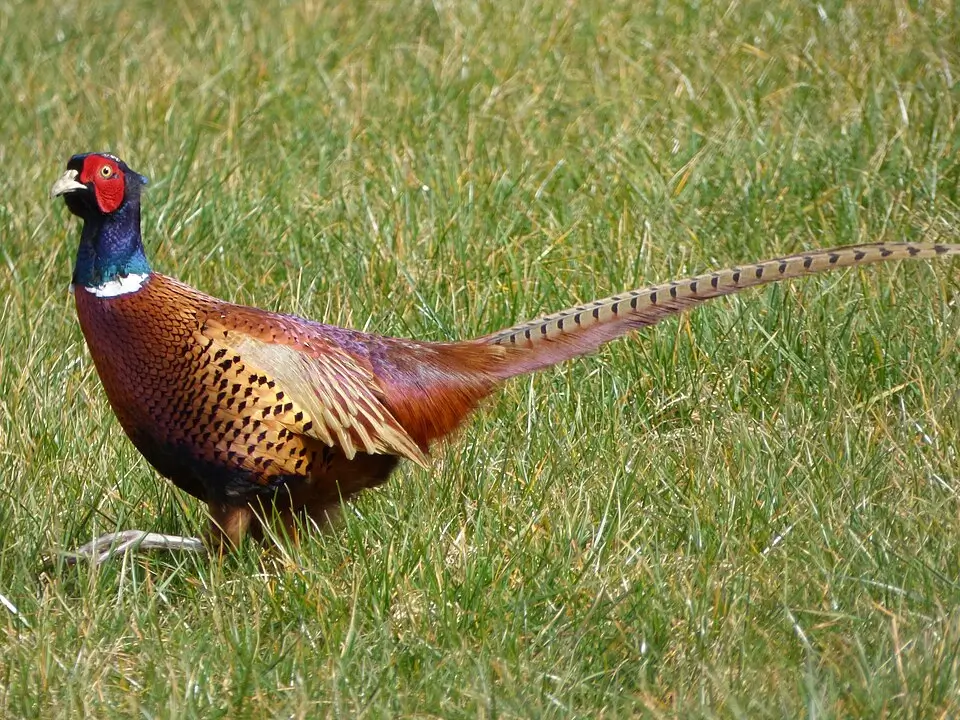
Male pheasants, often called roosters or cocks, are renowned for their extraordinary coloration. They typically display a rich, iridescent plumage featuring warm copper and golden-brown tones across the body, dark green and purple iridescence on the head and neck, and — in the most widely recognized subspecies — a distinctive white ring encircling the neck, which gives the North American population its popular name, the ring-necked pheasant. The face is adorned with bare red wattles and patches of skin, which become especially vivid during the breeding season. A long, elegant, barred tail extends well behind the body, adding to the bird's overall dramatic silhouette. Males are substantially larger than females and can weigh anywhere from roughly two to four pounds, with body lengths that can exceed three feet when the tail is included.
Female pheasants, or hens, are far more modestly colored in mottled brown, buff, and black tones that provide exceptional camouflage in their natural surroundings. This cryptic coloration serves an important purpose — hens incubate eggs and raise young on the ground, where predators are an ever-present threat. Though less visually spectacular than roosters, hens are equally important to the health of any pheasant population.
The common pheasant is a ground-dwelling bird that prefers to walk and run rather than fly. When startled, however, it produces one of the most heart-stopping launches in the bird world — an explosive, cackling flush that erupts from cover with powerful wingbeats and a distinctive rattling call. This dramatic escape behavior is a significant part of what makes pheasant hunting such an exhilarating sport.
Pheasants are omnivores, feeding on a wide variety of seeds, grains, berries, insects, and other invertebrates depending on the season. During winter, when insect and plant food sources are reduced, they rely heavily on waste grain found in agricultural fields. Males are polygynous, meaning a single rooster will mate with multiple hens during the spring breeding season. Hens typically lay a clutch of anywhere from eight to fifteen eggs in a shallow ground nest concealed within thick vegetation. Chicks are precocial — they are covered in down at hatching and capable of moving and feeding shortly after birth, though they remain with the hen for several weeks as they develop.
The common pheasant is a hardy bird, capable of withstanding significant cold and harsh weather conditions, which contributes to its success in a wide variety of climates — including the sometimes brutal winters found across Wyoming's high plains.
Habitat & Range
The original native range of Phasianus colchicus stretches from the Caucasus region and parts of Eastern Europe across Central Asia and into China, Korea, and Japan. The species name "colchicus" itself is derived from Colchis, an ancient region along the eastern coast of the Black Sea in what is now the nation of Georgia. It is believed that the ancient Greeks and Romans were among the first to introduce the bird to Western Europe, and subsequent centuries of deliberate introduction by hunters and sportsmen carried the species to North America, Australia, New Zealand, and many other regions.
In its preferred habitat, the common pheasant gravitates toward a mosaic of agricultural fields, grasslands, wetland edges, brushy fence rows, hedgerows, and riparian corridors. It thrives where open foraging areas are interspersed with dense cover for nesting, roosting, and escape from predators. Pheasants are not deep-forest birds; they prefer edges and transitional zones where different habitat types meet.
In Wyoming, the landscape offers a mix of environments that can support pheasant populations. The eastern plains and agricultural valleys of the state, where crops such as wheat, corn, and sunflowers are grown, historically provide some of the most productive pheasant habitat. Irrigated farmland along river corridors creates the kind of edge habitat that pheasants favor — dense grasses, cattail marshes, willow thickets, and food-rich crop fields all within close proximity. The Platte River valley and the agricultural benchlands of eastern Wyoming are among the areas most associated with pheasant presence in the state.
Wyoming's high elevation and semi-arid conditions mean that pheasant habitat can be more limited compared to prime pheasant states like South Dakota or Kansas, but where suitable habitat exists, birds can be found in appreciable numbers, particularly following mild breeding seasons and favorable weather conditions during the critical summer brood-rearing period.
Hunting Information
Pheasant hunting is one of the great traditions of American upland sport. The combination of challenging terrain, the requirement for skilled dogs, the unpredictable flush of a rooster, and the reward of a beautiful bird in hand make it a pursuit that hunters return to year after year with tremendous enthusiasm.
In Wyoming, pheasant hunting takes place against a backdrop of sweeping prairie vistas, river bottoms, and agricultural landscapes that give the experience a distinctly western character. While Wyoming is not as widely recognized as a premier pheasant destination compared to neighboring states to the east, the state does offer pheasant hunting opportunities, particularly in suitable agricultural areas of eastern and central Wyoming.
Hunters pursuing pheasants in Wyoming should consult the Wyoming Game and Fish Department directly for the most current and accurate information regarding season dates, bag limits, licensing requirements, and any specific regulations that apply to the areas they intend to hunt. Regulations can change from year to year based on population surveys and habitat conditions, so checking official sources before heading afield is always the responsible approach. As of the writing of this article, specific season dates and license details for Wyoming pheasant hunting were not available in the source data used for this piece.
Upland hunting dogs — particularly flushing breeds such as Labrador Retrievers, Springer Spaniels, and Boykin Spaniels, as well as pointing breeds like German Shorthaired Pointers, English Setters, and Vizslas — are enormously valuable companions in pheasant country. A well-trained dog can locate birds in heavy cover that a hunter on foot would simply walk past, and retrieving a downed rooster from thick cattails or willow tangles is a task that is much more reliably accomplished with a trained retriever than without one.
Access to hunting land is an important consideration in Wyoming. The state contains a mix of public lands managed by the Bureau of Land Management, Wyoming Game and Fish Department walk-in access properties, and privately held agricultural lands. Hunters are encouraged to seek proper permission before accessing private property and to take advantage of the various public access programs that make hunting available to all.
When it comes to gear and tactics, pheasant hunters typically favor upland-specific shotguns in 12 or 20 gauge, loaded with shells appropriate for the range at which birds are typically taken. Blaze orange clothing is commonly worn for visibility and safety. Walking the edges of fields, working through cattail sloughs, and pushing brushy draws are all productive strategies for locating roosters.
Conservation
The conservation story of the common pheasant in North America is largely one of habitat management and population stewardship rather than crisis. Because the bird is a non-native, introduced species in the United States, its population dynamics are influenced heavily by land use practices, particularly in agricultural areas. The shift away from small, diverse family farms toward large-scale monoculture agriculture has reduced the availability of the varied edge habitat that pheasants require, leading to population declines in some parts of the country over recent decades.
However, conservation organizations such as Pheasants Forever have made remarkable strides in restoring and protecting pheasant habitat across the country. Through cooperative programs with farmers and ranchers, these groups have helped establish and maintain cover strips, wetland buffers, native grass plantings, and other habitat features that benefit pheasants and a wide variety of other wildlife species simultaneously.
In Wyoming, habitat conservation efforts often focus on maintaining the agricultural and riparian corridor habitats that support pheasant populations in suitable portions of the state. Programs administered through the U.S. Department of Agriculture, including the Conservation Reserve Program (CRP), have helped preserve critical grassland and cover habitat in states across the pheasant range.
Weather plays an enormous role in pheasant population health. Severe late-spring or early-summer weather events — cold, wet conditions that arrive just as chicks are hatching and in their earliest, most vulnerable weeks of life — can dramatically reduce annual production of young birds. Mild, dry summers tend to produce strong hatch years, leading to excellent hunting the following autumn.
Responsible hunting, thoughtful land stewardship, and ongoing habitat conservation work together to ensure that future generations of hunters and wildlife observers will have the opportunity to experience the common pheasant in its full, spectacular glory on the landscapes of Wyoming and beyond.