Overview
Few birds capture the wild spirit of the American West quite like the sage-grouse, the iconic upland game birds belonging to the genus Centrocercus. These remarkable birds are synonymous with the vast, open sagebrush landscapes that define much of the interior West, and they hold a special place in the hearts of wildlife enthusiasts, conservationists, and hunters alike. As one of the largest native grouse species in North America, sage-grouse are instantly recognizable — dramatic in appearance, extraordinary in their mating behaviors, and deeply intertwined with the health of the sagebrush ecosystem they call home.
The genus Centrocercus belongs to the family Phasianidae, the broad family of birds that also includes pheasants, turkeys, quail, and other grouse. Two recognized species fall under this genus: the Greater Sage-Grouse (Centrocercus urophasianus) and the Gunnison Sage-Grouse (Centrocercus minimus). Together, these two species represent some of the most studied and discussed wildlife in the western United States, due in no small part to their striking appearance, complex ecology, and the ongoing conservation conversations that surround them.
Wyoming, in particular, stands as one of the most important states for sage-grouse in the entire country. As the least populous state in the nation, Wyoming's wide-open spaces, minimal urban development, and expansive sagebrush steppe make it a critical stronghold for these birds. Understanding Centrocercus — their biology, habits, habitat requirements, and role in western wildlife culture — is essential for anyone who appreciates the landscapes and traditions of the Mountain West.
Biological Traits
Sage-grouse of the genus Centrocercus are among the most visually distinctive birds in North America. The Greater Sage-Grouse is the largest grouse species on the continent, with adult males potentially weighing up to seven pounds or more, though females are significantly smaller. This pronounced size difference between males and females, known as sexual dimorphism, is a hallmark of the species and is directly tied to their elaborate breeding system.
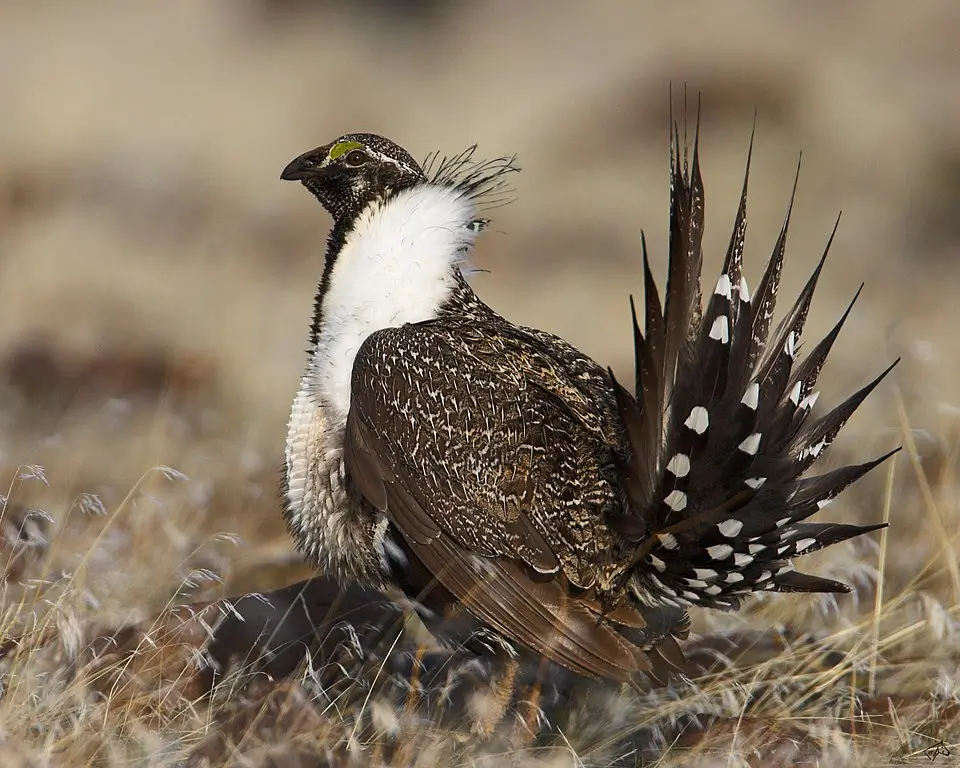
Males are adorned with striking plumage that makes them unlike almost any other bird. Their chests feature large, yellowish air sacs surrounded by white feathering, which are used during the breeding season to produce deep, booming sounds that resonate across the sagebrush flats. Long, pointed tail feathers fan out dramatically during display, adding to their theatrical appearance. The birds also have a distinctive black belly patch and a white breast that contrasts with the mottled brown and gray patterning of their back and wings — a coloration that provides excellent camouflage in the sagebrush environment.
Females, by contrast, are considerably smaller and sport more cryptic, mottled brown plumage ideally suited for nesting camouflage. This difference is not merely aesthetic; it reflects the very different reproductive roles each sex plays. Males invest almost entirely in display and competition, while females are solely responsible for incubation and chick-rearing.
Perhaps the most famous biological trait of Centrocercus is their spectacular lek-based mating system. Every spring, male sage-grouse gather at traditional display grounds known as "leks" — open areas where dozens of males strut, fan their tails, puff their air sacs, and compete intensely for the attention of visiting females. Leks are often used year after year, sometimes for decades, and they are considered one of the most dramatic wildlife spectacles that the American West has to offer. Females visit the lek, observe the males, and select mates based on display quality — a classic example of sexual selection in action.
The Gunnison Sage-Grouse (Centrocercus minimus), the smaller of the two species, was only formally recognized as a distinct species in the early 2000s. It is found in a much more restricted range, primarily in southwestern Colorado and a small portion of southeastern Utah. While similar in appearance and behavior to its larger relative, it has several distinguishing features, including more pronounced white banding on its tail feathers.
The diet of sage-grouse is strongly tied to sagebrush. Adults rely heavily on sagebrush leaves, particularly in winter when other food sources are scarce. In summer, they broaden their diet to include forbs, insects, and other green vegetation, which are especially important for growing chicks that need protein-rich food sources in their early weeks of life. This near-total dependence on sagebrush — for food, cover, and nesting — makes the health of the sagebrush ecosystem absolutely fundamental to the survival of the species.
Habitat & Range
The sagebrush steppe of the American West is one of the most extensive and ecologically important ecosystems in North America, and Centrocercus is perhaps its most emblematic resident. Sage-grouse are found across a broad swath of the interior West, from Washington and Montana in the north, south through Nevada, Utah, and Colorado, and east into Wyoming, South Dakota, and the Dakotas.
Wyoming is widely regarded as one of the most important sage-grouse strongholds in the entire range. The state's vast plateaus, basins, and high desert landscapes provide millions of acres of sagebrush habitat largely undisturbed by the urban expansion that has fragmented habitat in other parts of the West. The Green River Basin, the Powder River Basin, and the high sagebrush flats across much of central and southwest Wyoming support some of the densest sage-grouse populations remaining anywhere in North America.
Sage-grouse are highly dependent on landscape connectivity. They require large areas of intact sagebrush to support their seasonal movements — migrating between summer and winter ranges, and traveling to traditional lek sites in spring. Because of this, land management practices across entire regions have significant impacts on sage-grouse populations. The birds avoid areas with heavy shrub encroachment by conifers, prefer sagebrush communities with a mix of grass and forb understory, and need sources of water, particularly during summer.
Elevational migrations are common, with birds often moving to lower elevations with shallower snow during winter months, where sagebrush foliage remains accessible above the snowpack.
Hunting Information
Sage-grouse have a long history as an upland game bird in the American West, valued both for the challenging hunting experience they provide and for the opportunity to spend time in some of the most breathtaking landscapes in the country. Hunting Centrocercus is a tradition deeply embedded in western outdoor culture, often involving long walks across open country with pointing dogs working ahead through the sage.
In Wyoming — one of the premier states for sage-grouse hunting — the pursuit of these birds takes hunters into the heart of the sagebrush steppe, often miles from the nearest road. The experience is as much about the landscape and the solitude as it is about the birds themselves. Hunters typically use pointing breeds or flushing dogs, and shooting can be challenging given the bird's size, speed, and often long flushes in open terrain.
It is important to note that hunting regulations for sage-grouse vary by state and can change from year to year based on population surveys and wildlife management assessments. In Wyoming, hunters should always consult the Wyoming Game and Fish Department directly for the most current season dates, bag limits, and license requirements before planning a hunt. Given the species' conservation profile, regulatory frameworks are subject to active management and can differ significantly from one hunting unit to another. Obtaining up-to-date information directly from official wildlife management sources is essential.
Conservation
The conservation of Centrocercus is one of the most prominent wildlife issues in the American West. Both the Greater Sage-Grouse and the Gunnison Sage-Grouse have been subjects of significant conservation attention due to population declines associated with habitat loss, fragmentation, and degradation of sagebrush ecosystems. The Gunnison Sage-Grouse is listed as a threatened species under the Endangered Species Act.
Conservation efforts for sage-grouse are multifaceted, involving federal land management agencies, state wildlife agencies, private landowners, conservation organizations, and the hunting community. Initiatives have focused on protecting and restoring sagebrush habitat, managing invasive species such as cheatgrass that degrade sagebrush communities, limiting surface disturbance from energy development and other land uses, and maintaining landscape connectivity.
Wyoming has been at the forefront of state-led sage-grouse conservation, implementing land use plans designed to protect core sage-grouse habitat areas from incompatible development. The state's approach has been held up as a model for balancing wildlife conservation with the economic interests of ranching, energy, and outdoor recreation communities.
The lek count — an annual census of male sage-grouse attending display grounds — serves as the primary population monitoring tool across the range, providing biologists and managers with long-term trend data used to inform hunting regulations and conservation planning.