Overview
Few animals in North America are as misunderstood, as resilient, or as biologically fascinating as the Virginia opossum (Didelphis virginiana). As the continent's only native marsupial, this remarkable creature occupies a unique place in the animal kingdom — a living relic of an ancient lineage that once dominated much of the Western Hemisphere. From the forests of Central America to the suburbs of the northeastern United States, the Virginia opossum has proven itself to be one of nature's great survivors, adapting to a staggering range of environments and thriving alongside human civilization in ways that few other wild animals can match.
In West Virginia, a state defined by its rolling Appalachian mountains, dense hardwood forests, and rich tradition of outdoor pursuits, the Virginia opossum is a familiar presence. Whether spotted crossing a rural road at night, raiding a backyard compost pile, or glimpsed foraging along a creek bank, this nocturnal omnivore is very much a part of the Mountain State's natural heritage. For hunters, naturalists, and wildlife enthusiasts alike, understanding the Virginia opossum — its biology, its habits, and its place in the ecosystem — is a rewarding endeavor that deepens one's appreciation for the remarkable biodiversity found in "Almost Heaven."
Biological Traits
The Virginia opossum is a study in evolutionary ingenuity. As a marsupial, it belongs to the infraclass Metatheria, a group of mammals defined by the fact that their young are born at an extremely early stage of development and complete much of their growth outside the womb, typically in a specialized pouch on the mother's belly. This reproductive strategy sets opossums apart from virtually every other mammal found in North America north of Mexico, making them objects of genuine scientific interest.
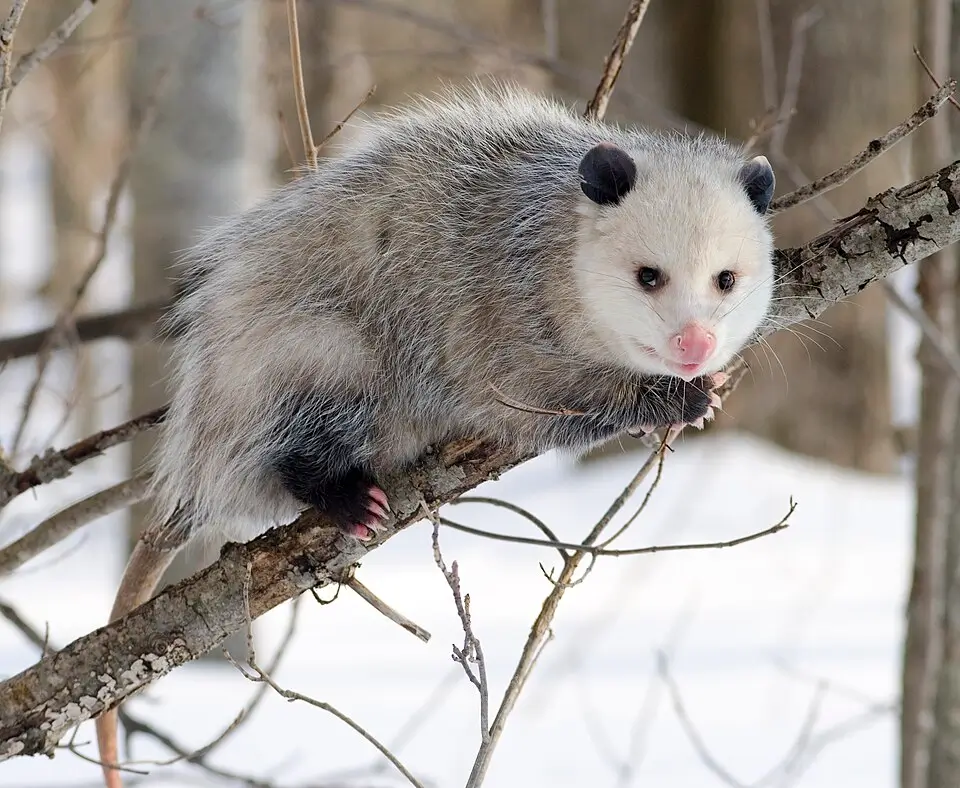
Adult Virginia opossums are medium-sized mammals, roughly comparable in size to a domestic cat. They are easily recognized by their distinctive pointed snouts, naked ears, and long, prehensile tails that are nearly hairless and scaly in appearance. Their fur is typically grayish-white overall, though individuals can vary from nearly white to darker gray tones, and their faces often appear pale or white with dark eyes. The tail, one of the opossum's most recognizable features, is adapted for grasping — young opossums in particular use it to help cling to branches and to their mothers — and while popular folklore suggests opossums hang from trees by their tails for extended periods, this behavior is relatively rare in adults.
One of the opossum's most celebrated survival mechanisms is its involuntary response to extreme threat: feigning death, a behavior so associated with this animal that it has given rise to the common phrase "playing possum." When faced with a predator and overwhelmed by fear, a Virginia opossum may enter a catatonic state in which it becomes completely limp, its eyes glaze over, and it may even emit a foul-smelling fluid from its anal glands to further discourage attack. This response is involuntary — the animal is not consciously deciding to play dead — and can last anywhere from a few minutes to several hours.
The Virginia opossum's immune system is another source of scientific fascination. Opossums possess a notable resistance to several snake venoms, including those produced by pit vipers such as rattlesnakes and copperheads — species that are well-represented across West Virginia. Research has investigated certain peptides found in opossum blood as potential sources for broad-spectrum antivenom treatments, highlighting the practical value of this species to biomedical science.
As omnivores, Virginia opossums eat an extraordinarily broad diet. They consume insects, earthworms, snails, frogs, small rodents, birds and their eggs, carrion, fruits, berries, grains, and virtually any other edible material they encounter. This dietary flexibility is one of the primary reasons for their success across such a wide range of habitats. Notably, opossums are recognized as one of the most effective natural tick consumers in their environment; research suggests that a single opossum may kill and consume thousands of ticks in a given season, providing a meaningful ecological service in tick-dense environments like those found throughout West Virginia's forests and fields.
The species is also known for having more teeth than any other land mammal in North America — a total of 50 teeth — which reflects its omnivorous lifestyle and ability to process a wide variety of foods. Their brain-to-body ratio is relatively small compared to many other mammals, and their body temperature tends to run lower than most placental mammals, which is thought to be one reason they are rarely associated with rabies; the virus struggles to replicate efficiently at their lower body temperatures.
Opossums are predominantly nocturnal, spending the daylight hours sheltering in hollow logs, rock crevices, brush piles, burrows dug by other animals, or even in the crawl spaces beneath human structures. They are largely solitary animals outside of mating season and do not maintain strong territorial boundaries. Unlike many other wild mammals, Virginia opossums do not hibernate, remaining active throughout the winter, though they may spend extended periods sheltering during the most severe cold spells. Their naked ears and tail tips are susceptible to frostbite in harsh winters, and individuals in northern parts of their range often show evidence of frost damage on these extremities.
Habitat and Range
The Virginia opossum is one of the most range-versatile mammals on the continent. Its natural distribution spans from Costa Rica in Central America north through Mexico and across much of the United States east of the Rocky Mountains. Over the past century, its range has expanded significantly westward, with established populations now present along much of the Pacific Coast of the United States and Canada.
The species thrives in deciduous and mixed forests, woodland edges, farmland, wetlands, riparian corridors, and suburban environments. It shows a particular affinity for areas near water, such as stream banks and pond edges, where food resources tend to be abundant. In agricultural landscapes, opossums are often found near grain fields, orchards, and livestock facilities, drawn by the reliable food sources these environments provide.
In West Virginia, the Virginia opossum finds ideal habitat throughout the state. The dense hardwood and mixed forests of the Appalachian highlands, the agricultural valleys, the riparian zones along the New River, the Greenbrier River, and the countless smaller streams and creeks — all of these provide the shelter, water, and food diversity that opossums require. West Virginia's relatively low human population density and abundance of forested land make it excellent opossum country, and the animal is common across all 55 of the state's counties.
Hunting Information
The Virginia opossum has a long history as a game animal across the American South and Appalachian region, including West Virginia. Opossum hunting is a traditional pursuit with deep cultural roots, often conducted at night with hounds that trail the animal by scent. Once treed or cornered, the opossum is typically harvested with a .22 caliber rifle or a small-bore shotgun. The meat of the Virginia opossum has historically been a valued food source, and traditional preparations — particularly slow-roasted or stewed opossum — remain part of the culinary heritage of Appalachian communities.
West Virginia, known affectionately as "Almost Heaven," offers hunters access to abundant wildlife across its mountainous terrain and forested counties. The state maintains a comprehensive licensing and regulatory framework administered through the West Virginia Division of Natural Resources (WVDNR). Hunters interested in pursuing opossum in West Virginia are encouraged to consult the current West Virginia Hunting Guide and to purchase the appropriate hunting license before heading afield. Licenses can be purchased conveniently online or through authorized license agents throughout the state. As regulations and season dates can change from year to year, hunters should always verify current season information and any applicable rules directly with the WVDNR prior to hunting.
West Virginia's landscape — with its countless ridges, hollows, creek bottoms, and forest edges — provides excellent habitat for opossum hunting, and the species' abundance across the state means that dedicated hunters have good opportunities to encounter animals. Night hunting with dogs is a traditional and effective method, and the experience of a moonlit night in the West Virginia hills, listening to hounds work a scent trail through the timber, is one that many hunters treasure for its own sake, regardless of harvest.
Conservation
The Virginia opossum is currently classified as a species of Least Concern by conservation authorities, reflecting its broad range, high reproductive rate, and ability to adapt to human-modified environments. The species is not under any significant conservation threat at the population level, though localized pressures such as vehicle collisions, habitat fragmentation, and harsh winters can impact specific populations.
From a broader ecological standpoint, the Virginia opossum performs valuable functions within its ecosystem. As a consumer of ticks, insects, carrion, and rodents, it helps regulate populations of organisms that can negatively impact human health and agricultural interests. Its role as prey for larger predators — including great horned owls, bobcats, coyotes, and foxes, all of which are present in West Virginia — also contributes to the food web dynamics of Appalachian ecosystems.
Responsible management of opossum populations through regulated hunting, as practiced in West Virginia and other states, contributes to the balanced stewardship of this species and the habitats it depends upon. West Virginia's strong tradition of conservation-minded hunting ensures that the Virginia opossum will remain a fixture of the Mountain State's wildlife community for generations to come.