Overview
Few birds capture the imagination quite like the American crow. Bold, resourceful, and unmistakably vocal, the American crow (Corvus brachyrhynchos) is one of North America's most recognizable and widespread avian species. Whether perched atop a fence post along a rural West Virginia highway, soaring over the rolling Appalachian ridgelines, or gathering in massive communal roosts during the winter months, this glossy black bird has long been a fixture of the American landscape. For hunters, wildlife enthusiasts, and casual observers alike, the American crow offers a fascinating window into the world of highly intelligent birds — a group that continues to surprise scientists with its behavioral complexity and adaptability.
West Virginia, with its diverse mix of forested mountains, river valleys, agricultural fields, and small towns, provides an ideal patchwork of habitat for this adaptable species. Known affectionately as "Almost Heaven," the Mountain State is home to a rich and varied wildlife community, and the American crow is very much a part of that story. Understanding this bird — its biology, its habits, and its role in the ecosystem — is the first step toward appreciating one of North America's most remarkable creatures.
Biological Traits
The American crow belongs to the family Corvidae, a group that also includes ravens, jays, magpies, and nutcrackers. Within this family, crows are considered among the most cognitively advanced birds on the planet. Scientific research has demonstrated that American crows are capable of using tools, recognizing individual human faces, communicating complex information to other members of their group, and even holding what researchers describe as "grudges" against perceived threats. Their large brain-to-body ratio is one of the highest among all bird species, which helps explain these remarkable cognitive abilities.
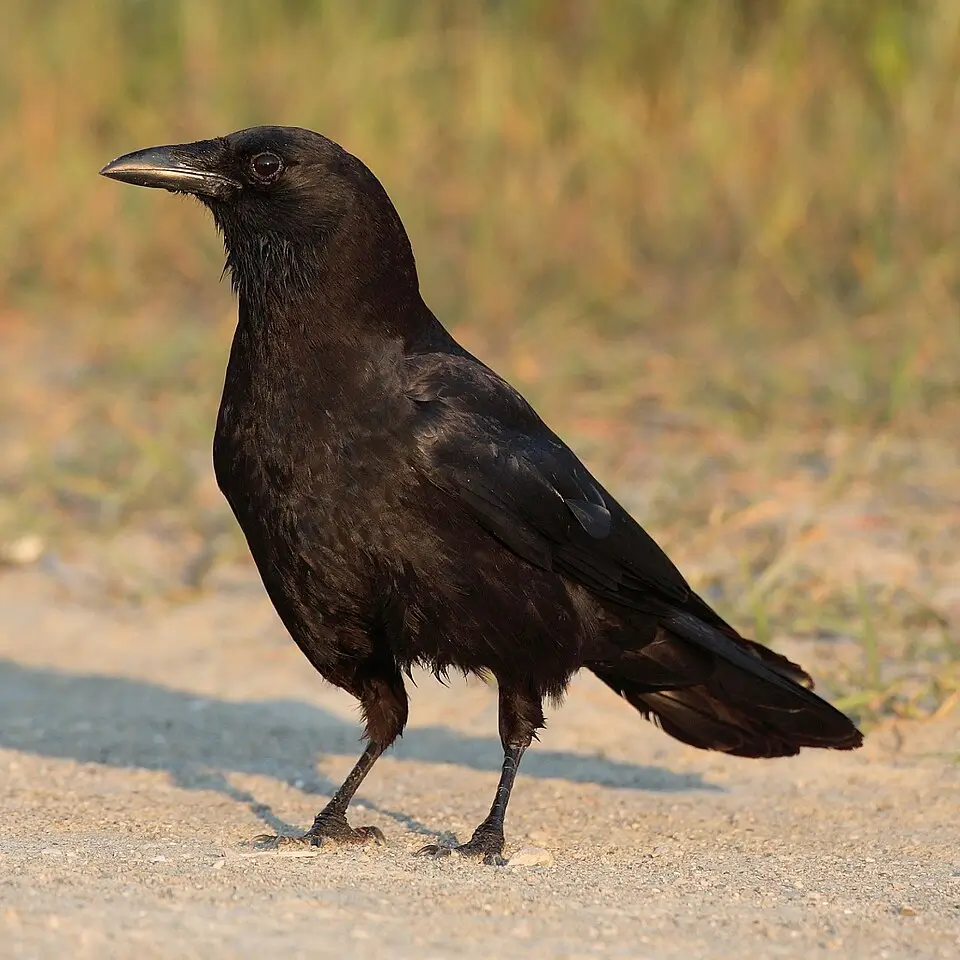
Physically, the American crow is a solidly built, all-black bird. Its plumage has an iridescent quality in good light, showing hints of purple and blue sheen across the wings and back. Adults are typically around 17 to 21 inches in length, with a wingspan that can range from roughly 33 to 39 inches. The bill is strong, slightly curved, and well-suited to the bird's omnivorous diet. The tail is fan-shaped, which helps distinguish crows from the larger and more solitary common raven (Corvus corax), which has a distinctly wedge-shaped tail.
The voice of the American crow is iconic — a loud, raucous "caw" that carries far across open landscapes. However, crows are capable of a surprisingly wide range of vocalizations, including rattles, clicks, and mimicry of other birds and sounds. Crow calls serve many functions, from alerting flock members to the presence of predators to coordinating group movements and maintaining social bonds.
American crows are highly social birds. They typically live in family groups, and young birds from previous years often help their parents raise subsequent broods — a behavior known as cooperative breeding. Crows build large, cup-shaped nests of sticks and other materials, typically placed high in trees. Clutch sizes generally range from three to six eggs, and both parents participate in incubation and chick-rearing. During fall and winter, individual family groups may merge into enormous communal roosts, sometimes numbering in the thousands or even hundreds of thousands of birds.
Their diet is famously eclectic. American crows are true omnivores, consuming everything from insects, earthworms, frogs, and small mammals to grain, berries, carrion, and human food waste. This dietary flexibility is a major reason for the species' extraordinary success across such a wide range of environments.
Habitat and Range
The American crow is found throughout most of North America, ranging from the Pacific Coast to the Atlantic seaboard and from southern Canada down through the central and southern United States. The species is present year-round across much of its range, though populations in northern areas may shift southward during the harshest winter months.
In West Virginia, the American crow is a year-round resident and a familiar presence across virtually every county in the state. West Virginia's varied terrain — encompassing rugged mountains, fertile valleys, extensive hardwood forests, farms, and suburban edges — creates a mosaic of feeding and nesting opportunities that suits the crow's generalist lifestyle perfectly. The state's mix of agricultural land and forest is particularly attractive, as crows often forage in open fields while retreating to wooded areas to roost and nest.
River corridors and bottomlands throughout West Virginia also serve as important crow habitat, offering a reliable supply of invertebrates, carrion, and plant material. Small towns and even the outskirts of cities like Charleston provide additional foraging opportunities, as crows are well known for their willingness to exploit human-altered environments, including landfills, parking lots, and suburban neighborhoods.
During the winter months, West Virginia may see an increase in crow numbers as birds from farther north augment resident populations. Large communal roosts — sometimes containing thousands of birds — can form during this period, particularly near agricultural areas or urban edges where food is abundant and roosting trees are available.
Hunting Information
Crow hunting has a long and storied tradition in North America, and it remains a popular activity for many hunters across the United States. West Virginia offers opportunities for crow hunting, and the Mountain State's combination of farmland, forested ridges, and river bottoms makes it excellent crow country.
Crow hunting is often considered one of the most challenging and exciting forms of small game hunting available. Crows are notoriously wary and intelligent, and their sharp eyesight and sophisticated social communication make them difficult to approach or fool. Hunters typically employ a combination of decoys, concealment, and electronic or mouth-blown calls to bring birds into range. Crow calling is itself a refined skill — skilled hunters use a variety of calls, including distress calls and owl or hawk imitations, to trigger the crow's instinctive mobbing response, drawing birds in close.
Because crows are federally protected as migratory birds under the Migratory Bird Treaty Act, hunting them is regulated at both the federal and state levels. Hunters in West Virginia should always consult the current West Virginia Hunting Guide for the most up-to-date information on licensing requirements, season dates, and applicable regulations before heading afield. The West Virginia Division of Natural Resources manages hunting seasons and licensing, and purchasing a valid West Virginia hunting license is a required first step for any hunter pursuing crows or other game in the state. Licenses can be purchased conveniently online or through authorized retailers, making the process accessible for both resident and non-resident hunters.
Those new to hunting in West Virginia are encouraged to take advantage of the state's official resources and first-time hunter guides, which can provide valuable information on regulations, safety, and finding quality hunting destinations across this diverse and beautiful state.
Conservation
The American crow is currently listed as a species of least concern by conservation authorities, and its overall population is considered stable and robust. Unlike many other bird species that have experienced significant declines due to habitat loss, development, and other pressures, the American crow has largely thrived in the modern era, in part because of its extraordinary adaptability to human-altered environments.
That said, the American crow has not been without its conservation challenges. The emergence of West Nile virus in North America during the late 1990s had a profound and well-documented impact on crow populations, causing significant mortality across much of the species' range. Crow populations showed declines in many areas following the initial spread of the virus, though populations have since shown signs of recovery and adaptation in many regions.
Crows play meaningful ecological roles in the environments they inhabit. As omnivores and scavengers, they help clean up carrion and control populations of insects and small rodents. Their habit of caching food — burying surplus items for later retrieval — can contribute to seed dispersal and soil disturbance. Their presence also provides benefits for other wildlife, as their alarm calls often alert a wide range of animals to the presence of predators like hawks, owls, and foxes.
Maintaining healthy habitats — including the forests, agricultural lands, and wetlands that support crow populations in West Virginia and beyond — benefits not only crows but the full spectrum of wildlife that shares these ecosystems. Conservation-minded hunters, farmers, and landowners all play a role in sustaining these landscapes for future generations.
Conclusion
The American crow is far more than a common black bird. It is a highly intelligent, socially complex, and ecologically important species that has carved out a successful niche across the length and breadth of North America. In West Virginia, this adaptable bird is a year-round companion to residents who venture outdoors — whether they are hiking the Appalachian highlands, farming the river valleys, or heading out on a crisp autumn morning in pursuit of game. Understanding and appreciating the American crow enriches our experience of the natural world and reminds us of the depth and diversity of wildlife that makes Almost Heaven such a special place.