Overview
Few birds in North America capture the imagination of hunters, birders, and naturalists quite like the American woodcock (Scolopax minor). This remarkable, rotund little bird occupies a fascinating ecological niche — it is technically a shorebird that has abandoned the shore, choosing instead to live deep in moist, forested thickets far from the open water that most of its relatives call home. Secretive by nature, perfectly camouflaged, and most active at dawn and dusk, the American woodcock is simultaneously one of the most elusive and most beloved upland game birds on the continent.
In West Virginia, a state defined by its rugged mountains, dense hardwood forests, and winding river bottoms, the American woodcock finds excellent habitat and a devoted following among hunters and wildlife enthusiasts alike. Known affectionately by various nicknames — "timberdoodle," "bogsucker," "mud snipe," and "Labrador twister" among them — the woodcock has inspired a kind of cult following that few other game birds can claim. Understanding this bird's biology, behavior, and habitat requirements is the first step toward appreciating one of North America's most unique and charismatic species.
Biological Traits
The American woodcock is a member of the sandpiper family Scolopacidae, making it a true shorebird by taxonomy even if its lifestyle tells a very different story. It is the only member of the genus Scolopax native to North America, a lineage it shares with several Old World woodcock species found across Europe and Asia.
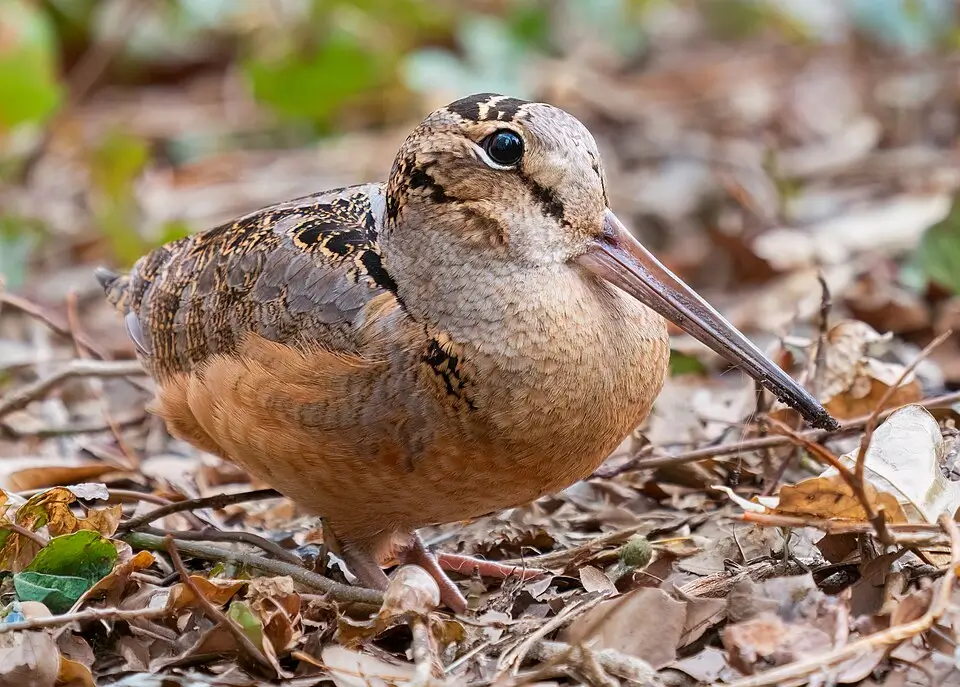
Perhaps the most immediately striking feature of the woodcock is its extraordinary bill — long, slender, and flexible at the tip. This specialized tool is perfectly adapted for probing soft, moist soil in search of earthworms, which make up the vast majority of the bird's diet. The bill's flexible tip, known as a prehensile tip, allows the woodcock to grasp and pull worms from the earth without withdrawing the entire bill from the soil. Sensory receptors near the tip help the bird detect the subtle movements of worms below the surface, making it an extraordinarily efficient forager even in complete darkness.
The woodcock's eyes are positioned remarkably high and far back on its skull, giving it an almost 360-degree field of vision — a critical adaptation for a ground-dwelling bird that spends much of its time feeding in dense cover where predators can appear from any direction. Interestingly, this eye placement means the woodcock actually has a better field of view behind its head than directly in front of it.
The bird's plumage is a masterwork of cryptic coloration. Browns, tans, blacks, and rufous tones blend seamlessly into the leaf litter of the forest floor, making a sitting woodcock nearly invisible to the human eye — and to predators. The head features distinctive dark transverse bars rather than the longitudinal streaking common in many other shorebirds, adding to its unique appearance.
In terms of size, the American woodcock is a compact, stocky bird. It is often described as having a "chunky" or pear-shaped body, with short legs, a short tail, and large, rounded wings that produce a distinctive twittering sound during flight — caused by air passing through the three narrow outer primary feathers. When flushed from cover, its erratic, twisting flight pattern is both surprising and thrilling, a characteristic that has endeared it to generations of upland hunters.
One of the most celebrated aspects of woodcock biology is the male's elaborate springtime courtship display, commonly called the "sky dance." At dusk and dawn, male woodcocks take to open clearings and forest edges to perform their remarkable aerial display. The performance begins with a loud, nasal "peent" call delivered repeatedly from the ground. The male then launches into the sky in a spiraling, rising flight that can reach several hundred feet in altitude, all while producing a melodious, liquid twittering with his wings. At the apex of the flight, the bird circles and then plummets back to earth in a zigzagging descent, landing near the spot from which it launched. This display is one of the great wildlife spectacles of the eastern North American spring, and it draws birdwatchers and naturalists to fields and forest edges every year.
Habitat and Range
The American woodcock is found across much of the eastern half of North America, ranging from the Gulf Coast and Florida in the south to southern Canada in the north. The breeding range extends across the northeastern United States and into the Great Lakes region and southern Canada, while wintering populations concentrate in the southeastern United States, particularly in states along the Gulf Coast.
The species is intimately associated with young, successional forests — particularly stands of alder, aspen, and birch mixed with moist bottomlands and forest openings. Ideal woodcock habitat tends to include a combination of dense shrubby cover for nesting and roosting, moist soil areas with abundant earthworm populations for feeding, and nearby open areas or forest clearings for courtship displays. The species shows a strong preference for areas where early-successional forest meets older, more mature timber, creating the structural diversity that the bird needs across different times of day and different seasons.
West Virginia's landscape is exceptionally well-suited to support American woodcock populations. The state's mountainous terrain creates countless moist hollows, stream bottoms, and alder-choked drainages that serve as prime woodcock habitat. The state's abundant hardwood forests, many of which include areas of younger regenerating growth following timber harvesting or natural disturbance, provide the kind of structural diversity that woodcocks thrive in. River bottomlands along the major drainages of the state are particularly productive areas, as they combine moist, worm-rich soils with the dense shrubby cover the species prefers.
During migration, West Virginia serves as an important corridor for woodcocks moving between their northern breeding grounds and southern wintering areas. The state's position in the central Appalachians places it squarely in the path of migrating birds, and during peak migration periods in fall and spring, hunters and observers can encounter concentrations of woodcocks that far exceed local breeding populations.
Hunting Information
The American woodcock holds a cherished place in the tradition of upland bird hunting in the eastern United States. Hunting woodcock is an experience that blends equal parts patience, athleticism, and an intimate knowledge of the landscape. Because the birds rely so heavily on camouflage and often hold tight when a hunter approaches, flushing them typically requires a good bird dog — pointing breeds and flushing spaniels alike have long been used to locate and move woodcocks from their dense coverts.
Woodcock hunting is regulated at both the federal and state levels in the United States, as the species is classified as a migratory game bird under the Migratory Bird Treaty Act. Federal frameworks set the parameters within which individual states may establish their own season dates and bag limits. Hunters pursuing woodcock in West Virginia should consult the current West Virginia Hunting Guide — which covers licenses, seasons, and regulations — for the most up-to-date and accurate information on season dates, legal shooting hours, and bag limits. The West Virginia Division of Natural Resources manages hunting regulations in the state, and purchasing the appropriate hunting license is required before taking to the field. West Virginia's hunting license purchasing process has become increasingly convenient, with both residents and non-residents able to buy licenses through modern online systems.
Prime woodcock hunting in West Virginia typically coincides with the fall migration, when the local breeding population is augmented by birds moving south from northern states and Canada. Hunters seek out the moist alder runs, rhododendron thickets, and creek bottoms that the birds favor, moving slowly through the cover while working their dogs. The sudden, explosive flush of a woodcock and its twisting, erratic escape flight provides a challenging and memorable shooting opportunity that keeps hunters coming back year after year.
Conservation
The American woodcock faces conservation challenges that are shared by many species dependent on early-successional forest habitats. Across the eastern United States, the maturing of forest landscapes — as former agricultural fields and young woodlands succeed to mature timber — has reduced the amount of young, shrubby forest that woodcock rely on. Long-term population trend data collected through the U.S. Fish and Wildlife Service's annual Singing Ground Survey, which monitors male woodcocks during their spring courtship displays, has indicated declining population trends in parts of the species' range over recent decades.
Conservation efforts for the American woodcock have focused significantly on habitat management — promoting the creation and maintenance of young forest through targeted timber harvesting, prescribed burning, and other management tools. Hunting organizations, conservation agencies, and private landowners have all played important roles in these efforts. The American Woodcock Society, among other organizations, actively works to improve woodcock habitat across the breeding and wintering range.
In West Virginia, the state's diverse and still largely forested landscape provides a strong foundation for woodcock conservation. Continued attention to habitat management — particularly the maintenance of young successional forest and the preservation of moist bottomland areas — will be essential to ensuring that future generations of hunters and wildlife enthusiasts can enjoy encounters with this extraordinary bird.
The American woodcock stands as a reminder of the rich biodiversity that the forests of eastern North America support, and of the deep connections between healthy, well-managed landscapes and the wildlife that depends on them.