Overview
Few birds in North America carry as much cultural mystique as the common snipe (Gallinago gallinago). For generations, the word "snipe" has been woven into the fabric of outdoor lore — from campfire pranks involving "snipe hunts" to the admiring respect earned among serious wingshooters who know just how challenging this bird truly is to pursue. Yet beyond the jokes and legends lies a genuinely remarkable creature: a secretive, cryptically patterned shorebird that has mastered the art of survival across wetlands, bogs, and grasslands spanning much of the Northern Hemisphere.
The common snipe is a bird of genuine biological interest. Its extraordinary bill, explosive flushing behavior, and the haunting, wind-driven sound it produces during courtship displays have fascinated naturalists and hunters alike for centuries. In states like West Virginia — with its mosaic of mountain streams, beaver ponds, marshy meadows, and boggy hollows — the common snipe is a rewarding species to encounter, whether you are a birder, a hunter, or simply someone who appreciates the wild character of the natural world.
This article explores what makes the common snipe so unique, where it lives, how it behaves, and what hunters and wildlife enthusiasts in West Virginia and beyond should know about this extraordinary bird.
Biological Traits
The common snipe (Gallinago gallinago) belongs to the family Scolopacidae — the sandpipers and their allies — making it a member of the broader shorebird group, even though it is frequently found far from open coastlines. It is a medium-sized wading bird, compact and sturdy in build, with a set of physical adaptations that are nothing short of remarkable.
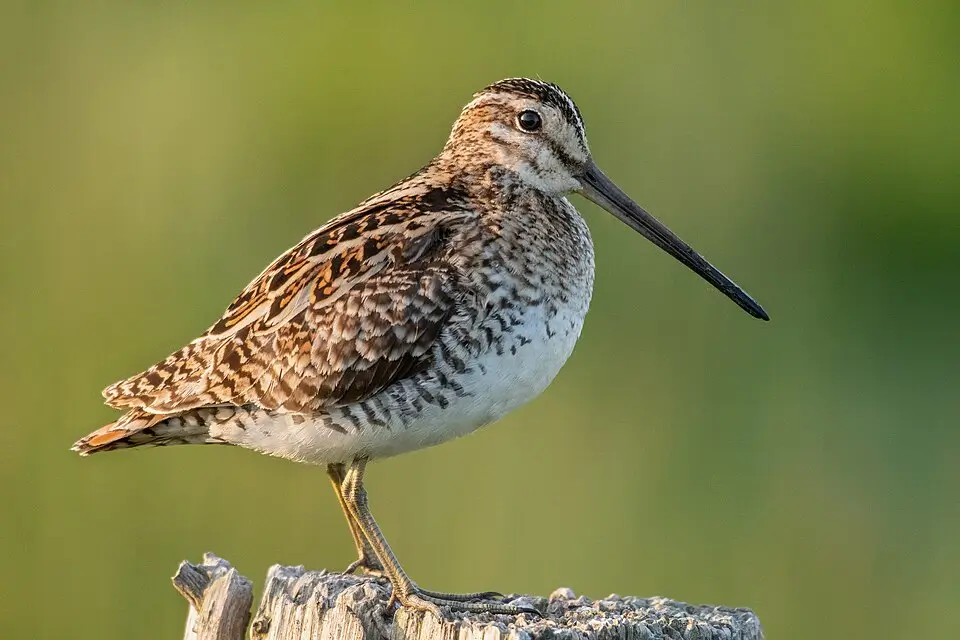
Perhaps the snipe's most iconic feature is its bill. Long, straight, and extraordinarily sensitive, the bill of a common snipe can reach roughly 6 to 7 centimeters in length. The tip of the bill contains a high concentration of nerve endings called Herbst corpuscles, which allow the bird to detect invertebrate prey beneath the soil surface by touch alone — a technique called "rhyncokinesis," in which the bird can flex just the tip of its bill to grasp prey underground without opening its mouth fully. This is a sophisticated evolutionary adaptation that sets snipe apart from many other birds.
The plumage of the common snipe is a masterwork of camouflage. Browns, buffs, tawny oranges, and rich black streaks combine to create a pattern that blends almost seamlessly with the leaf litter, grasses, and muddy substrates of its preferred habitats. Pale supercilium (eyebrow) stripes and dark crown stripes give the bird's head a bold, striped appearance that further breaks up its outline when viewed from above. When a snipe crouches motionless in vegetation, it can be virtually invisible even at close range — a fact that any hunter who has nearly stepped on one can confirm firsthand.
In flight, the common snipe is an entirely different creature. When flushed, it launches into the air with a sudden, explosive burst of wingbeats and immediately begins a rapid, twisting, zigzagging flight that has confounded hunters and frustrated predators for millennia. This erratic escape behavior is no accident; it is a highly evolved anti-predator response that makes the bird exceedingly difficult to track and intercept. The speed and unpredictability of a flushed snipe are the primary reasons that skilled wingshooters regard the common snipe as one of the most demanding targets in upland and wetland hunting.
One of the most enchanting biological aspects of the common snipe is its courtship display, known as "winnowing" or "drumming." During the breeding season, male snipe perform steep aerial dives at twilight and dawn, and as they do, air rushes over their stiffened outer tail feathers to produce a distinctive, pulsing, almost ghostly sound that carries long distances over open wetlands. This sound — sometimes described as a trembling hum or a bleating — has earned the bird folk names like "heather bleater" and "heaven's goat" in various European cultures. It is one of the more magical sounds in the natural world and one that connects a listener directly to the ancient rhythms of wetland ecosystems.
Common snipe are probing feeders that spend much of their time working through soft, moist soils in search of earthworms, insect larvae, crustaceans, and other small invertebrates. They are most active during dawn and dusk, resting in dense cover during the middle of the day. Their eyes are positioned high and far back on their skull, giving them an almost 360-degree field of vision — another adaptation that helps them detect approaching threats from nearly any direction.
Habitat & Range
The common snipe has a broad global distribution, breeding across much of the Palearctic region — from Iceland and the British Isles eastward through Eurasia to Siberia and parts of East Asia. A closely related species, the Wilson's snipe (Gallinago delicata), is the predominant snipe of North America and was long considered the same species as the common snipe. The two are now recognized as distinct species by most ornithological authorities, though they are nearly identical in appearance and behavior.
In terms of habitat, common snipe — and Wilson's snipe in North America — are birds of wet, open to semi-open country. They favor bogs, fens, wet meadows, the edges of marshes and ponds, flood-prone grasslands, and the muddy margins of slow-moving streams and drainage ditches. They require soft, probe-able soil to feed effectively and dense, low ground cover for roosting and shelter.
In West Virginia, habitat of this type can be found in a variety of settings. The state's mountainous terrain supports numerous boggy hollows, beaver-influenced wetlands, and stream-fed meadows that provide exactly the kind of moist, vegetated habitat that snipe require during migration and in winter. The Canaan Valley — a high-elevation wetland complex in Tucker County — is one notable area where snipe habitat is well-developed, and the broader Appalachian landscape of West Virginia supports a patchwork of suitable areas throughout the state.
During migration, snipe can appear almost anywhere there is appropriate habitat, including flooded agricultural fields, sewage treatment ponds, and the margins of farm ponds. They are often found singly or in small loose groups called "wisps," though larger concentrations can occur at productive foraging sites.
Hunting Information
The common snipe — and in North America, Wilson's snipe — has a long and storied history as a game bird. Indeed, the very word "sniper," referring to a skilled long-range marksman, derives from the difficulty of hunting snipe, which were considered so challenging to shoot that only the most capable marksmen could do so consistently.
Hunting snipe in West Virginia requires a valid West Virginia hunting license. As with all migratory bird hunting in the United States, hunters pursuing snipe must also comply with federal migratory bird regulations, which are administered by the U.S. Fish and Wildlife Service and updated on an annual basis. Hunters are strongly encouraged to consult the current West Virginia Hunting Guide — available through the West Virginia Division of Natural Resources — for the most up-to-date information on seasons, bag limits, and licensing requirements before heading afield.
West Virginia offers a good environment for snipe hunting thanks to its diverse wetland habitats and its position along Appalachian migratory corridors. The best hunting typically occurs during the fall migration window when birds are moving through the region. Hunters working marshy edges, wet meadows, and boggy stream corridors with a well-trained pointing or flushing dog will find that snipe hunting is a wonderfully immersive, athletic form of wingshooting. Dogs with a keen nose and steady manner are invaluable for locating and recovering snipe in dense wetland cover.
Successful snipe hunters typically use lightweight shotguns in 20 or 12 gauge, and open chokes — improved cylinder or skeet — are generally recommended to account for the close, fast-moving nature of flushed birds. The lightning-fast, twisting flight of a flushed snipe demands quick reflexes and a smooth, instinctive shooting style. Many experienced wingshooters will candidly admit that the common snipe is among the hardest birds to consistently hit in the field, which is precisely part of its enduring appeal as a game species.
Beyond the shooting itself, snipe hunting offers a full sensory experience: the crunch of frost-edged grasses underfoot in the early morning, the rich smell of wet earth and marsh vegetation, and the electric anticipation of a dog locking up on point. It is a form of hunting that connects practitioners directly to a centuries-old tradition and to some of the most productive and ecologically rich landscapes on the planet.
Conservation
The common snipe and its North American cousin, Wilson's snipe, are not currently considered threatened or endangered. Their broad range and adaptable habits have allowed them to maintain healthy populations across much of their historic range. However, like many wetland-dependent species, snipe are sensitive to habitat loss, particularly the drainage of bogs, fens, and wet meadows for agriculture and development.
Wetland conservation efforts across North America — supported by federal programs, state agencies, and organizations such as Ducks Unlimited — have helped protect and restore significant areas of snipe habitat. Migratory bird hunting regulations, enforced through the federal Migratory Bird Treaty Act and managed cooperatively between the U.S., Canada, and Mexico, provide an important regulatory framework that ensures sustainable harvest levels.
In West Virginia, habitat conservation on both public and private lands plays an important role in supporting snipe populations during migration and wintering periods. The protection and restoration of wetland areas, riparian corridors, and moist grasslands benefits not only snipe but a broad community of wildlife that depends on these productive ecosystems.
For hunters and wildlife enthusiasts alike, the common snipe serves as a compelling ambassador for wetland conservation — a bird whose survival is directly linked to the health of the wet, muddy, sometimes overlooked corners of the landscape that provide so much ecological value.