Overview
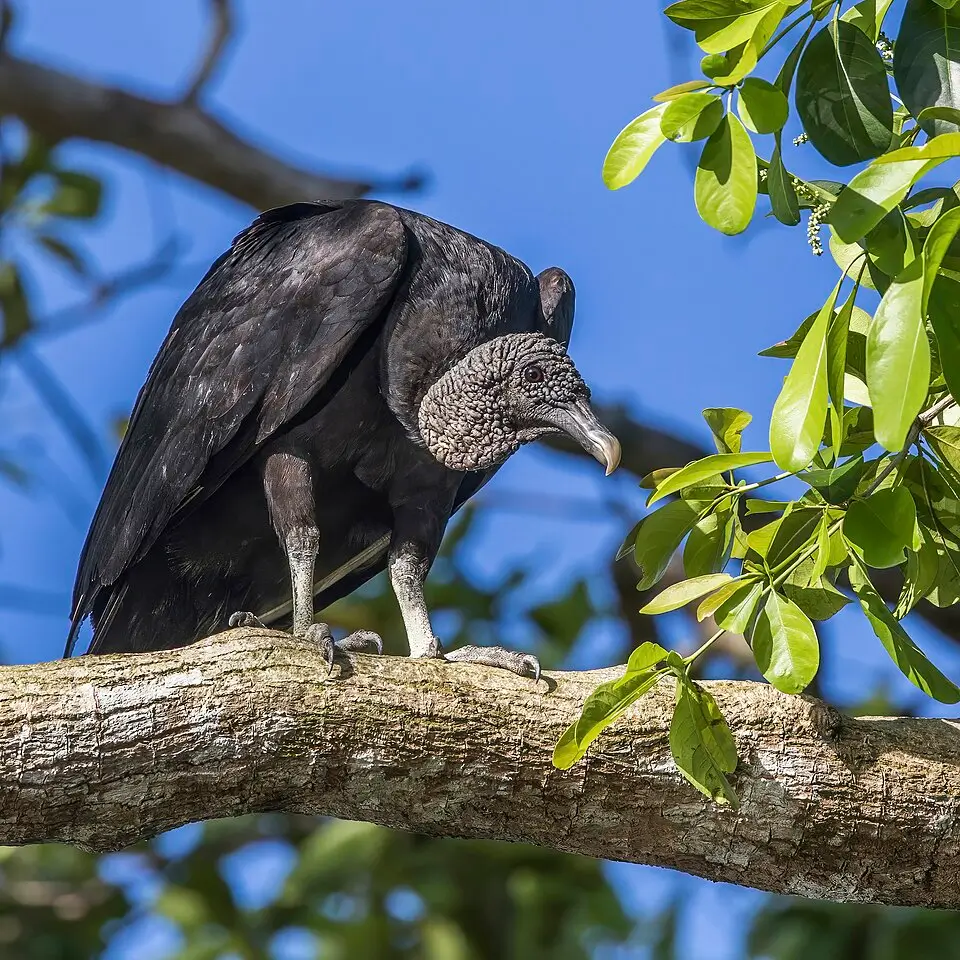
Few birds command as much fascination — or as much misunderstanding — as the Black vulture (Coragyps atratus), one of North America's most recognizable and ecologically vital avian species. With its jet-black plumage, bald gray head, and unmistakable soaring silhouette, the Black vulture is a permanent fixture across much of the Western Hemisphere. Often spotted wheeling lazily on thermal updrafts above open fields, highways, and forested ridgelines, this remarkable bird plays a role in the natural world that is both unique and indispensable.
Despite its somewhat ominous reputation in popular culture, the Black vulture is a creature worthy of genuine admiration. It is a highly social animal, a devoted parent, and a biological marvel engineered by evolution specifically to perform one of nature's most critical tasks: the rapid recycling of carrion. Without vultures like the Black vulture, carcasses would accumulate across the landscape, spreading disease and disrupting entire ecosystems. Understanding this bird — its biology, its behavior, and its place in the environment — offers a window into the elegant complexity of the natural world.
In West Virginia, a state celebrated for its rugged mountains, dense hardwood forests, and abundant wildlife, the Black vulture is a familiar and increasingly common sight. The species has expanded its range northward over recent decades, and today it shares the skies of the Mountain State alongside its close relative, the Turkey vulture (Cathartes aura). For hunters, wildlife enthusiasts, and outdoor adventurers alike, the Black vulture is an essential part of the "Almost Heaven" experience.
Biological Traits
The Black vulture is a member of the family Cathartidae — the New World vultures — and is classified under the order Accipitriformes. Despite superficially resembling Old World vultures found in Europe, Africa, and Asia, New World vultures like the Black vulture are not closely related to those birds. Their similarities are largely the result of convergent evolution, where unrelated species independently develop similar traits in response to comparable ecological pressures.
In terms of physical appearance, the Black vulture is a stocky, medium-to-large bird. Adults typically measure between 22 and 29 inches in length, with a wingspan that can range from approximately 4 to 5 feet. The plumage is uniformly glossy black across the body and wings, while the wingtips display distinctive silvery-white patches that are highly visible during flight. The head and neck are unfeathered and covered in wrinkled, dark gray skin — an adaptation that helps keep the bird clean while feeding inside carcasses and may also help regulate body temperature.
One of the most fascinating aspects of Black vulture biology is its sensory toolkit. Unlike the Turkey vulture, which is renowned for its extraordinary sense of smell and uses olfactory cues to locate food, the Black vulture relies much more heavily on vision. It frequently follows Turkey vultures to carcasses, using them as unwitting guides to food sources. Once at a feeding site, the Black vulture's aggressive social nature often allows it to dominate the carcass, pushing smaller or more passive birds aside.
The Black vulture's digestive system is a biological wonder. Its stomach acid is extraordinarily corrosive — among the strongest found in any vertebrate animal — allowing it to safely consume and neutralize pathogens that would be lethal to most other animals. This includes dangerous bacteria such as anthrax, botulinum toxin, and hog cholera. In this way, the bird acts as a living sanitation system, eliminating disease from the environment simply by eating.
Black vultures are notably social creatures. They roost communally, sometimes in groups numbering in the hundreds, and forage together. They are also among the few bird species known to maintain long-term family bonds. Young birds stay with their parents for extended periods after fledging, and family groups have been observed foraging together consistently. Mating pairs are believed to remain together for multiple seasons, if not for life.
Breeding behavior in Black vultures is similarly distinctive. Unlike most birds, they do not construct a formal nest. Instead, females lay one to three eggs directly on the ground, in hollow logs, inside cave crevices, beneath dense brush, or in abandoned structures. Both parents share incubation duties, and both participate actively in raising the chicks. The young are covered in white downy feathers at hatching and develop their characteristic black plumage over several months.
Habitat & Range
The Black vulture is among the most geographically widespread raptors in the Western Hemisphere. Its range extends from the eastern and southeastern United States southward through Central America and into South America, reaching as far as Uruguay and Argentina. Within North America, the species is most densely concentrated in the southeastern United States, though it has been expanding its range steadily northward.
The species thrives in a diverse array of habitats. It is particularly common in open and semi-open environments such as farmland, pastures, rural roadsides, open woodland edges, and suburban areas. Black vultures tend to avoid dense, unbroken forest interiors, preferring landscapes where open areas provide good soaring conditions and where human activity — farming, ranching, and transportation — increases the availability of carrion. River corridors and wetland edges are also frequently used, as these areas tend to produce reliable food sources.
In West Virginia, the Black vulture occupies a particularly interesting ecological niche. The state's combination of open river valleys, agricultural lowlands, and forested mountain ridges provides a varied landscape that supports healthy vulture populations. The Shenandoah and Potomac river valleys in the eastern part of the state, as well as the broad agricultural valleys of the Eastern Panhandle, are especially productive areas for spotting Black vultures. The species is regularly observed throughout the year in West Virginia, as it does not undertake long-distance migrations the way many other birds do. While some individuals may shift southward during the coldest months, many remain in the region year-round when food resources are sufficient.
Hunting Information
The Black vulture is a federally protected bird under the Migratory Bird Treaty Act of 1918 (MBTA), a landmark piece of wildlife conservation legislation that extends protection to hundreds of migratory bird species across the United States. This federal protection means that Black vultures cannot be hunted, captured, harmed, or killed without a specific federal permit. This applies uniformly across all states, including West Virginia.
As a result, there is no open hunting season for Black vultures in West Virginia or in any other state. No license or tag is issued for their harvest. Hunters and outdoor enthusiasts who encounter Black vultures in the field should appreciate them as protected wildlife and enjoy the observation opportunity they provide.
It is worth noting that, while Black vultures cannot be legally hunted, there are legal mechanisms available for landowners and agricultural producers who experience conflicts with these birds. In cases where Black vultures cause documented damage to livestock or property, USDA Wildlife Services administers a federal depredation permit program that allows authorized individuals to address specific conflict situations. However, this is an administrative process entirely separate from sport hunting and requires documented justification and federal authorization.
For hunters pursuing other game in West Virginia — white-tailed deer, turkey, black bear, or waterfowl — Black vultures can sometimes serve as incidental wildlife indicators. A group of vultures circling or descending near a hunting area may indicate the presence of a carcass, which in turn can attract predators and scavengers worth monitoring.
Conservation
The conservation status of the Black vulture is currently listed as one of Least Concern by the International Union for Conservation of Nature (IUCN), reflecting the species' wide distribution, large overall population, and apparent adaptability to human-modified landscapes. In North America, population trends have generally been stable to increasing, particularly in the northern portions of its range where the species continues to expand.
The Migratory Bird Treaty Act remains the cornerstone of the Black vulture's legal protection in the United States. Enacted in 1918, this legislation has been one of the most effective wildlife conservation tools in American history, protecting hundreds of species from exploitation and commercial harvest. The Black vulture benefits directly from this protection, which shields it from shooting, trapping, and any other form of intentional harm.
Despite its healthy overall numbers, the Black vulture faces ongoing challenges. Collisions with vehicles are a significant source of mortality, as birds frequently feed on road-killed animals and are struck by passing traffic. Lead poisoning from ingesting fragments of lead ammunition in hunter-harvested carcasses and gut piles is another documented threat shared with other vulture and raptor species. Power line electrocution, habitat loss in portions of its range, and human persecution — though illegal — also contribute to mortality.
Conservation-minded hunters and outdoor enthusiasts can support Black vulture populations by being aware of these challenges. The use of non-lead ammunition when hunting helps reduce the risk of inadvertent lead poisoning in scavenging birds. Reporting injured or distressed vultures to state wildlife agencies or licensed wildlife rehabilitators is another meaningful action that individuals can take.
In West Virginia, the Department of Natural Resources (DNR) and various conservation organizations work to protect and monitor non-game wildlife species, including the Black vulture. Citizen science programs such as eBird allow birdwatchers and outdoor enthusiasts to contribute valuable population data by reporting vulture sightings, helping biologists track range shifts and population trends over time.
Conclusion
The Black vulture is a testament to the power of evolutionary specialization and ecological interdependence. From its acid-resistant digestive system to its keen eyesight and complex social bonds, every aspect of this bird's biology is calibrated to fulfill its role as nature's foremost recycler. In West Virginia's diverse and beautiful landscapes, the Black vulture soars as a permanent and protected presence — a reminder that even the most overlooked creatures play a vital part in the web of life that makes wild places worth exploring and defending.
Whether you spot one riding a thermal above a Blue Ridge ridgeline or perched in a bare sycamore tree along the Potomac, take a moment to appreciate the Black vulture for what it truly is: one of nature's most extraordinary and essential birds.