Overview
Few animals embody the rugged spirit of the American West quite like the mule deer (Odocoileus hemionus). With its oversized, mule-like ears that give the species its common name, this remarkable cervid has captured the imagination of wildlife enthusiasts, photographers, and hunters alike for generations. From the sun-baked desert foothills of the Southwest to the high alpine meadows of the Pacific Northwest, mule deer represent one of North America's most recognizable and beloved large mammals.
In states like Washington, where diverse geography creates a tapestry of ecosystems ranging from lush coastal rainforests to stark high-desert shrublands east of the Cascades, mule deer occupy a particularly important ecological and cultural role. They are a keystone prey species for large predators, a vital component of healthy ecosystems, and a prized quarry for hunters who pursue them each autumn through some of the continent's most breathtaking landscapes. Understanding the mule deer — its biology, behavior, habitat preferences, and conservation status — is essential not only for hunters hoping to pursue them successfully but for anyone who appreciates the natural heritage of the American West.
Biological Traits
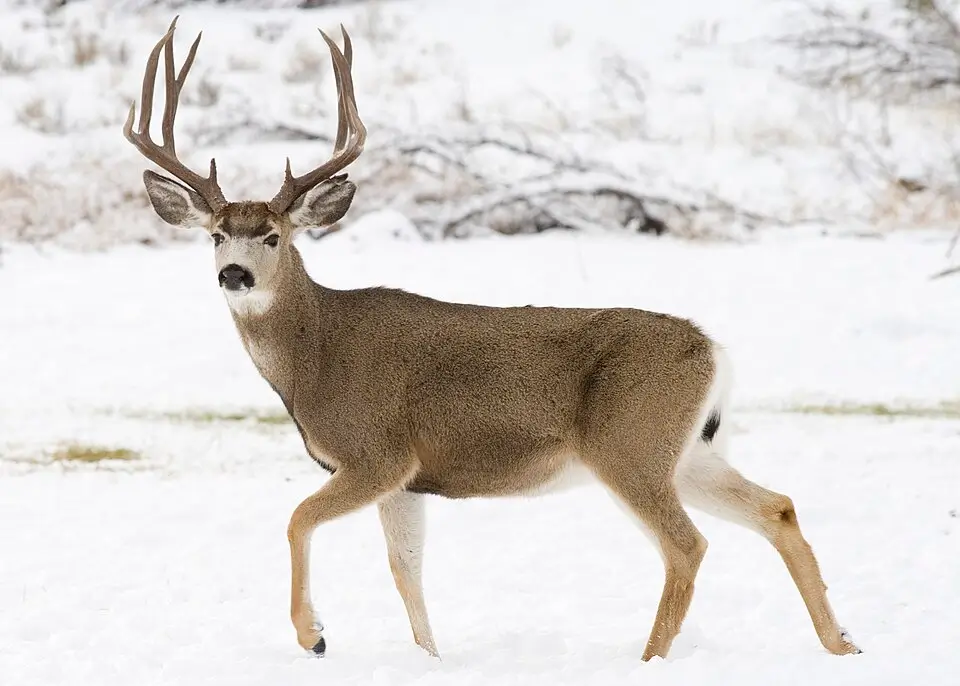
The mule deer (Odocoileus hemionus) belongs to the family Cervidae and is closely related to the white-tailed deer (Odocoileus virginianus), with which it shares a genus. The species name hemionus is derived from the Greek word for "half-mule," a direct reference to the animal's distinctively large ears, which can measure up to 11 inches in length and serve as highly sensitive sound-detection instruments. These ears can rotate independently, allowing the deer to pinpoint sounds from multiple directions simultaneously — an invaluable survival tool in open terrain.
One of the most distinctive physical features that separates mule deer from their white-tailed cousins is the tail. Mule deer sport a narrow, rope-like tail with a black tip, in sharp contrast to the broad, white "flag" tail of a white-tailed deer. Their antlers are also notably different: mule deer antlers bifurcate, or fork evenly, as they grow upward, creating a symmetrical, branching structure. White-tailed deer antlers, by contrast, feature a main beam with individual tines projecting upward from it.
Mule deer are medium-to-large ungulates. Adult bucks are significantly larger than does, as is common among cervids. Bucks carry their impressive antlers from spring through early winter, shedding them annually after the rut — the autumn breeding season — concludes. During the rut, bucks become highly active, traveling widely in search of receptive does and engaging in sparring contests with rival males. The rut typically peaks in November across much of the mule deer's range, though timing can vary slightly by region and elevation.
Does typically give birth to one or two fawns in late spring or early summer, following a gestation period of approximately 200 days. Fawns are born with spotted coats that provide excellent camouflage among dappled vegetation, and they are capable of standing and nursing within hours of birth. Twins are common when food resources are plentiful, and a healthy doe in good condition may successfully raise both fawns to independence.
Mule deer are crepuscular animals, meaning they are most active during the twilight hours of dawn and dusk. During midday, they commonly seek shade in brushy draws, timber stands, or rocky terrain. Their diet is highly varied and opportunistic, consisting primarily of forbs, shrubs, grasses, and browse — the woody stems and leaves of shrubs and trees. Sagebrush is a particularly important food source across much of their range, especially during the lean winter months when other vegetation is unavailable. In summer, mule deer often seek out lush, high-elevation meadows where nutritious forbs are abundant.
The species is further divided into several recognized subspecies, including the Rocky Mountain mule deer (O. h. hemionus), the desert mule deer (O. h. crooki), the California mule deer (O. h. californicus), and the Columbian black-tailed deer (O. h. columbianus), among others. The black-tailed deer, found in coastal regions of the Pacific Northwest including western Washington, is considered a subspecies of mule deer and shares much of its behavioral and biological heritage with its inland relatives.
Habitat & Range
Mule deer are remarkably adaptable animals, inhabiting a wide variety of terrain types across western North America. Their range extends from the coastal forests of British Columbia and the Pacific Northwest southward through the Rocky Mountains and Great Basin, all the way to the deserts of northern Mexico. They are found at elevations ranging from sea level along the Pacific Coast to well above 10,000 feet in the high Rockies.
In Washington state, mule deer are primarily found east of the Cascade Mountains, where the landscape transitions from dense coniferous forest to open shrub-steppe, ponderosa pine parklands, and rugged canyon country. The Columbia Plateau, Okanogan Highlands, and the breaks and coulees carved by rivers like the Columbia, Snake, and Methow provide classic mule deer habitat — open ground punctuated by rocky outcroppings, sagebrush flats, and scattered timber.
Mule deer are well known for their seasonal migrations, often traveling substantial distances between summer and winter ranges. In mountainous regions, deer may spend the warmer months at high elevations, where cooler temperatures and abundant forage provide ideal summer conditions. As winter approaches and snowpack begins to build, they migrate downslope to lower-elevation winter ranges where food remains accessible. These migration corridors, which can span dozens of miles, are critical to the long-term health of mule deer populations and represent an important conservation consideration as human development expands across the West.
Hunting Information
Hunting mule deer is a deeply rooted tradition across the American West and represents one of the most popular and storied pursuits in big-game hunting. In Washington state, mule deer hunting takes place primarily in the eastern portions of the state, where populations are most concentrated. Hunters seeking mule deer in Washington should consult the Washington Department of Fish and Wildlife (WDFW) for current season dates, unit-specific regulations, licensing requirements, and any applicable permit or tag systems, as these details change from year to year and vary by wildlife management unit.
Mule deer hunting typically coincides with the onset of cooler autumn weather and the approach of the rut, when bucks become more visible and active. Glassing — the practice of using binoculars or spotting scopes to scan open hillsides and canyon rims from a distance — is perhaps the most effective and widely used technique for locating mule deer in the open terrain they prefer. Unlike whitetails, which often rely on heavy cover for security, mule deer tend to inhabit more open country and can frequently be spotted from significant distances with quality optics.
Still-hunting, spot-and-stalk, and stand hunting near known travel corridors, water sources, or feeding areas are all productive strategies depending on the terrain and time of season. Mule deer bucks are known for their habit of stopping to look back when alarmed rather than immediately fleeing — a behavioral trait that can work in a hunter's favor when executing a careful stalk. Their preference for rocky, broken terrain means that physical fitness and the ability to navigate rugged country are important assets for any mule deer hunter.
Archery hunters pursuing mule deer enjoy extended seasons in many management units, often beginning in early September when bucks are still in velvet or have just shed it. Rifle hunters typically take to the field in October and into November, with the timing often aligned to overlap with pre-rut and rut activity. Muzzleloader seasons provide yet another opportunity for those who enjoy the challenge of close-range hunting with traditional equipment.
Washington hunters are encouraged to check in with the WDFW well in advance of the season to understand current regulations, unit boundaries, and any special requirements. Obtaining the appropriate license and tags before heading afield is essential, as regulations can vary significantly between general season and special permit units.
Conservation
The conservation status of mule deer in North America reflects both the resilience of the species and the ongoing challenges it faces in a rapidly changing landscape. Mule deer populations are managed by state and provincial wildlife agencies throughout their range, with considerable attention paid to habitat quality, predator-prey dynamics, disease, and the impacts of drought and severe winters on population health.
Healthy mule deer populations depend on the preservation and connectivity of both summer and winter ranges, as well as the migration corridors that link them. Urban and agricultural development, highway construction, and energy infrastructure can fragment these corridors, isolating populations and reducing their long-term genetic diversity and resilience. Conservation organizations, wildlife agencies, and state governments have increasingly recognized the importance of protecting key migration routes and working with landowners to maintain habitat connectivity across the landscape.
Hunters have historically played a central role in funding and advocating for mule deer conservation. License fees, tags, and excise taxes on hunting equipment collected under the Federal Aid in Wildlife Restoration Act (commonly known as the Pittman-Robertson Act) provide critical funding for wildlife management, habitat acquisition, and population monitoring. Organizations dedicated to mule deer conservation work alongside agencies to restore degraded habitat, reduce barriers to migration, and conduct research that informs sound management decisions.
In Washington, the WDFW actively manages mule deer populations through regulated hunting seasons, habitat programs, and ongoing population surveys. The state's diverse geography, from the shrub-steppe of the Columbia Basin to the forested highlands of the Okanogan, provides a range of habitat types that support healthy deer populations when managed thoughtfully and protected from excessive degradation.
The future of mule deer in the West depends on the continued commitment of hunters, conservationists, landowners, and wildlife managers working together to safeguard the habitat, water, and open landscapes that these animals need to thrive. With careful stewardship, the mule deer will continue to roam the canyons, ridgelines, and sagebrush flats of Washington and the broader American West for generations to come.