Overview
Few birds capture the spirit of the Pacific Northwest's wild landscapes quite like the grouse of the genus Dendragapus. These striking, forest-dwelling upland game birds occupy the rugged mountain forests and subalpine zones stretching from the coastal ranges to the high Cascades, making them an iconic species for wildlife enthusiasts and hunters alike. Known colloquially as "blue grouse" — a name still widely used by hunters and naturalists throughout the region — birds of the genus Dendragapus represent some of the most fascinating and sought-after upland game in North America.
Washington State, nestled in the heart of the Pacific Northwest, provides some of the most spectacular habitat for these birds on the continent. From the fog-draped forests of the Olympic Peninsula to the towering conifer stands of the eastern Cascades, Washington's wild terrain is tailor-made for Dendragapus grouse. Understanding these birds — their biology, their habits, and their place in the broader ecosystem — deepens the appreciation of anyone lucky enough to encounter them in the field, whether they carry binoculars or a shotgun.
Biological Traits
The genus Dendragapus belongs to the family Phasianidae, the large and diverse family that includes pheasants, turkeys, quail, and other grouse. Within North American upland birds, Dendragapus grouse are considered medium-to-large in size, with adult males being noticeably bigger and more dramatically colored than females — a trait common across many grouse species.
The genus Dendragapus is broadly divided into two closely related species: the Dusky Grouse (Dendragapus obscurus) and the Sooty Grouse (Dendragapus fuliginosus). For much of the 20th century, these two birds were classified together as a single species under the name "Blue Grouse," but taxonomic revisions separated them based on differences in genetics, vocalizations, and geography. The split is now widely recognized by ornithological authorities, including the American Ornithological Society. Despite their formal separation, the two species are strikingly similar in appearance and behavior, and many hunters and wildlife observers continue to refer to them collectively as "blue grouse" in casual conversation.
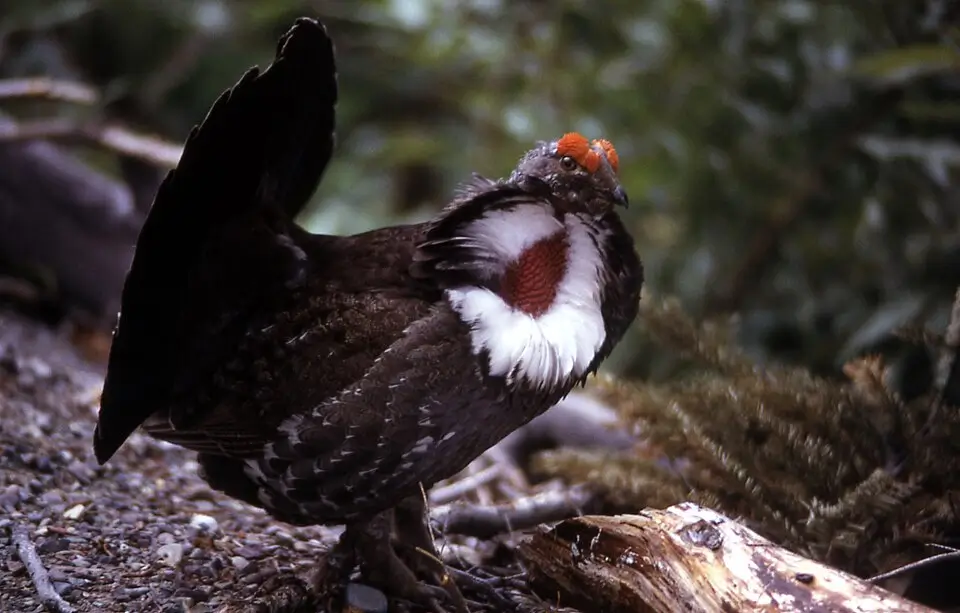
Male Dendragapus grouse are handsome birds, displaying predominantly gray and blue-gray plumage across the body, accented with brown and black vermiculations on the back and wings. The tail is relatively long and fan-shaped. One of the most distinctive features of the male is the colorful bare skin patches on the neck, known as cervical apteria or air sacs, which are inflated during courtship displays. Depending on the species, these patches may appear yellow-orange or red-purple, bordered by white-tipped feathers that fan outward during display. The male's hooting call — a series of deep, resonant booming notes — can carry surprisingly far through dense forest, and tracking down a hooting male is a memorable experience for any naturalist.
Females, by contrast, are cryptically patterned in mottled brown, black, and buff — excellent camouflage for a bird that nests on the ground and must avoid detection by predators while incubating eggs. This sexual dimorphism is a hallmark of the species and reflects the different survival pressures faced by each sex.
One of the most remarkable behavioral traits of Dendragapus grouse is their seasonal altitudinal migration, which is unusual among North American birds and virtually unique among grouse. Unlike most wildlife that descends to lower elevations in winter, blue grouse do the opposite — they move upslope as cold weather arrives, spending the harshest months of the year in the highest conifer forests, where they subsist almost entirely on conifer needles. This counterintuitive strategy allows them to exploit a food source — fir, pine, and spruce needles — that few other animals can digest efficiently, while simultaneously avoiding the deep snows and predator activity of lower elevations.
In summer, Dendragapus grouse return to lower elevations, where breeding takes place and chicks are raised on a diet rich in insects and herbaceous vegetation. The shift in diet from summer to winter is dramatic: from protein-rich invertebrates and berries to a near-exclusive reliance on conifer needles. Their digestive system is well adapted to this seasonal switch, with an enlarged cecum that helps break down the tough, resinous plant material.
Breeding occurs in spring, with males establishing territories and performing their elaborate hooting displays from prominent perches in trees or on the ground. Females are largely solitary nesters, scraping a shallow depression among forest debris and laying a clutch of eggs that they incubate alone. Chicks are precocial — meaning they are covered in down and capable of moving about and feeding themselves shortly after hatching — and they grow rapidly through the summer months.
Habitat & Range
Dendragapus grouse are fundamentally birds of western North American conifer forests. Their range extends from southeastern Alaska and British Columbia southward through the Cascades and Sierra Nevada of the western United States, as well as through the Rocky Mountains as far south as New Mexico and Arizona. The two species divide this range roughly along geographical lines: the Sooty Grouse (D. fuliginosus) occupies coastal and near-coastal mountain ranges, while the Dusky Grouse (D. obscurus) is more associated with the interior Rocky Mountain ranges.
In Washington State, both species have a presence, with the Sooty Grouse being particularly associated with the Cascade Range and the Olympic Mountains. These birds thrive in mature and old-growth conifer forests dominated by species such as Douglas fir, western hemlock, Engelmann spruce, and subalpine fir. Openings in the forest, forest edges, and avalanche chutes provide important foraging habitat during the warmer months, where grouse can find the berries, clover, and insects that supplement their diet.
Washington's diverse topography — ranging from sea-level rainforests on the Olympic Peninsula to the high volcanic peaks of the Cascades — supports Dendragapus populations across a wide variety of forest types. The state's extensive public lands, including national forests and wilderness areas, provide vast swaths of undisturbed habitat that sustains healthy grouse populations.
Hunting Information
Dendragapus grouse, commonly pursued under the banner of "blue grouse" hunting, represent a cherished upland hunting tradition across the Pacific Northwest, including Washington State. Hunting blue grouse is often described as one of the most scenic and physically demanding forms of upland bird hunting, given the mountainous terrain these birds inhabit. Hunters typically pursue them on foot, hiking through steep conifer forests and open subalpine meadows during the fall season.
Washington State does offer hunting opportunities for blue grouse, and interested hunters should consult the Washington Department of Fish and Wildlife (WDFW) for the most current and accurate season dates, bag limits, and licensing requirements. Regulations can vary by region, game management unit, and year, so it is essential to verify the specific rules that apply to your intended hunting area before heading afield. The WDFW publishes updated hunting pamphlets and online resources each season.
In terms of approach, blue grouse are often hunted without the assistance of pointing or flushing dogs, though well-trained bird dogs can certainly be an asset. These birds have a reputation for being less wary than many other upland species — a trait sometimes humorously described as "foolish" by hunters — and they may hold tight or even allow hunters to approach at close range before flushing. Their tendency to perch in conifers when pressured can make them unusually visible targets compared to birds that flush and disappear into dense brush.
Early in the season, when birds are concentrated at lower elevations and temperatures are still mild, can be an excellent time to hunt. As the season progresses and birds move upslope, accessing them may require more strenuous hiking. Lightweight upland gear, sturdy boots, and a willingness to cover rugged mountain terrain are the hallmarks of a successful blue grouse hunter.
Conservation
Dendragapus grouse are not currently considered threatened or endangered at the species level. Their populations are generally considered stable across much of their range, supported by the vast expanses of conifer forest that characterize the mountainous West. However, like all wildlife, they are not entirely immune to the pressures of habitat change, including timber harvest practices, wildfire, and long-term shifts in forest composition associated with climate change.
Conservation of Dendragapus grouse is closely tied to the conservation of old-growth and mature conifer forests. Maintaining large, connected blocks of forest habitat that support the full range of the birds' seasonal movements — from summer breeding areas at mid-elevations to winter refugia in high subalpine forests — is key to ensuring healthy populations for future generations. Responsible hunting, thoughtful land management, and ongoing wildlife monitoring by agencies like the WDFW all play important roles in sustaining these magnificent birds.
Washington's commitment to managing its extraordinary natural landscapes, including the national forests, state forests, and wilderness areas that provide prime Dendragapus habitat, is a strong foundation for the long-term conservation of blue grouse and countless other species that share their forest home.