Overview
Few birds in the sporting world carry the kind of mystique and cultural weight of the common snipe. Long the subject of jokes, tall tales, and even the origin of the word "sniper," this remarkable shorebird has earned a reputation as one of the most challenging quarry a wing shooter can pursue. Yet beyond its fame in hunting lore, the common snipe — known scientifically as Gallinago gallinago — is a genuinely fascinating creature, a master of camouflage, a long-distance migrant, and an ecological indicator of healthy wetland habitats.
In Washington State, situated in the heart of the Pacific Northwest, the common snipe finds an ideal combination of coastal marshes, inland bogs, river floodplains, and agricultural wetlands that support both resident and migratory populations. For birders, hunters, and naturalists alike, the common snipe represents one of the region's most rewarding wildlife encounters — whether you are watching one probe the mud with its long bill at the edge of a beaver pond or flushing one from a grassy marsh edge on a crisp autumn morning.
This guide explores everything you need to know about the common snipe: its biology, behavior, habitat preferences, hunting traditions, and conservation status. Whether you are a seasoned snipe hunter or a curious naturalist encountering this bird for the first time, there is always more to discover about Gallinago gallinago.
Biological Traits
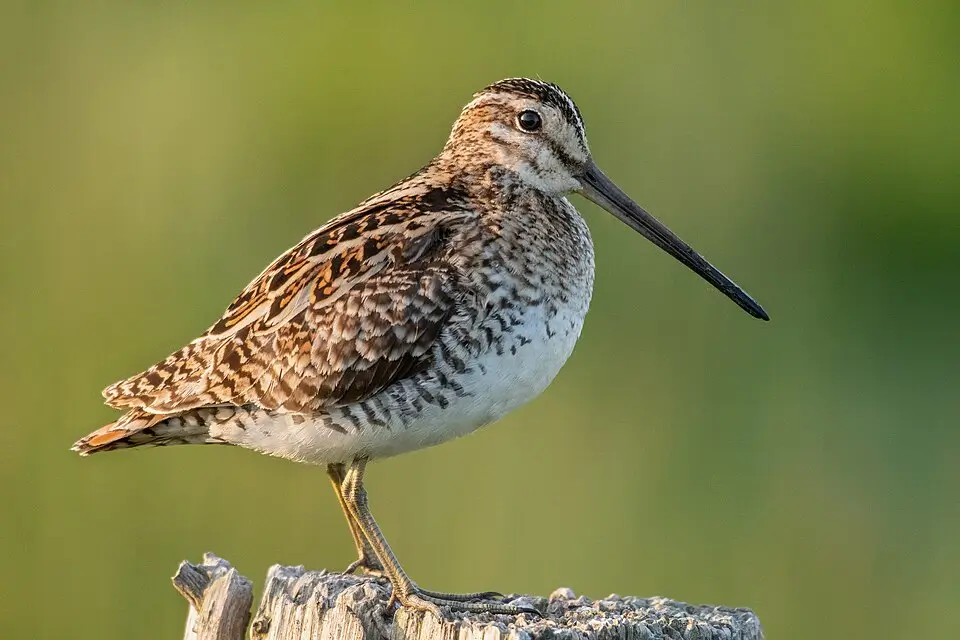
The common snipe is a medium-sized wading bird belonging to the family Scolopacidae, the same family that includes woodcocks, curlews, and sandpipers. It is a compact, well-camouflaged bird, featuring a complex pattern of brown, black, buff, and white streaking across its upperparts that renders it virtually invisible against a backdrop of dead grass and muddy wetland edges.
One of the snipe's most distinctive physical features is its extraordinarily long, straight bill, which can account for a significant proportion of the bird's total body length. This bill is not merely for show — it is a precision instrument, packed with sensitive nerve endings near the flexible tip that allow the bird to detect and grasp invertebrate prey buried deep in soft mud or saturated soil. This feeding strategy, known as "stitching" or probing, allows snipe to locate earthworms, insect larvae, crustaceans, and other small invertebrates entirely by touch, without needing to see their prey directly.
The bird's eyes are set high and far back on its rounded head, providing an almost panoramic field of vision that makes it extremely difficult to approach without detection. This wide visual field, combined with cryptic plumage, makes the common snipe one of the wariest birds in the wetlands.
When flushed, the common snipe explodes from cover in a rapid, erratic, zigzagging flight pattern that has long confounded hunters and predators alike. The bird typically utters a sharp, raspy "scaipe" call as it bursts into the air, then veers unpredictably before eventually dropping back into cover some distance away. This evasive flight behavior is the very reason the term "sniper" entered the English language — a marksman skilled enough to hit a flying snipe was considered to possess extraordinary shooting ability.
During the breeding season, the common snipe performs one of the most unusual and haunting displays in the bird world: "drumming" or "winnowing." In this aerial courtship display, the male climbs high into the sky and then dives steeply, spreading his stiffened outer tail feathers so that the rushing air vibrates them, producing a distinctive hollow, pulsating sound often compared to the bleating of a goat. In many parts of Europe, the common snipe is still called the "heather bleater" or "sky goat" in local dialects, a testament to how evocative this sound is.
The species is generally solitary outside of the breeding season, though loose aggregations — known as a "wisp" of snipe, one of the more poetic collective nouns in birdwatching — can sometimes be found in particularly productive wetland habitats.
Habitat & Range
The common snipe has an impressively broad global range, breeding across much of the Palearctic region from Iceland and the British Isles eastward through Russia and Siberia, as well as across much of northern and central North America. Wintering populations are found in southern Europe, Africa, southern Asia, and across much of the southern United States and Central America.
The species thrives in a wide variety of wetland environments, showing a particular affinity for areas where soft, saturated soil is accessible for probing. Key habitats include freshwater and brackish marshes, bogs, fens, wet meadows, river floodplains, agricultural fields with seasonal flooding, the margins of ponds and streams, and coastal estuaries. The common thread running through all preferred snipe habitats is moisture — specifically, soft wet ground where the bird can insert its bill without obstruction and find abundant invertebrate prey.
In Washington State, the landscape offers an exceptional diversity of snipe-friendly habitats. The western part of the state, receiving abundant Pacific rainfall, supports rich networks of lowland marshes, river deltas, and coastal wetlands where snipe can be found from late summer through early spring. The Skagit Valley, Willapa Bay area, the Columbia River lowlands, and numerous wildlife refuges across the state provide critical stopover and wintering habitat for migrating snipe traveling the Pacific Flyway. Eastern Washington, with its irrigated agricultural valleys, natural lakes, and river systems, also supports snipe during migration and, in some wetter areas, during the breeding season as well.
The Olympic Peninsula's rain-soaked lowlands and the Puget Sound basin's extensive wetland networks are particularly notable for snipe activity during the autumn migration. Birders and hunters familiar with the region know to search the grassy edges of wet fields, flooded pastures, and shallow marsh margins where snipe prefer to feed.
Hunting Information
The common snipe has been a prized game bird for centuries, cherished by hunters for the incredible challenge it presents in the field. Long before modern wing shooting became a popular pastime, market hunters in Europe and North America pursued snipe in enormous numbers, and the bird's table quality — lean, flavorful, and considered a delicacy — added to its desirability. Today, snipe hunting is a far more selective and conservation-minded pursuit, with regulated seasons and bag limits in place across North America.
In Washington State, snipe hunting opportunities are generally tied to the migratory bird hunting framework administered at both the federal and state levels. Hunters interested in pursuing common snipe in Washington should consult the Washington Department of Fish and Wildlife (WDFW) for the most current season dates, bag limits, and license requirements, as regulations change from year to year and may not be available at the time of this writing. A valid Washington State hunting license and a Federal Migratory Bird Hunting and Conservation Stamp (commonly known as the Duck Stamp) are typically required to hunt migratory birds, including snipe, in Washington.
The method of hunting snipe in Washington and throughout North America typically involves walking through suitable wetland habitat — wet meadows, marsh edges, flooded agricultural fields — and flushing birds within shooting range. Pointing dogs, particularly breeds with a soft mouth and strong nose, can be extremely effective at locating and holding snipe in cover, though the birds' tendency to run ahead of a dog rather than hold tight makes them a true test of a dog's abilities. Flushing breeds and retrievers are also used successfully, particularly in denser cover.
Because of the snipe's explosive, unpredictable flush and erratic flight, open-choke shotguns and appropriately sized shot loads are recommended. The challenge of consistently hitting snipe in flight is the reason the birds have historically separated accomplished wing shots from casual hunters, and success in the field requires patience, quick reflexes, and a thorough knowledge of the bird's habits.
Access to good snipe habitat is often the greatest challenge facing the modern snipe hunter in Washington. Hunters are encouraged to research public land options, including state wildlife areas and national wildlife refuges where bird hunting is permitted, and to always obtain proper permission before accessing private property.
Conservation
The common snipe is currently listed as a species of Least Concern by the International Union for Conservation of Nature (IUCN), reflecting its broad global range and large overall population. However, like many wetland-dependent species, the common snipe faces ongoing pressures from the continued loss and degradation of wetland habitats across its range.
Wetland drainage for agriculture, urban development, and water management has reduced available snipe habitat in many parts of North America and Europe over the past century. Climate change presents additional challenges, particularly in northern breeding areas where changes in precipitation patterns and permafrost dynamics may alter the availability of suitable nesting habitat. However, significant conservation efforts focused on wetland protection and restoration — including programs supported by Duck Stamp revenues, conservation organizations, and state wildlife agencies — have helped preserve and restore critical habitats that benefit snipe along with dozens of other wetland-dependent species.
In Washington State, the protection of the Pacific Flyway's wetland network is of great importance to migratory shorebirds including the common snipe. State and federal wildlife refuges, conservation easements on agricultural lands, and voluntary wetland restoration programs all contribute to maintaining the healthy wetland ecosystems that snipe depend upon throughout their annual cycle.
Hunters, birders, and conservationists share a common interest in the well-being of the common snipe and the wetlands it calls home. The purchase of hunting licenses and Federal Duck Stamps directly funds habitat conservation, making hunters some of the most significant financial supporters of the very ecosystems that sustain snipe populations.