Overview
Few birds capture the imagination of hunters and wildlife enthusiasts quite like the Common pheasant. With its spectacular plumage, explosive flush, and challenging nature as a game bird, Phasianus colchicus has earned a devoted following across the globe. In Washington State — nestled in the stunning Pacific Northwest of the United States — the Common pheasant holds a cherished place in the hearts of sportsmen and women who venture out each season into the rolling farmlands, river bottoms, and shrub-steppe habitats that define much of this diverse state.
The Common pheasant is one of the most widely hunted game birds in the world, and its story is a fascinating blend of natural history, human introduction, and wildlife management. From the rolling hills of eastern Washington to the agricultural valleys of the western part of the state, this bird has found a home far from its native range, thriving in landscapes that mirror the open grasslands and forest edges it naturally favors. Whether you are a seasoned upland hunter or simply a nature lover hoping to catch a glimpse of a brilliantly colored rooster strutting through a field at dawn, the Common pheasant is a species worthy of deep appreciation.
Biological Traits
The Common pheasant, known scientifically as Phasianus colchicus, belongs to the family Phasianidae, which also includes turkeys, grouse, partridges, and peacocks. This family is celebrated for producing some of the most visually striking birds on Earth, and the Common pheasant is no exception.
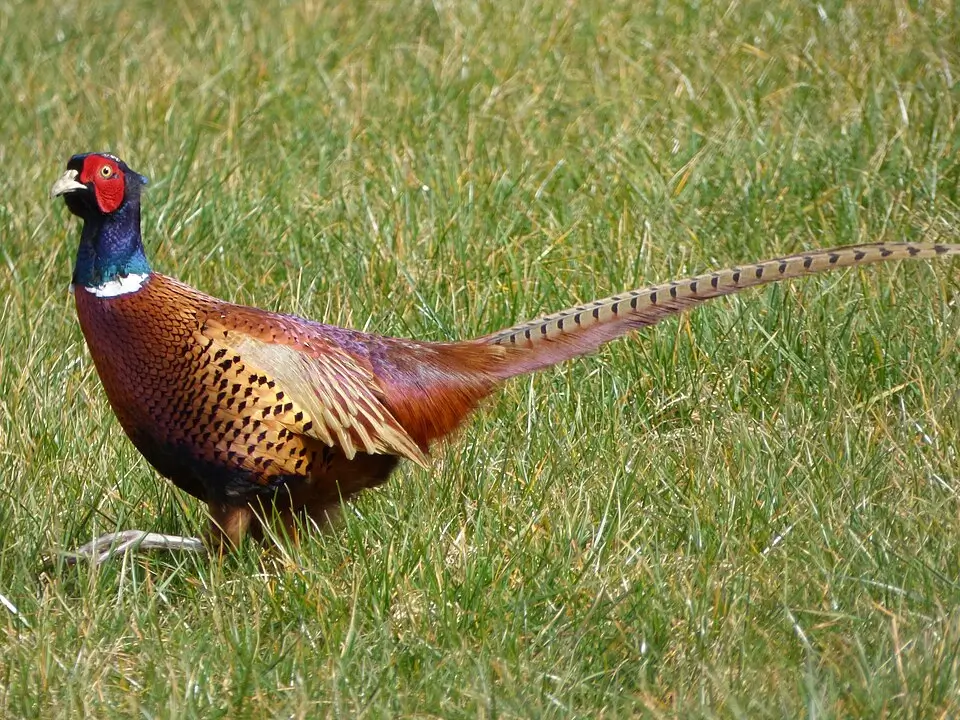
Male pheasants — referred to as roosters or cocks — are among the most visually stunning birds found in North American fields today. They are characterized by their rich, iridescent plumage that combines deep chestnut browns, burnished golds, and striking greens. Perhaps most iconic is the rooster's bright red facial wattle and the distinctive white ring around the neck, a feature that reflects the influence of the Chinese ring-necked subspecies (P. c. torquatus) that was widely introduced across North America. Long, elegantly barred tail feathers complete the rooster's impressive silhouette, making him unmistakable even at a distance.
Female pheasants, known as hens, are considerably more subdued in appearance — a trait common among many bird species where camouflage serves a vital protective purpose during nesting. Hens display mottled brown and buff tones that allow them to blend seamlessly into grassy and brushy environments, making them nearly invisible to predators while they incubate their eggs on the ground.
Common pheasants are polygamous birds. During the breeding season, dominant roosters establish territories and attract harems of hens. A single rooster may mate with several hens within his territory, crowing loudly and performing elaborate displays to assert dominance and attract mates. The crow of a rooster pheasant — a loud, guttural two-note call often accompanied by a rapid wing-beat — is one of the most recognized sounds of rural North America.
Hens typically lay clutches of around 8 to 15 eggs in shallow ground nests hidden in tall grass or dense vegetation. Incubation lasts approximately 23 to 28 days, and the precocial chicks are capable of following their mother and foraging for insects almost immediately after hatching. As they mature, young pheasants shift toward a diet that includes seeds, grains, berries, and a variety of plant material, making them well adapted to agricultural landscapes where food is abundant.
Pheasants are strong, fast fliers capable of reaching impressive speeds in short bursts, though they tend to prefer running to escape threats when given the option. This behavioral tendency — combined with their explosive, loud flush when finally taking wing — is a large part of what makes them such an exciting and demanding quarry for hunters and their dogs.
Habitat & Range
The native range of Phasianus colchicus stretches across a vast swath of Asia, from the Caucasus region and parts of Eastern Europe through Central Asia and into China, Korea, and parts of Southeast Asia. The species' very name — colchicus — is a reference to Colchis, an ancient region located along the eastern shores of the Black Sea in what is now the country of Georgia, reflecting the long historical association between this bird and that part of the world.
Over centuries of human history, the Common pheasant was introduced far beyond its native range. It was brought to Europe by the Romans and later spread extensively across the British Isles and continental Europe, where it became a cornerstone of gamebird hunting tradition. In North America, ring-necked pheasants were introduced during the 19th century and quickly established wild populations across a wide range of suitable habitats, from the Great Plains to the Pacific Coast.
In Washington State, the Common pheasant thrives in a variety of landscapes. The agricultural regions of eastern Washington — including the Columbia Basin and the Palouse — provide ideal habitat with their combination of grain fields, irrigation canals, riparian corridors, and brushy draws. These areas offer the pheasant everything it needs: food in the form of spilled grain and weed seeds, protective cover in cattail marshes and shrubby field edges, and reliable water sources.
Western Washington presents different but also suitable habitats, particularly in areas where farming, grasslands, and lowland shrub cover come together. The bird generally favors areas where open fields transition into cover — edges are everything for pheasants, as they provide both foraging opportunities and rapid access to escape cover.
Washington's climate, which ranges from the wet, mild conditions of the Puget Sound region to the drier, continental conditions of the eastern part of the state, supports pheasant populations in different ways. Cold, snowy winters can pose challenges for resident birds, while the relatively mild winters of lower-elevation valleys allow populations to remain stable year after year.
Hunting Information
Pheasant hunting holds a proud tradition in Washington State, attracting hunters from across the region each season. The pursuit of ring-necked pheasants is a classic upland hunting experience that often involves well-trained bird dogs — flushing breeds like Labradors and Spaniels or pointing breeds like German Shorthaired Pointers — working through fields and cover while hunters move in to take the flushing birds.
Hunting pheasants in Washington generally requires appropriate state hunting licenses and upland game bird licenses or permits. Because hunting regulations, season dates, and bag limits are updated annually by the Washington Department of Fish and Wildlife (WDFW), hunters are always encouraged to consult the most current WDFW hunting pamphlet or official website before heading afield. Regulations may vary by region, public land unit, and specific management area, so staying current with the rules is an important part of responsible hunting.
Public hunting opportunities exist across Washington, including on Department of Fish and Wildlife-managed lands, national wildlife refuges, and other public properties. Many pheasant hunters also access private agricultural lands through landowner permission or through organized hunting access programs that encourage landowners to open their property to sportsmen in exchange for certain benefits.
Pheasant hunting is often a social activity, bringing together friends, family, and hunting partners for memorable days afield. The combination of Washington's spectacular scenery, crisp autumn weather, and the thrill of a rooster erupting from the cover makes pheasant season one of the most anticipated times of year for upland enthusiasts across the state.
Conservation
The conservation of Common pheasant populations in Washington and across North America is closely tied to habitat preservation and land management practices. Like many grassland and farmland birds, pheasants have faced challenges associated with changes in agricultural practices, including the loss of hedgerows, field borders, and idle lands that once provided critical nesting and brood-rearing cover.
Organizations such as Pheasants Forever have worked extensively alongside state wildlife agencies to restore and enhance pheasant habitat through conservation programs that encourage landowners to maintain or create grassland buffers, food plots, and brushy cover areas. These habitat improvements benefit not only pheasants but a wide variety of other wildlife species as well.
In Washington, the WDFW manages pheasant populations through a combination of habitat programs, regulated hunting seasons, and in some areas, pheasant release programs designed to supplement wild bird numbers and provide additional hunting opportunities. These efforts reflect the ongoing commitment of hunters, conservationists, and wildlife managers to sustain healthy pheasant populations for future generations.
The Common pheasant's adaptability, combined with dedicated management and habitat conservation efforts, gives reason for optimism about its continued presence in Washington's landscapes. For hunters, wildlife watchers, and anyone who has ever paused at the edge of a golden grain field to listen for the distant crow of a rooster at sunrise, that is very good news indeed.