Overview
Few birds capture the imagination of wildlife enthusiasts and hunters quite like the American woodcock (Scolopax minor). Known by a colorful assortment of nicknames — timberdoodle, bogsucker, mud snipe, and Labrador twister, among others — this remarkable shorebird has carved out a unique ecological niche far removed from the open coastlines we typically associate with its closest relatives. The American woodcock is a bird of contradictions: a shorebird that lives in the forest, a chunky, round-bodied creature capable of explosive aerial acrobatics, and a secretive woodland dweller that puts on one of the most spectacular courtship displays in all of North American ornithology.
For generations, the woodcock has held a cherished place in the hearts of upland hunters, celebrated for the challenges it presents in dense alder thickets and young successional forests. The sight of a well-trained pointing dog locked on a woodcock in the fading autumn light is an experience that hunters describe as nearly mystical. But beyond the hunting tradition, the American woodcock is a genuinely extraordinary animal worthy of appreciation by anyone who loves wildlife and the natural world.
This article explores the biology, habitat, range, and cultural significance of the American woodcock, along with information about hunting traditions and conservation efforts surrounding this beloved upland species.
Biological Traits
The American woodcock (Scolopax minor) belongs to the family Scolopacidae, the large and diverse family of shorebirds that also includes sandpipers, snipes, and curlews. Despite its family membership, the woodcock has evolved in a dramatically different direction from most of its coastal relatives, adapting over millennia to life in moist, forested environments rather than open tidal flats or sandy beaches.
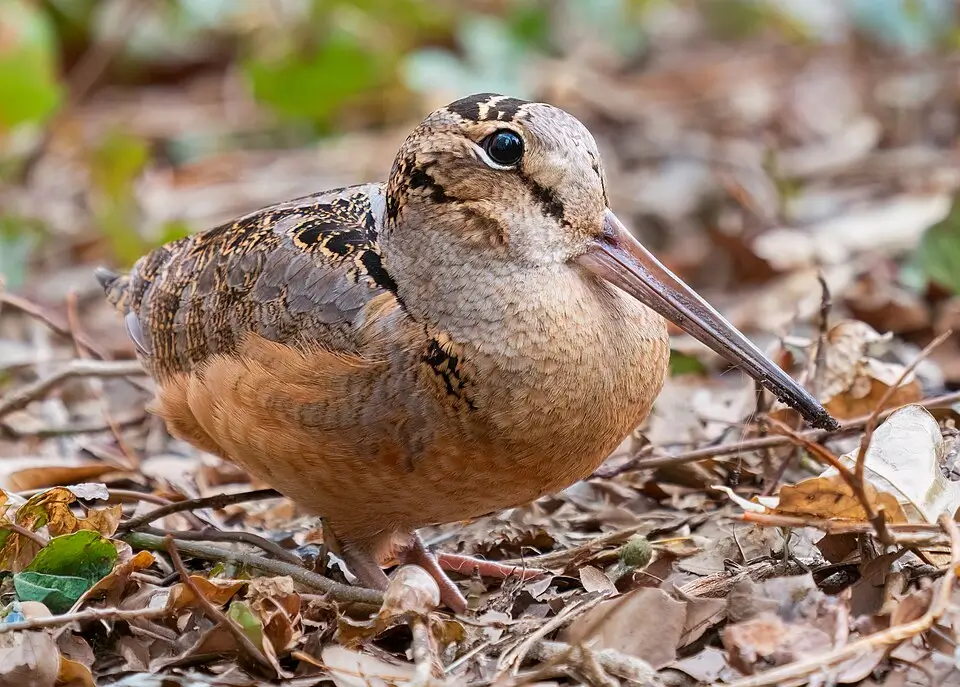
One of the woodcock's most remarkable anatomical features is its bill. Long, flexible, and sensitive at the tip, the bill is perfectly engineered for probing deep into soft soil in search of earthworms, which form the cornerstone of the bird's diet. The tip of the upper mandible can be moved independently — a feature known as rhynchokinesis — allowing the woodcock to grasp and manipulate prey items underground without opening the entire bill. This is a sophisticated feeding adaptation that reflects millions of years of evolutionary refinement.
The woodcock's eyes are positioned high and toward the back of its large, rounded head, providing an almost 360-degree field of vision. This placement allows the bird to watch for aerial predators even while its bill is buried in the ground — a remarkable survival adaptation. The brain of the woodcock is also unusual among birds; its cerebellum is rotated, oriented differently than in most avian species, which is thought to be a consequence of this unique eye positioning.
In terms of size, the American woodcock is a relatively compact bird, with a plump, round body and short legs. Its cryptic, dead-leaf patterning of brown, black, and tan provides extraordinary camouflage among the leaf litter of the forest floor. When flushed from its hiding spot, the woodcock erupts into flight with a distinctive twittering sound produced by its specialized outer wing feathers — a sound instantly recognizable to anyone who has spent time hunting or birding in woodcock country.
Perhaps the most celebrated aspect of the American woodcock's biology is its springtime courtship display, known as the "sky dance." At dusk and dawn during early spring, male woodcock gather on open singing grounds — clearings, fields, or forest edges — and deliver a loud, buzzy "peent" call from the ground. After a series of these calls, the male launches himself into the night sky in a spiraling, climbing flight that can reach impressive heights. At the apex of the flight, he produces a series of liquid, musical chirping sounds before tumbling back to earth in a zigzagging descent. This display is repeated multiple times each evening and is considered one of the most enchanting wildlife experiences available to anyone willing to visit the right habitat on a spring evening.
Habitat and Range
The American woodcock is primarily an eastern North American species, with its breeding range extending across the eastern United States and southern Canada. The bird's range runs roughly from the Great Plains eastward to the Atlantic Coast, spanning from southern Canada down through the Gulf Coast states. Core breeding populations are concentrated in the Great Lakes region, New England, the Mid-Atlantic states, and the Canadian Maritime provinces.
The woodcock is strongly associated with young, early-successional forests and shrubby wetlands. It favors habitats where alder thickets, aspen groves, and dense shrubby undergrowth meet moist, productive soils rich in earthworms. Abandoned farmland that has begun to revert to forest, streamside thickets, and beaver pond margins are classic woodcock habitats. The bird requires a mosaic of habitat types throughout its annual cycle: dense cover for nesting and loafing during the day, open singing grounds for courtship, and moist soils for feeding.
As a migratory species, the American woodcock undertakes seasonal movements between its northern breeding grounds and southern wintering areas. Wintering populations concentrate in the Gulf Coast states, particularly Louisiana, Mississippi, Alabama, and the Carolinas, where mild temperatures and soft soils allow year-round earthworm availability.
It is important to note that the American woodcock is not a native or established species in Washington State or the broader Pacific Northwest. The bird's natural range is centered firmly in the eastern half of North America. Occasionally, vagrant individuals may appear far outside the normal range — as can happen with migratory birds — but Washington is not considered woodcock habitat, and there is no established hunting season or management program for the species in the state. Hunters and wildlife enthusiasts in Washington interested in woodcock would need to travel to the bird's core range in the Midwest, Northeast, or South to pursue this species.
Hunting Traditions and Information
The American woodcock has been a prized game bird in North America for well over a century. Its hunting tradition is deeply woven into the fabric of upland bird culture, particularly in the northeastern and Great Lakes states where woodcock populations are most robust. Hunters pursue woodcock with flushing and pointing dogs — breeds like English setters, Brittany spaniels, and German shorthaired pointers are popular choices — working through dense alder runs and young aspen stands where the birds concentrate during migration.
Woodcock hunting is regulated at the federal level in the United States through the U.S. Fish and Wildlife Service, as woodcock are migratory birds protected under the Migratory Bird Treaty Act. Specific season dates, bag limits, and possession limits are set annually through a federal regulatory process and can vary by region and management zone. Hunters interested in pursuing woodcock should consult the U.S. Fish and Wildlife Service and their respective state wildlife agencies for the most current and accurate season information.
In states within the woodcock's core range — such as Michigan, Wisconsin, Maine, Vermont, Minnesota, and others — autumn woodcock seasons typically coincide with the peak of the fall migration, when birds are moving through on their way south. This migration can concentrate birds in favorable habitat, creating exciting hunting opportunities for those who know where to look.
For Washington State specifically, woodcock hunting is not a recognized or regulated activity, as the species does not maintain a breeding or wintering population in the Pacific Northwest. Washington hunters interested in migratory upland birds have a wealth of other opportunities available, including pheasant, blue grouse, ruffed grouse, and Hungarian partridge, among other species that thrive in the state's diverse landscapes.
Conservation
The American woodcock faces a long-term population decline that has been documented by wildlife biologists over several decades. Singing ground surveys and other monitoring efforts conducted by the U.S. Fish and Wildlife Service have indicated a gradual downward trend in woodcock populations across much of the breeding range. The primary driver of this decline is widely believed to be habitat loss — specifically, the maturation and loss of early-successional forest habitats that the woodcock depends upon.
As young forests and abandoned agricultural lands have matured or been converted to other land uses, the shrubby, dense young-forest habitats that woodcock require have become less abundant across the landscape. Conservation organizations including the American Woodcock Society, the Ruffed Grouse Society, and various state and federal wildlife agencies have worked to address this challenge through habitat management programs that create and maintain the early-successional forest conditions that woodcock need.
Active habitat management techniques such as timber harvesting, prescribed burning, and shrub control can effectively set back forest succession and create or restore high-quality woodcock habitat. Many state wildlife agencies and private landowners have embraced these techniques as tools for woodcock conservation. The American Woodcock Conservation Plan, developed through a collaborative effort involving federal and state agencies, provides a framework for habitat conservation and population management across the species' entire range.
The woodcock's status as a cherished game bird has actually been an asset to its conservation, as the hunting community has consistently supported habitat conservation efforts that benefit the species. The connection between hunters, wildlife managers, and conservation organizations working together on behalf of the woodcock is a positive example of how hunting traditions can align with and support broader wildlife conservation goals.
Conclusion
The American woodcock is one of North America's most distinctive and beloved wildlife species. From its remarkable feeding anatomy and extraordinary sensory adaptations to its celebrated sky dance and deep roots in upland hunting tradition, the timberdoodle occupies a unique and irreplaceable place in our natural and cultural heritage. While Washington State sits outside the woodcock's native range, understanding and appreciating this species enriches the broader perspective of any wildlife enthusiast or hunter who cares about North American biodiversity. For those willing to seek out woodcock country in the eastern United States, the experience of a spring sky dance at dusk or a golden October day behind a good bird dog in an alder swamp is one that is not easily forgotten.