Overview
Few birds in North America command attention quite like the Wood duck (Aix sponsa). Often described as one of the most beautiful waterfowl on the continent — and arguably in the entire world — the Wood duck is a species that blends stunning visual elegance with fascinating biological adaptations. Whether you're a wildlife enthusiast scanning the edges of a quiet beaver pond, a photographer hoping to capture a flash of iridescent color among the cattails, or a waterfowl hunter seeking one of the most rewarding gamebirds in the eastern United States, the Wood duck holds a special place in the outdoor tradition.
In Vermont, where rolling forests meet meandering rivers, glacial lakes, and sprawling wetland systems, the Wood duck finds some of its finest habitat in the northeastern United States. The Green Mountain State's landscape — shaped by millennia of glacial activity and defined by rich deciduous and mixed forests — provides an ideal backdrop for this cavity-nesting duck to thrive. Understanding the Wood duck, from its biological characteristics to its conservation story, is a worthwhile endeavor for anyone who spends time in Vermont's great outdoors.
Biological Traits
The Wood duck's scientific name, Aix sponsa, offers an immediate clue to the bird's most celebrated attribute. The species name sponsa is derived from Latin, meaning "betrothed" or "bride" — a nod to the bird's extraordinary plumage, which early naturalists likened to a creature dressed for a wedding. The genus Aix comes from the Greek word for a type of diving bird, though Wood ducks are technically dabbling ducks, belonging to the family Anatidae.
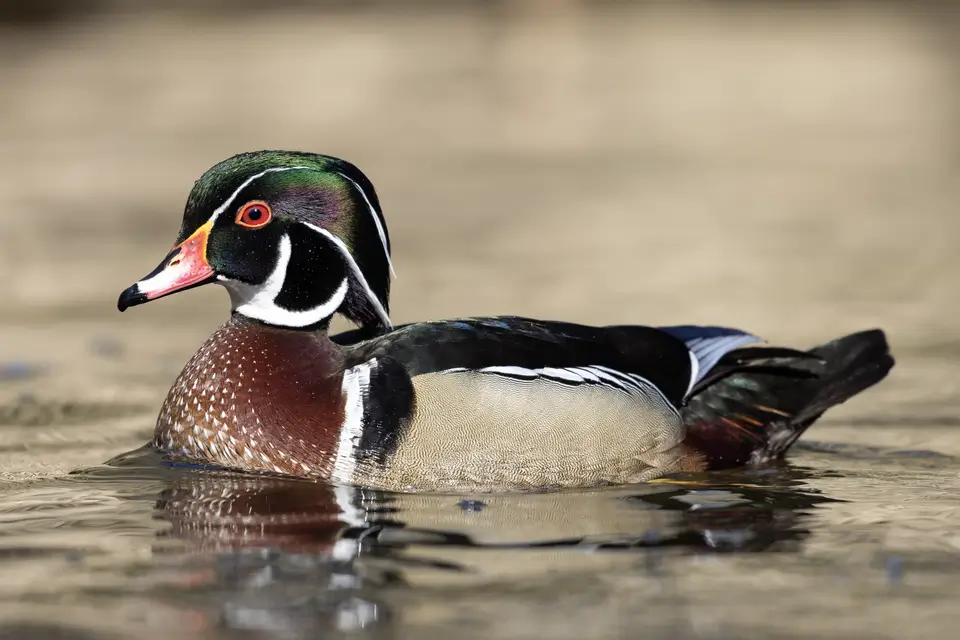
The male Wood duck, or drake, is widely regarded as one of the most ornate birds in North America. His head features a sweeping, iridescent green and purple crest, accented with bold white stripes. His chestnut breast is dotted with white spots, and his flanks are painted in warm tans and golds, separated from the breast by a striking black and white bar. The eyes are vivid red, surrounded by a red orbital ring, and the bill is patterned in red, white, and black. In short, the drake Wood duck appears almost too extravagant for the natural world — like a living work of art.
Female Wood ducks, as is typical in many duck species, are more subdued in coloration. They wear a gray-brown plumage with a distinctive white teardrop-shaped eye patch, which serves as a reliable field identification marker. Though less flamboyant than the drake, the hen Wood duck possesses her own quiet elegance.
One of the most notable biological characteristics of the Wood duck is its adaptation for life in wooded environments. Unlike many waterfowl that nest on the ground near open water, Wood ducks are cavity nesters. Hens seek out natural tree cavities — often old woodpecker holes, particularly those created by Pileated Woodpeckers — as well as nest boxes, to lay their eggs. This preference for woodland nesting sites is what gives the bird its common name. The species has evolved long, sharp claws that allow it to perch on branches and cling to the rough bark of trees — a highly unusual trait among ducks.
Shortly after hatching, Wood duck ducklings face one of the most dramatic moments in the avian world. Unable to fly, the newly hatched chicks must leap from their nest cavity — which can be dozens of feet above the ground or water — in response to calls from their mother below. Their lightweight bodies and fluffy down allow them to bounce harmlessly upon landing, after which they follow their mother to water. This extraordinary behavior never fails to astonish observers who witness it for the first time.
Wood ducks are omnivores with a diet that shifts seasonally. They consume a wide variety of plant material, including seeds, acorns, berries, and aquatic vegetation, as well as invertebrates such as insects and small crustaceans. Acorns are a particularly important food source in the fall, and forested wetlands that produce abundant mast crops are prime Wood duck habitat. Their broad, relatively flat bill is well-suited to dabbling and scooping food from shallow water and soft mud.
Habitat & Range
The Wood duck's range encompasses much of the eastern United States, parts of the Pacific Coast, and portions of southern Canada. In the East, populations are associated with wooded swamps, beaver ponds, slow-moving rivers flanked by mature timber, and forested lake edges. The species shows a clear preference for water bodies that offer a combination of open water for foraging, emergent aquatic vegetation for cover, and mature trees — particularly those containing natural cavities — for nesting.
Vermont, despite being a landlocked state in the New England region of the Northeastern United States, is exceptionally well-suited to Wood duck habitat. The state's mosaic of deciduous and mixed forests, its numerous rivers and streams (many of which support active beaver populations that create ideal impoundments), and its network of wetlands and shallow lakes provide everything Wood ducks require throughout the breeding season. Beaver ponds, in particular, are something of a Wood duck paradise — the standing dead timber associated with flooded areas provides abundant cavity nesting opportunities, and the calm, shallow water teems with the invertebrates and aquatic vegetation that ducks rely upon.
During the breeding season, Wood ducks are migratory in the northern parts of their range, including Vermont. Hens typically return to the same nesting areas year after year, a behavior known as site fidelity, which has implications for local population management. In late summer and early fall, Wood ducks begin staging for migration, gathering in larger groups before moving south to their wintering grounds in the southeastern United States.
Hunting Information
The Wood duck holds a cherished position in the tradition of waterfowl hunting in the eastern United States. For hunters who pursue ducks in wooded settings — jump-shooting along beaver ponds and flooded timber, or setting up small spreads of decoys in forested swamps — the Wood duck is often the primary quarry and a prized addition to any game bag.
In Vermont, waterfowl hunting is regulated through a combination of federal frameworks established by the U.S. Fish and Wildlife Service and state regulations administered by the Vermont Fish and Wildlife Department. Specific season dates, bag limits, and licensing requirements for Wood ducks and other migratory waterfowl change from year to year and are determined through annual federal frameworks that account for population surveys and breeding habitat assessments. Hunters pursuing Wood ducks in Vermont are encouraged to consult the most current Vermont Fish and Wildlife Department regulations and the federal migratory bird hunting regulations before heading afield, as this information is updated each season.
What remains consistent is the type of hunting experience Wood ducks offer. Early-season hunting — often in September, when federal frameworks typically allow for early teal and sometimes wood duck seasons — can be exceptional in Vermont's wooded wetlands. The birds move actively at dawn and dusk, trading between roosting and feeding areas along wooded waterways. A hunter positioned near a beaver pond or wooded stream edge, particularly in areas with overhanging trees and natural funnels, can enjoy fast-paced shooting as Wood ducks weave through the timber.
Wood ducks are generally considered one of the more challenging ducks to decoy, as they often respond more readily to calls and natural funneling cover than to large decoy spreads. A few Wood duck decoys placed in calm water near emergent vegetation, combined with a Wood duck call used sparingly, can be an effective approach. Their flight pattern — fast, agile, and often through dense tree cover — demands quick reflexes from the hunter and adds to the excitement of pursuing this species.
As table fare, Wood ducks are highly regarded. Their diet of acorns, seeds, and aquatic invertebrates contributes to a rich, flavorful meat that many hunters consider among the finest of all waterfowl.
Conservation
The conservation story of the Wood duck is one of North American wildlife management's genuine success stories. By the early twentieth century, the combination of unregulated market hunting and widespread loss of the mature forested wetlands that Wood ducks depend upon for nesting had driven the species to alarmingly low numbers. Some ornithologists of the era feared that the Wood duck might be on the path to extinction.
The turnaround began with the passage of the Migratory Bird Treaty Act of 1918, which placed federal protections on Wood ducks and other migratory birds, ending the era of commercial waterfowl hunting. Equally important was the widespread adoption of artificial nest box programs. Because Wood ducks readily accept man-made nest cavities, volunteers, conservation organizations, and wildlife agencies across the country began installing nest boxes along waterways and in suitable wetland habitats. The response from Wood duck populations was remarkable, and the species rebounded strongly over the following decades.
Today, Wood ducks are one of the most abundant duck species in the eastern United States, and their recovery stands as a testament to what thoughtful wildlife management and habitat conservation can achieve. Conservation of wetland habitats, continued nest box programs, and regulated hunting that operates within sustainable population parameters all contribute to keeping Wood duck numbers healthy.
In Vermont, the protection and management of wetland habitats remains a priority for wildlife conservation. The Wood duck serves as an important indicator species for the health of forested wetland ecosystems, and its presence in a waterway is generally a positive sign that habitat quality is being maintained.