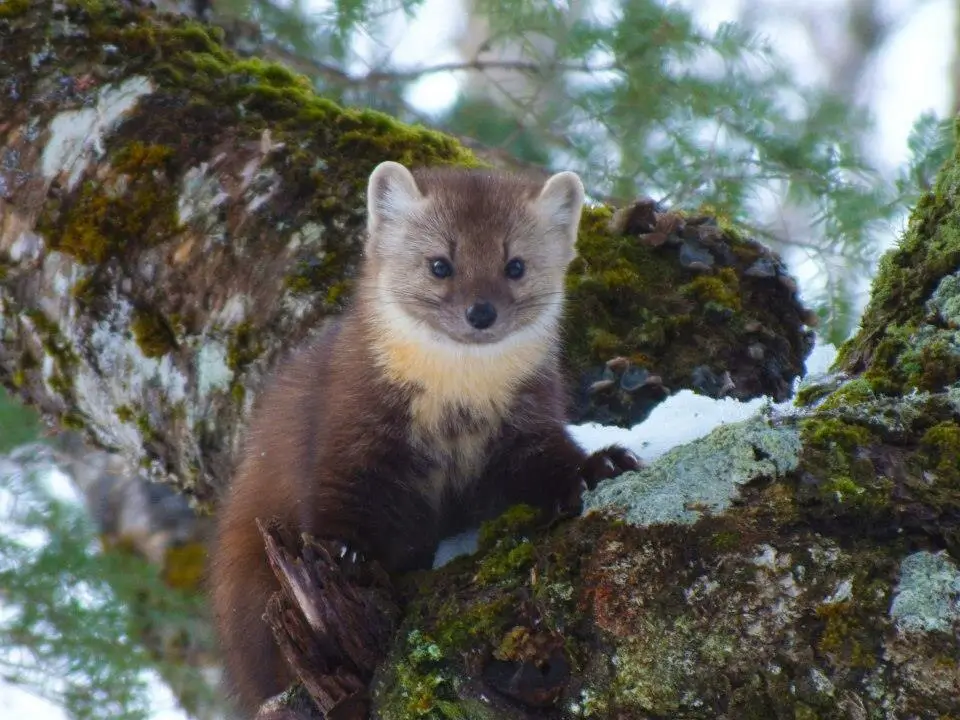
Overview
Few creatures embody the spirit of the wild, untamed northern forest quite like the American marten (Martes americana). Sleek, agile, and fiercely adapted to life among the towering conifers and hardwoods of North America's boreal and montane forests, this small but formidable carnivore has captured the imagination of naturalists, wildlife biologists, and outdoor enthusiasts for generations. Known alternately as the pine marten — a name borrowed from its close European relative — the American marten is a member of the weasel family, Mustelidae, a group that includes some of the most efficient and specialized predators on the continent.
In the northeastern United States, the American marten holds a particularly storied place in the natural history of states like Vermont. Vermont's landscape, defined by rolling green mountains, dense coniferous forests, and a climate that swings from vibrant summers to deep, snow-laden winters, provides a glimpse of the kind of habitat this species calls home. Understanding the American marten means understanding the intricate web of ecology, behavior, and conservation that defines the northern wilderness — and appreciating why this animal continues to be a subject of deep interest for hunters, wildlife managers, and nature lovers alike.
Biological Traits
The American marten (Martes americana) belongs to the order Carnivora and the family Mustelidae, placing it alongside relatives such as the fisher, ermine, mink, otter, and wolverine. This classification immediately hints at the marten's predatory nature and its physical adaptations for hunting in challenging environments.
Martens are medium-sized mustelids, generally larger than a mink but smaller than a fisher. Their bodies are long and lithe, perfectly engineered for moving through dense brush, scaling trees with remarkable speed, and pursuing prey in tight, complex terrain. Their legs are relatively short but muscular, and their feet are equipped with semi-retractile claws that give them exceptional grip on bark and branches alike. During winter months, the fur between their toe pads thickens substantially, effectively serving as natural snowshoes that distribute their weight across the surface of deep snow — a critical adaptation for life in northern climates.
The marten's fur is one of its most distinctive features. The coat is typically soft and dense, ranging in color from pale yellow to dark brown across the body, often with a characteristic pale or orange-buff throat and chest patch that varies between individuals. This luxurious pelage, which thickens in winter to provide insulation against brutal cold, was historically one of the most prized furs in the North American fur trade and played a significant role in the exploration and development of the continent.
Martens are primarily carnivorous, with red-backed voles and other small mammals forming a substantial part of their diet. They are opportunistic hunters, however, and will readily consume red squirrels, snowshoe hares, birds and bird eggs, insects, fish, and even berries and other plant matter when available. Their hunting style is active and energetic — they investigate every log, burrow, and hollow tree in their territory, using their keen sense of smell and sharp hearing to locate prey both above and below the snow surface in winter.
American martens are largely solitary animals outside of the breeding season. Mating typically occurs in summer, but the species exhibits delayed implantation — a reproductive strategy common among mustelids — in which the fertilized egg does not immediately implant in the uterine wall. As a result, although mating happens in summer, birth does not occur until late winter or early spring, with litters generally consisting of between one and five young, known as kits. The young are born blind and helpless, relying entirely on their mother during their early weeks of life. By late summer, the kits are largely independent and begin to establish their own home ranges.
Martens are known to be active year-round, neither migrating nor hibernating in response to winter conditions. They are considered crepuscular to nocturnal in many areas, though daytime activity is not uncommon. Their keen senses and quick, agile movements make them effective hunters in all lighting conditions.
Habitat & Range
The American marten's range spans a broad arc across the northern reaches of North America, from Alaska and western Canada eastward through the boreal forests of Quebec and Ontario, and south into the mountainous regions of the western United States and the northeastern states. Historically, their range extended considerably farther south in the East, but habitat loss and unregulated trapping during the 18th and 19th centuries led to significant contractions across much of New England and the Great Lakes region.
Martens are intimately associated with mature, structurally complex forests. They show a strong preference for dense coniferous and mixed-coniferous forests characterized by a multilayered canopy, abundant coarse woody debris on the forest floor, and a rich understory that provides both thermal cover and hunting opportunities. Old-growth and late-successional forest stands are particularly favored, as these ecosystems tend to offer the fallen logs, snags, brush piles, and subnivean (under-snow) spaces that martens depend upon for denning, hunting, and escape from predators.
In Vermont, the Green Mountains and the Northeast Kingdom region represent the core of any suitable marten habitat in the state. Vermont's forests, which cover a substantial majority of the state's land area, include significant tracts of spruce-fir and northern hardwood forest at higher elevations — exactly the conditions that martens favor. Vermont's geographic position, bordering the Canadian province of Quebec to the north, means it sits at the southern edge of the primary marten range in the East, and the presence or absence of martens in the state is closely tied to the health and connectivity of these forest ecosystems.
Hunting Information
The American marten has a long history as a valued furbearer in North America. Its dense, silky pelt was among the most commercially important furs of the historical fur trade, and regulated trapping of martens has taken place across much of their range where populations are robust.
However, the situation in Vermont is more nuanced. The source data available for this article does not include specific current hunting or trapping season dates, license requirements, or regulatory frameworks for American marten in Vermont. This is an important distinction for anyone interested in pursuing martens in the state. In many northeastern states, including Vermont, marten populations are considered sensitive due to historical declines, and wildlife management agencies take a careful, science-based approach to any harvest regulations.
Anyone interested in trapping or hunting American marten in Vermont is strongly encouraged to consult the Vermont Fish & Wildlife Department directly for the most current and accurate information regarding season dates, bag limits, licensing requirements, and any applicable restrictions. Regulations can change from year to year based on population surveys, habitat assessments, and broader conservation goals, making it essential to verify the rules before heading into the field.
Across jurisdictions where marten trapping is permitted, the most common methods involve the use of body-gripping traps or box traps set along travel corridors, near downed logs, or at the base of large trees — locations where martens naturally investigate in search of prey. Trappers working in marten country must also be well-versed in identifying and responding to the demands of deep snow and cold temperatures that characterize prime marten habitat during the trapping season.
Conservation
The conservation story of the American marten in the northeastern United States is one of both cautionary history and genuine hope. By the early 20th century, unregulated trapping and widespread logging had eliminated or severely reduced marten populations across much of New England and the Great Lakes states. The loss of mature forest habitat was particularly damaging, as martens depend so heavily on the structural complexity of old forests.
In more recent decades, the recovery of forest cover across much of the Northeast, combined with more carefully managed harvest regulations, has allowed marten populations to stabilize or recover in some areas. Reintroduction programs have been undertaken in several states and provinces where local populations had been extirpated. Continued forest conservation, sustainable forestry practices that preserve old-growth characteristics, and ongoing wildlife monitoring are all critical components of ensuring that American marten populations remain healthy for future generations.
Climate change also poses an emerging challenge for the American marten. As a species closely tied to cold, boreal forest conditions and reliable winter snowpack, the marten may face increasing pressure as temperatures rise and snow conditions become less predictable across its southern range margins — including areas like Vermont.