Overview
Few animals in North America command as much immediate recognition — or as cautious a distance — as the striped skunk (Mephitis mephitis). With its bold black-and-white coloration and legendary chemical defense mechanism, this medium-sized mammal has earned a permanent place in the cultural imagination of the continent. Yet beyond its notorious reputation, the striped skunk is a remarkably adaptable, ecologically important, and biologically fascinating creature that deserves a closer and more appreciative look.
Found across a sweeping range that extends from southern Canada through the contiguous United States and into northern Mexico, the striped skunk is one of the most widespread and successful wild mammals on the continent. In states like Vermont, nestled in the heart of New England and surrounded by dense forests, rolling farmland, and abundant wetlands, the striped skunk thrives as a year-round resident. Whether you are a wildlife enthusiast, a hunter, a naturalist, or simply a curious observer, understanding the striped skunk opens a window into the rich and intricate web of life that defines North American ecosystems.
This article explores the biology, behavior, habitat preferences, hunting traditions, and conservation status of the striped skunk — an animal that is far more than just its infamous spray.
Biological Traits
The striped skunk is a member of the family Mephitidae, which comprises all skunk species in the Americas. Its scientific name, Mephitis mephitis, derives from the Latin word for noxious gas or vapor — a fitting reference to its most celebrated defense mechanism.
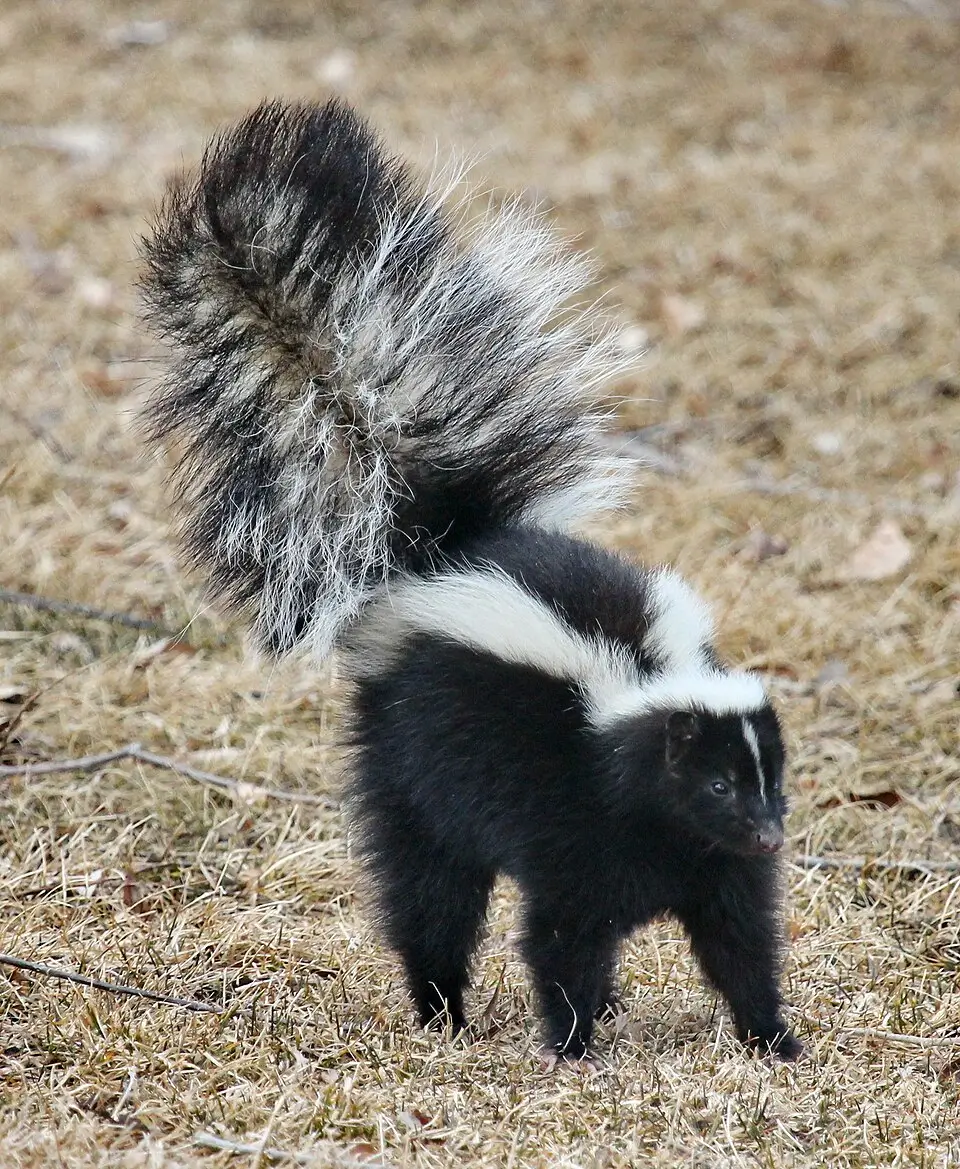
In terms of physical appearance, the striped skunk is immediately identifiable. Its glossy black fur is offset by a distinctive white stripe that typically begins at the top of the head and splits into two broad bands running down either side of the back toward the tail. The tail itself is a dramatic plume of mixed black and white fur. There is considerable individual variation in the width and extent of the white markings, but the basic pattern remains consistent across the species.
Striped skunks are medium-sized carnivores, with adults generally weighing between four and ten pounds, though some individuals — particularly in areas with abundant food — can reach up to fourteen pounds. Males tend to be slightly larger than females. Their body shape is stocky and low-slung, with short, powerful legs equipped with long claws well adapted for digging.
The skunk's most famous biological feature is, of course, its scent glands. Located on either side of the anus, these glands can project a sulfur-containing chemical compound — a thiol-based mixture — with remarkable accuracy at distances of up to ten feet, and the odor can be detected by humans at much greater distances. This spray serves as a last-resort defense mechanism. Before spraying, skunks typically provide clear visual warnings: they will stamp their front feet, arch their back, raise their tail, and perform a handstand-like display to signal their readiness to spray. Predators that learn to heed these warnings give skunks a wide berth.
Despite being classified in the order Carnivora, striped skunks are highly omnivorous. Their diet shifts with the seasons and takes advantage of whatever food sources are most abundant. In warmer months, they consume large quantities of insects — particularly beetles, grasshoppers, and grubs — as well as small mammals, eggs, amphibians, berries, and various plant matter. In autumn, they bulk up on high-calorie foods to prepare for winter.
Striped skunks do not truly hibernate, but they do enter a state of torpor during cold winter months. They may spend extended periods in dens — often pre-existing burrows dug by other animals, hollow logs, or spaces beneath buildings — and their body temperature and metabolic rate drop significantly, though they may emerge during mild winter spells to forage.
Reproduction occurs in late winter, typically in February or March. After a gestation period of approximately 60 to 75 days, females give birth to litters of four to seven kits, though litters of up to ten have been recorded. The young are born blind and helpless but develop rapidly. Their scent glands are functional almost from birth, providing early protection. By late summer, the young skunks are largely independent.
Skunks have a relatively short lifespan in the wild, with most individuals living just two to three years. Mortality is high, caused by predation, disease, vehicle collisions, and harsh winters. Despite this, populations remain robust due to their reproductive success.
Habitat & Range
The striped skunk is one of the most habitat-flexible mammals in North America. It occupies a remarkably diverse array of environments, including mixed forests, open grasslands, agricultural lands, suburban neighborhoods, and riparian corridors. It shows a preference for edge habitats — the transitional zones between forest and open land — where food resources tend to be rich and diverse.
Vermont provides an ideal combination of habitat types for the striped skunk. The state's landscape includes extensive hardwood and mixed forests, river valleys, farmland, wetland margins, and small-town and suburban areas where skunks often find shelter beneath structures and in brushy hedgerows. The state's relatively low human population density and abundant natural land mean that skunks coexist readily with both wild and human-dominated landscapes.
Skunks are not strongly territorial, and home ranges can overlap considerably, particularly outside the breeding season. They tend to be most active at dawn, dusk, and during nighttime hours, making them crepuscular and nocturnal in habit. During the active seasons of spring, summer, and fall, they range broadly in search of food, using their highly developed sense of smell and strong digging claws to locate grubs, tubers, and other buried food items.
Across North America, the striped skunk's range extends from central Canada south through all of the contiguous United States to northern Mexico. It is absent only from the most arid desert regions and from high mountain elevations. Vermont, lying in the northeastern corner of the species' range, supports healthy skunk populations throughout the state.
Hunting Information
Hunting and trapping of striped skunks has a long tradition in North America, tied both to the fur trade and to wildlife management practices. Skunk fur, historically known as "Alaskan sable," was once a valued commodity in the fur market, prized for its soft texture and striking appearance.
For hunters and trappers interested in pursuing striped skunks in Vermont, it is important to consult the Vermont Fish & Wildlife Department directly for the most current and accurate licensing requirements, season dates, and any applicable regulations. Specific season dates, license requirements, and bag limits for Vermont were not available in the source data used for this article, and regulations can change from year to year.
Vermont, as a state with a strong tradition of outdoor recreation and wildlife stewardship, generally provides regulated trapping and hunting seasons for furbearing species including skunks. The state's regulatory framework is designed to ensure sustainable harvest while maintaining healthy wildlife populations. Hunters and trappers should always verify current rules before heading afield.
Common harvest methods for skunks include live trapping and leg-hold trapping, as well as opportunistic harvest during other small game or predator hunting activities. Anyone pursuing skunks should be well prepared for the possibility of an odoriferous encounter, and experienced trappers typically carry supplies for scent neutralization.
Beyond regulated harvest, skunks are sometimes managed when they become a nuisance near residential or agricultural settings. In these cases, licensed wildlife control operators may relocate or dispatch individuals in accordance with state guidelines.
Conservation
The striped skunk is currently listed as a species of Least Concern by the International Union for Conservation of Nature (IUCN), reflecting its wide distribution, large population size, and adaptability to a broad range of habitats, including human-modified landscapes. Unlike many wildlife species that struggle in the face of habitat loss and fragmentation, the striped skunk has in many ways benefited from the expansion of suburban and agricultural environments, which provide reliable food sources and den sites.
That said, striped skunks do face ongoing challenges. Road mortality is a significant source of death for skunks, which are frequently struck by vehicles as they forage along roadsides and cross highways at night. Disease is another important factor: skunks are one of the primary wildlife reservoirs for rabies in North America, and periodic rabies epizootics — outbreaks of disease in animal populations — can cause significant local population declines. Canine distemper also affects skunk populations.
Habitat quality remains important for long-term population health. While skunks tolerate modified landscapes, they benefit from intact wetland margins, diverse edge habitats, and access to natural prey such as ground-nesting insects. Practices that support healthy soil insect communities and maintain diverse vegetation structure also support robust skunk populations.
From a broader ecological perspective, skunks play a valuable role in their ecosystems. As predators of insects, small rodents, and eggs, they help regulate prey populations. Their digging activity aerates soil and turns over organic material. They also serve as prey for large predators such as great horned owls, which appear to be relatively unaffected by the skunk's chemical defense, as well as coyotes, bobcats, and other carnivores.
In Vermont and across their range, striped skunks are a thread in the rich tapestry of wildlife that makes North American landscapes so vibrant and diverse. Appreciating this remarkable animal — on its own ecological terms — adds depth and wonder to any outdoor experience.