Overview
Few sights in the natural world are as awe-inspiring as a flock of Sandhill cranes moving across the sky. With their broad, sweeping wingspans, distinctive crimson foreheads, and resonant, bugling calls that carry for miles across open landscapes, Sandhill cranes (Grus canadensis) are among the most recognizable and beloved birds on the continent. These ancient birds have soared over North America for millions of years, and their continued presence today stands as a testament to both their remarkable resilience and the power of thoughtful wildlife conservation.
Whether you encounter them along a remote wetland, spot them staging in enormous migratory flocks, or listen to their prehistoric-sounding calls echo across a misty morning marsh, Sandhill cranes leave a lasting impression on everyone fortunate enough to witness them. For hunters, birdwatchers, and wildlife enthusiasts alike, these majestic birds represent one of North America's most treasured wild resources. This article takes a deep dive into the life of the Sandhill crane — from its biological traits and sweeping range to its place in hunting culture and conservation history.
Biological Traits
The Sandhill crane is a large, long-legged wading bird belonging to the family Gruidae, the true cranes. Scientifically classified as Grus canadensis, it is one of the most studied birds in North America, and for good reason — its biology is as fascinating as its appearance.
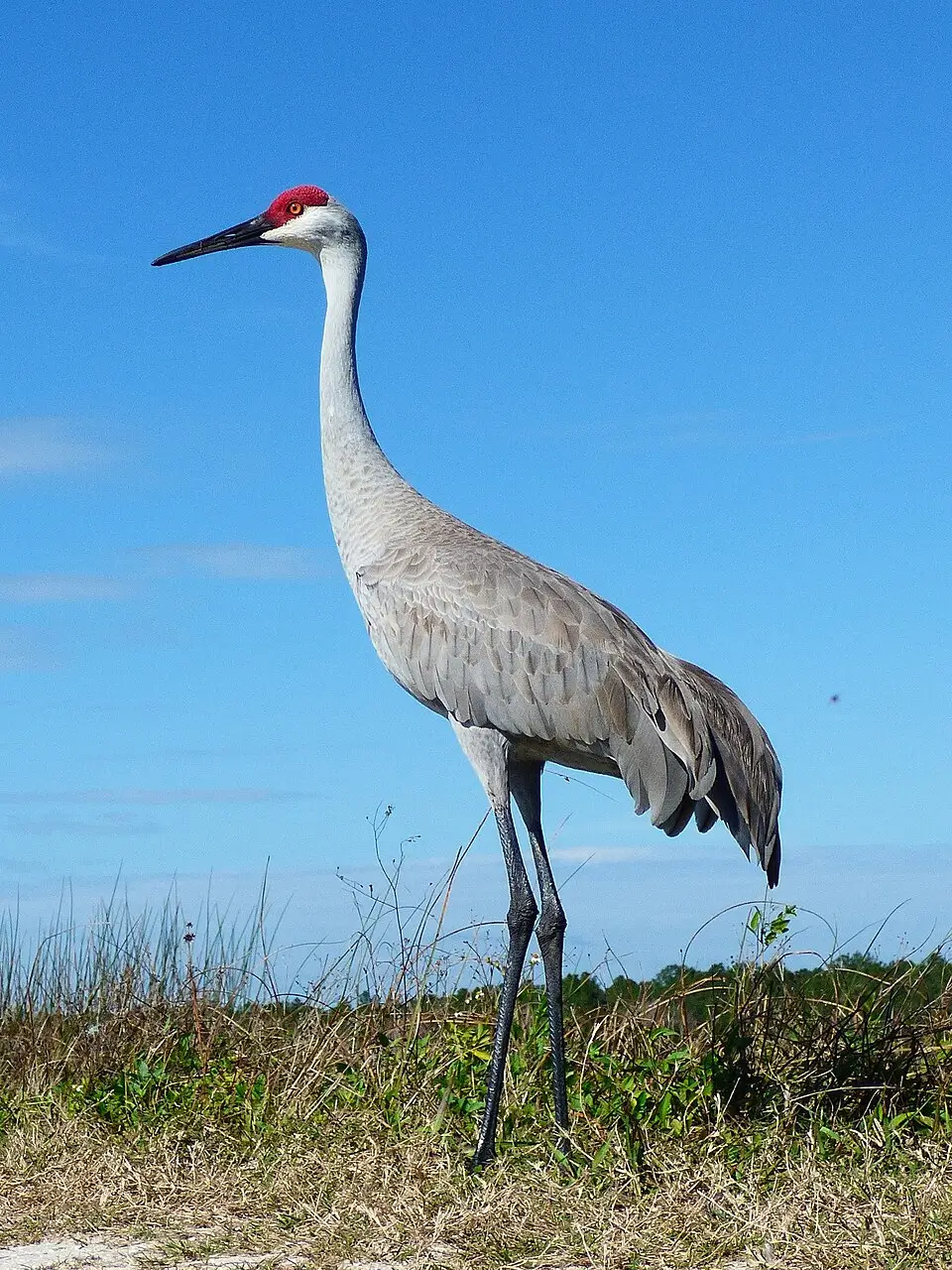
Adult Sandhill cranes are primarily gray in plumage, though the exact shade can vary considerably across subspecies and geographic populations. During certain seasons, individuals may display rusty or brownish tones on their feathers, a result of the birds preening with iron-rich mud and vegetation. One of the most striking physical features of the Sandhill crane is the bare, bright red patch of skin on the forehead, which becomes particularly vivid during courtship and social interactions. Long, bushy feathers extending over the rump give the bird a distinctive silhouette that sets it apart from herons and other large wading birds.
Sandhill cranes are tall birds, typically standing between 3 and 4 feet in height, with wingspans that can extend to approximately 6 to 7 feet. Their long necks are held straight during flight — a key characteristic that distinguishes them from herons, which tuck their necks back while airborne. Their calls are equally distinctive: a deep, rattling, bugling sound produced by an elongated trachea that coils within the sternum, amplifying the sound and giving it an almost otherworldly resonance.
These birds are omnivores with a broad and flexible diet. They forage in fields, meadows, and wetlands for grains, seeds, berries, insects, small rodents, frogs, snakes, and aquatic invertebrates. This dietary adaptability has been a key factor in their success across a wide range of environments.
Sandhill cranes are also famous for their elaborate courtship dances. Both males and females participate, leaping, bowing, stretching their wings, and calling loudly in coordinated displays that strengthen pair bonds. Once paired, Sandhill cranes are largely monogamous and may maintain their pair bond for many years. Breeding pairs typically produce one to three eggs per clutch, with both parents sharing incubation duties. Chicks, called colts, are precocial — meaning they are mobile and active shortly after hatching — and remain with their parents through their first winter migration.
Sandhill cranes are notably long-lived birds. In the wild, individuals can live for 20 years or more, and captive birds have been recorded living even longer. This longevity, combined with relatively low annual reproductive rates, makes each individual bird ecologically significant and underscores the importance of careful population management.
There are several recognized subspecies of the Sandhill crane, varying in size and migratory behavior. Some subspecies undertake extraordinary long-distance migrations, traveling thousands of miles between their northern breeding grounds and southern wintering areas, while others are largely non-migratory and remain in Florida, Mississippi, and Cuba year-round.
Habitat & Range
The Sandhill crane occupies an impressively broad geographic range across North America. Migratory populations breed in the vast boreal forests, tundra, and wetland regions of Canada, Alaska, and the northern contiguous United States, then travel southward to winter in warmer regions including the Gulf Coast, the American Southwest, and Mexico. Some of the most spectacular wildlife events in North America occur along the Platte River in Nebraska, where hundreds of thousands of Sandhill cranes gather each spring during migration — a phenomenon that draws wildlife watchers from around the world.
Sandhill cranes thrive in a variety of habitats throughout the year. During the breeding season, they favor freshwater wetlands, marshes, wet meadows, and bogs with open water, emergent vegetation, and nearby upland areas for foraging. During migration and winter, they frequently use agricultural fields — particularly those with corn, wheat, and other grain crops — as well as grasslands, river valleys, and coastal marshes.
Regarding Vermont specifically, Sandhill cranes are not a commonly encountered species. Vermont is a landlocked state in the New England region of the Northeastern United States, bordered by Massachusetts to the south, New Hampshire to the east, New York to the west, and the Canadian province of Quebec to the north. The state's landscape of forested hills, river valleys, and agricultural meadows does provide some habitat that cranes could utilize during migration, and sightings of individual birds or small groups do occur occasionally during migratory periods. However, Vermont does not lie within the core migratory corridors or primary breeding and wintering areas of the Sandhill crane, making encounters with this species relatively uncommon in the state.
Hunting Information
The Sandhill crane holds a unique and celebrated place in North American hunting culture. Often referred to as the "ribeye of the sky" by hunters who have had the pleasure of preparing them for the table, Sandhill cranes are highly regarded for their exceptional table quality — a fact that surprises many people unfamiliar with crane hunting. The dark, richly flavored breast meat is frequently compared to high-quality beef, making the Sandhill crane one of the most prized game birds on the continent.
Crane hunting seasons are managed and regulated by both federal and state wildlife agencies across North America. In states and provinces where hunting seasons are established, they are carefully calibrated through population monitoring, harvest data, and scientific assessment to ensure that sustainable hunting does not negatively impact crane populations. Hunters typically pursue Sandhill cranes using decoys, calls, and pass-shooting techniques over agricultural fields and wetland staging areas.
However, when it comes to Vermont specifically, official hunting information for Sandhill crane is not currently available. The Vermont Fish & Wildlife Department manages hunting seasons and regulations for game species within the state, but Sandhill cranes are not a species with an established hunting season in Vermont at this time. This reflects the relatively limited presence of Sandhill cranes in the state compared to regions of the country where the species is more abundant and where regulated hunting seasons have been established. Hunters interested in pursuing Sandhill cranes should look to states in the Central Flyway, Pacific Flyway, and portions of the South where crane hunting opportunities are well-established and actively managed. Always consult current state and federal regulations before pursuing any migratory bird species.
Conservation
The conservation story of the Sandhill crane is one of North American wildlife management's great success stories. In the early 20th century, Sandhill crane populations — particularly certain subspecies — experienced significant declines due to habitat loss, drainage of wetlands, and unregulated hunting. The passage of the Migratory Bird Treaty Act of 1918 provided federal protection for Sandhill cranes and other migratory species, marking a turning point in their recovery.
Through the combined efforts of federal and state wildlife agencies, conservation organizations, and private landowners, Sandhill crane populations rebounded substantially over the following decades. Today, the greater Sandhill crane population is considered stable and, in many regions, robust. Regulated hunting of certain subspecies and populations is now permitted in numerous states and provinces, reflecting the species' healthy status and the success of science-based wildlife management.
Wetland conservation remains central to the long-term well-being of Sandhill cranes. Programs that protect, restore, and enhance wetland habitats benefit not only cranes but the full spectrum of wetland-dependent wildlife. Agricultural practices that maintain grain fields and open landscapes also support crane populations, particularly during migration and winter.
The Sandhill crane serves as a powerful symbol of what is possible when humans commit to coexisting with wildlife and investing in habitat conservation. Its ancient lineage — fossil records suggest crane-like birds have existed for tens of millions of years — and its continued presence across a vast continent remind us that nature's resilience is extraordinary when given the chance to flourish.