Overview
Few animals in North America capture the imagination quite like the raccoon (Procyon lotor). With its instantly recognizable black facial mask and boldly ringed tail, this resourceful mammal has carved out a unique place in both the natural world and human culture. From dense hardwood forests to urban backyards, the raccoon is one of the most adaptable and widely recognized wildlife species on the continent. In Vermont, where rolling green mountains meet clear rivers and pastoral farmland, raccoons are a familiar and integral part of the landscape — encountered by hikers, farmers, wildlife enthusiasts, and hunters alike.
The raccoon's reputation is well earned. Clever, curious, and remarkably dexterous, these animals have thrived in environments that have challenged or displaced other wildlife. Their ability to exploit diverse food sources and adapt to changing conditions has made them one of the most successful medium-sized mammals in North America. Whether you're a seasoned hunter pursuing them by moonlight with a pack of hounds, a naturalist studying their behavior, or simply a Vermont resident who has spotted one raiding a compost bin, the raccoon never fails to impress.
This article dives deep into the biology, habitat, hunting traditions, and conservation status of the raccoon — with a special focus on life in the Green Mountain State of Vermont.
Biological Traits
The raccoon (Procyon lotor) belongs to the family Procyonidae and is the largest member of that family native to North America. Its scientific name is particularly descriptive: Procyon derives from Greek, roughly translating to "before the dog," while lotor is Latin for "washer" — a nod to the raccoon's well-known habit of manipulating and seemingly "washing" its food in water before eating. Scientists believe this behavior is actually a way for raccoons to enhance the sensitivity of their highly developed front paws, which are among the most tactile appendages in the animal kingdom.
Those front paws deserve special attention. Raccoons possess five dexterous fingers on each front foot, allowing them to open latches, unscrew lids, pry apart crevices, and handle food with a precision that surprises many who encounter them. This manual dexterity is paired with an impressive brain, giving raccoons strong problem-solving abilities and a capacity to remember solutions to tasks for extended periods of time.
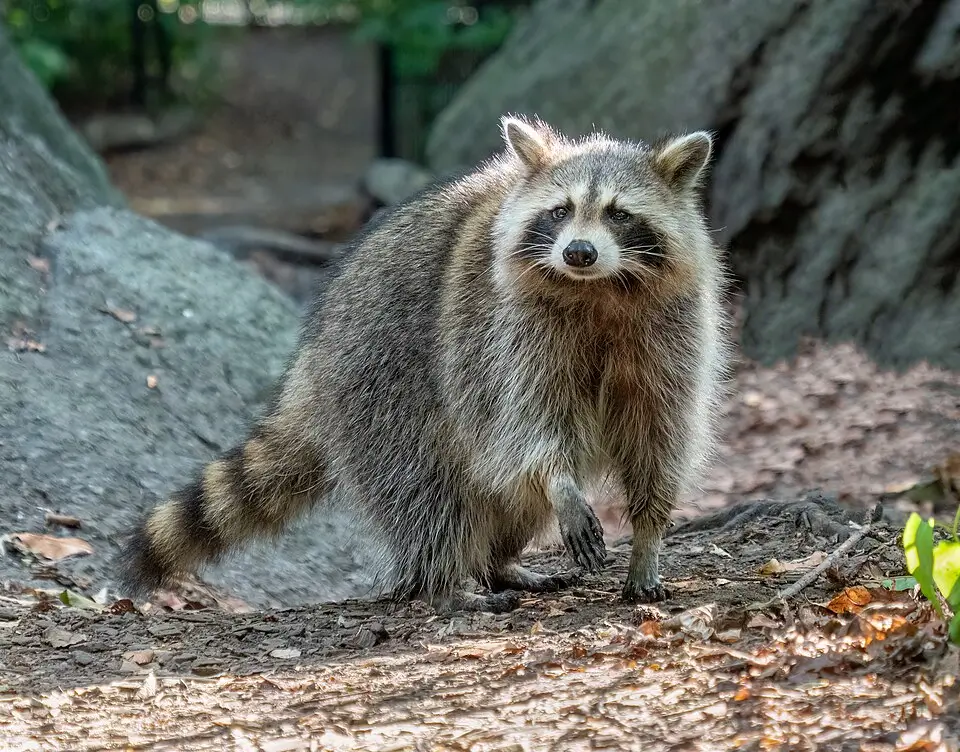
The raccoon's most iconic physical feature is undoubtedly its black facial mask — a band of dark fur stretching across the eyes that contrasts sharply with its lighter face. This mask, combined with the alternating light and dark rings on its bushy tail, makes the raccoon one of the most recognizable animals in North America. The body is stocky and rounded, covered in a dense coat of grizzled gray-brown fur that provides excellent insulation against cold weather.
Raccoons are omnivores with a remarkably varied diet. They consume fruits, nuts, berries, insects, small mammals, fish, amphibians, bird eggs, and virtually anything edible they can find — including human refuse. This dietary flexibility is one of the key reasons raccoons have thrived across such a wide range of environments. In Vermont, seasonal food availability shapes much of their behavior. During summer and early autumn, raccoons gorge themselves to build fat reserves, often doubling their body weight before the lean winter months set in.
While raccoons do not truly hibernate, they do enter a state of torpor during particularly harsh winter weather, retreating to dens in hollow trees, rock crevices, or other sheltered locations for days or even weeks at a time. Vermont's cold winters mean that raccoons in the state are especially reliant on their fat reserves built up during the fall feeding frenzy.
Raccoons are primarily nocturnal, though they are sometimes active during daylight hours, particularly in late summer and fall when food is abundant. They are generally solitary animals outside of the breeding season, though females with young kits may be seen traveling together. Mating typically occurs in late winter or early spring, and after a gestation period of approximately 63 days, females give birth to litters of two to five young. Kits are born helpless and develop slowly, remaining with their mother through their first winter before striking out on their own.
Habitat & Range
The raccoon is one of the most habitat-flexible mammals in North America. Originally associated with forested areas near water — rivers, lakes, marshes, and streams — raccoons have successfully colonized suburban neighborhoods, agricultural landscapes, coastal wetlands, and even urban city centers. Their range spans virtually the entire continental United States, much of Canada, and extends into Central America and parts of South America. Introduced populations have also established themselves in parts of Europe and Japan.
In Vermont, raccoons find an ideal combination of habitats. The state's extensive deciduous and mixed forests provide shelter and denning sites, while its abundant waterways — including Lake Champlain, the Connecticut River, and countless smaller streams and ponds — offer prime foraging opportunities. Vermont's agricultural valleys, particularly in the Champlain lowlands, attract raccoons to cornfields, orchards, and farmsteads. The state's moderate human population and patchwork of forest, farmland, and wetland create a mosaic landscape that suits raccoons particularly well.
Raccoons generally prefer areas near water, as aquatic prey items such as crayfish, frogs, and fish are important components of their diet. Hollow trees are a preferred denning site, though raccoons will readily use ground burrows, rock piles, barn lofts, and even attic spaces when suitable tree cavities are unavailable. In Vermont's northern forests, large sugar maples, yellow birch, and beech trees often provide the hollow cavities that raccoons favor for raising young and sheltering during winter cold snaps.
Hunting Information
Raccoon hunting has a rich and storied tradition in North America, and Vermont is no exception. Historically, raccoon pelts were an important part of the New England fur trade, and the traditions of night hunting with hounds remain a cherished part of rural Vermont culture today. Coon hunting, as it is commonly called, is typically a nighttime pursuit conducted with specially trained hounds — breeds such as the Black and Tan Coonhound, Treeing Walker Coonhound, and Redbone Coonhound — that track raccoons by scent and tree them until the hunter arrives.
The experience of coon hunting is as much about the dogs, the camaraderie, and the autumn night air as it is about the harvest itself. Hunters gather with friends and fellow enthusiasts, listening to the music of hounds working through the darkness of Vermont's forests, guided by the stars and the sound of baying dogs. When a raccoon is treed, the hunter closes the distance, often illuminating the animal's reflective eyes high in the branches with a flashlight or headlamp.
Raccoons may also be hunted by trapping, a method deeply embedded in Vermont's rural heritage. Trappers use a variety of methods including cage traps and body-gripping traps set near water, trails, and other high-activity areas.
Important Note: Specific season dates, licensing requirements, and regulations for raccoon hunting and trapping in Vermont were not available in the source data consulted for this article. Hunters and trappers are strongly encouraged to consult the Vermont Fish and Wildlife Department directly for current, accurate regulations before pursuing raccoons in the state. Regulations can change from year to year, and compliance with all state and local laws is both a legal obligation and an ethical responsibility.
Raccoon meat, while not as widely consumed today as it once was, has a long culinary history in North America and remains a regional delicacy in some areas. The fur continues to have value in the craft and garment trades.
Conservation
The raccoon is currently listed as a species of Least Concern on the IUCN Red List, reflecting its wide distribution, large population, and remarkable adaptability. Unlike many wildlife species that have struggled with habitat loss and human encroachment, the raccoon has in many cases benefited from human presence, finding abundant food and shelter opportunities in agricultural and suburban settings.
In Vermont, raccoons face few significant conservation pressures as a species. Like all wildlife, they benefit from the state's commitment to responsible land stewardship, healthy waterway management, and balanced hunting and trapping regulations. Vermont's large areas of protected forest land, state parks, and wildlife management areas provide ample habitat for thriving raccoon populations.
One legitimate wildlife management concern associated with raccoons is their role as a primary vector for rabies, particularly in the northeastern United States. Vermont wildlife managers and public health officials monitor raccoon populations and rabies prevalence carefully. The oral rabies vaccine (ORV) program has been an important tool in managing rabies in raccoon populations across the Northeast. Hunters and trappers handling raccoons should be aware of rabies risks and take appropriate precautions.
Distemper and parvovirus can also periodically reduce local raccoon populations, naturally cycling numbers down before they recover. These natural population dynamics are part of the ecological balance that keeps raccoon numbers in check in the absence of heavy hunting or trapping pressure.
Vermont's broader conservation ethic — reflected in its strong wildlife management programs, sustainable forestry practices, and land conservation initiatives — benefits the raccoon and the many other species that share its habitat. The Green Mountain State's forests, wetlands, and waterways remain among the most intact in the northeastern United States, providing a healthy environment for raccoons and the entire ecological community they inhabit.
Conclusion
The raccoon is a true North American original — clever, adaptable, and endlessly fascinating. In Vermont, this masked wanderer is woven into the fabric of the natural landscape, from the cornfields of the Champlain Valley to the forested ridges of the Green Mountains. Whether admired as a wildlife spectacle, pursued through autumn nights by baying hounds, or simply encountered on a quiet evening walk, the raccoon reminds us of the richness and resilience of wild nature. Understanding and appreciating this remarkable animal enriches our connection to the outdoors and deepens our commitment to the responsible stewardship of Vermont's extraordinary natural heritage.