Overview
Few animals embody the rugged spirit of the American West quite like the mule deer. With its oversized, mule-like ears, distinctive bounding gait, and striking presence across some of North America's most breathtaking landscapes, Odocoileus hemionus has earned a special place in the hearts of wildlife enthusiasts, photographers, and hunters alike. Known colloquially as the "muley," this species is one of the most widely recognized and beloved large game animals on the continent. Whether silhouetted against a crimson desert sunset or picking its way through a high-country alpine meadow dusted with early autumn snow, the mule deer is a symbol of wildness and freedom that has shaped Western culture, conservation policy, and hunting tradition for generations.
The mule deer's scientific name, Odocoileus hemionus, tells us something important about the animal right away. The genus Odocoileus is shared with its close cousin, the white-tailed deer (Odocoileus virginianus), placing both species squarely within the family Cervidae — the true deer family. The species epithet hemionus comes from the Greek word for "half mule" or "mule-like," a direct reference to those famously large ears that give the animal its common name. This detail alone illustrates how striking and immediately recognizable the mule deer's ears are — they were notable enough to inspire the very name scientists chose for the species.
Understanding the mule deer in depth — its biology, its range, its relationship with hunters and conservationists, and its place in the broader ecological web — offers a rewarding journey into one of North America's great wildlife success stories.
Biological Traits
The mule deer is a medium-to-large ungulate, and like all members of the deer family, it is an herbivore superbly adapted to extract nutrition from a wide variety of plant material. Bucks (males) are notably larger than does (females), a trait common across the Cervidae family known as sexual dimorphism. Adult bucks can be impressively large animals, carrying heavy, branching antlers that they grow and shed on an annual cycle driven by photoperiod — the changing ratio of daylight to darkness throughout the year.
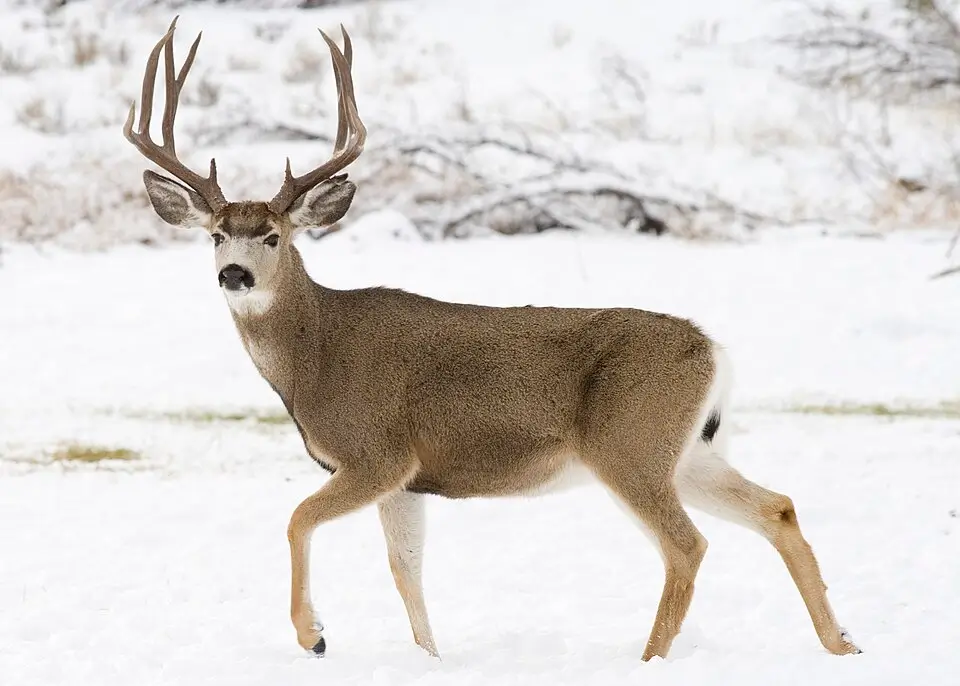
One of the most distinctive biological features of the mule deer, beyond its ears, is its antler configuration. Unlike the white-tailed deer, whose antlers grow from a main beam with tines projecting off it, mule deer antlers are bifurcated — meaning they fork, or divide into two equal branches, and then each branch forks again. This dichotomous branching pattern creates a deeply symmetrical, characteristic rack that experienced hunters and wildlife observers can use to distinguish a mule deer buck from a whitetail at a glance.
Another signature trait is the mule deer's tail, which is white with a black tip — quite different from the white-tailed deer's broad, flag-like white tail. The mule deer's rump patch is also prominently white, which serves as a visual signal to other deer, particularly useful for fawns following their mothers through dense cover.
Perhaps most charming of all the mule deer's biological traits is its unique mode of locomotion known as "stotting" or "pronking" — a bouncy, four-legged bounding gait in which all four hooves leave the ground simultaneously. This distinctive movement, sometimes called a "stiff-legged bounce," is believed to serve multiple purposes: it may signal fitness to predators (essentially communicating that the deer is healthy and not worth chasing), help the animal navigate rocky or uneven terrain, and allow it to quickly survey its surroundings from a slightly elevated vantage point with each bound.
Mule deer are also known for their acute senses. Those large ears are not merely aesthetic — they are highly functional, capable of rotating independently to pick up sounds from multiple directions simultaneously. Combined with excellent vision and a well-developed sense of smell, mule deer are finely tuned to detect the presence of predators such as mountain lions, coyotes, wolves, and bears, as well as the approach of human hunters.
The mule deer's diet varies seasonally and by region, but it is primarily a browser, feeding on shrubs, forbs, grasses, and woody plants. In summer, deer take advantage of lush, protein-rich vegetation at higher elevations, building fat reserves that will sustain them through the leaner winter months. In winter, they often migrate to lower elevations where food remains accessible beneath or above the snowpack.
Breeding season, known as the rut, typically occurs in the fall, when bucks compete for access to does through a combination of sparring, posturing, and vocalization. Fawns are born in late spring or early summer, often as twins, and are marked with white spots at birth — a natural camouflage that fades as the fawns mature.
Habitat & Range
The mule deer is fundamentally a species of western North America. Its range extends from the coastal ranges of California and the deserts of Baja California northward through the Great Basin, the Rocky Mountains, the Great Plains, and into Canada and Alaska. Several recognized subspecies occupy different geographic regions, including the Sitka black-tailed deer of the Pacific Northwest and coastal Alaska, and the desert mule deer of the American Southwest.
Mule deer are highly adaptable animals capable of thriving in an impressive variety of ecosystems. They are found in high alpine meadows, pinyon-juniper woodlands, sagebrush flats, chaparral, riparian corridors, and even the fringes of desert environments. What unites these diverse habitats is the presence of adequate food, water, and cover, along with the terrain features — ridges, draws, canyons, and rocky slopes — that mule deer prefer for escape and security.
Seasonal migration is a critical aspect of mule deer ecology. Many populations undertake significant migrations between summer range at higher elevations and winter range at lower elevations, sometimes traveling dozens or even hundreds of miles. These migration corridors are vital to the health of mule deer populations, and their protection has become a major focus of conservation efforts across the West.
Hunting Information
Mule deer hunting is a cherished tradition across the American West and is one of the most popular big game pursuits in states such as Colorado, Wyoming, Utah, Montana, Idaho, Nevada, and many others. Hunters pursue mule deer with rifles, muzzleloaders, and archery equipment across a wide variety of seasons and terrain types, from early archery seasons in late summer to late-season rifle hunts in the snow-covered high country.
Spot-and-stalk hunting is perhaps the most classic and celebrated method for pursuing mule deer. Hunters use binoculars and spotting scopes to glass vast expanses of open country from elevated vantage points, then plan careful stalks on located animals. This style of hunting rewards patience, physical fitness, and sharp observation skills — qualities that the open, rugged terrain of mule deer country demands.
It is important to note that mule deer are not found in Vermont. Vermont is a New England state located in the northeastern United States, and the native deer species of Vermont is the white-tailed deer (Odocoileus virginianus). Mule deer are a western species, and their natural range does not extend into New England. Hunters in Vermont who are interested in deer hunting should pursue the state's robust white-tailed deer population through Vermont's official fish and wildlife licensing and season framework. Anyone interested in hunting mule deer should consult the wildlife management agency of a western state where the species is present, as regulations, license requirements, and season dates vary considerably by state, unit, and hunting method. Always verify current regulations with the appropriate state agency before planning a hunt.
Conservation
The mule deer has faced both challenges and conservation successes over the decades. Habitat loss, fragmentation of migration corridors, drought, disease, and pressure from predators have all been cited as factors affecting mule deer populations in various regions. At the same time, hunters, wildlife managers, and conservation organizations have worked collaboratively to fund research, protect critical habitat, and restore populations where needed.
The North American Model of Wildlife Conservation — largely funded through hunting license fees and excise taxes on sporting equipment through the Federal Aid in Wildlife Restoration Act (Pittman-Robertson Act) — has played a significant role in supporting mule deer management and research. Hunter-conservation organizations dedicated specifically to mule deer habitat and advocacy have also invested substantially in on-the-ground conservation work across the West.
Migration corridor protection has emerged as one of the most pressing conservation priorities for mule deer in the 21st century. As development, fencing, and infrastructure projects have fragmented traditional migration routes, wildlife managers and advocates have worked to identify, map, and protect these corridors through a combination of land acquisition, conservation easements, wildlife-friendly fencing programs, and wildlife crossing structures on highways.
The mule deer's story is ultimately one of resilience — an animal adapted over millennia to some of North America's most challenging landscapes, now navigating a rapidly changing world with the support of dedicated conservationists, hunters, and wildlife professionals who recognize its irreplaceable ecological and cultural value.