Overview
Few birds are as deeply woven into the fabric of the North American outdoor experience as the Mourning Dove (Zenaida macroura). Its soft, mournful cooing — the sound from which it takes its common name — drifts across farm fields, woodland edges, and suburban backyards from coast to coast. For birdwatchers, it is a daily visitor to the backyard feeder. For hunters, it represents one of the most beloved and widely pursued migratory game birds on the continent. And for naturalists and wildlife enthusiasts alike, it stands as a remarkable example of adaptability, resilience, and ecological importance.
In Vermont, a state known for its rolling green hills, dense hardwood forests, and rich outdoor heritage, the Mourning Dove holds a special place. Vermont's landscapes — from the fertile Champlain Valley to the quiet agricultural corridors of the Northeast Kingdom — offer ideal habitat for this graceful bird. Whether you are a hunter looking to pursue doves in the Green Mountain State, a birder hoping to attract them to your yard, or simply someone curious about this iconic species, this guide offers a thorough look at everything you need to know about the Mourning Dove.
Biological Traits
The Mourning Dove is a medium-sized bird belonging to the family Columbidae, which includes all pigeons and doves. Its scientific name, Zenaida macroura, honors Princess Zénaïde Charlotte Julie Bonaparte, wife of naturalist Charles Lucien Bonaparte, with macroura deriving from the Greek words for "long-tailed" — a fitting descriptor for one of the bird's most distinctive features.
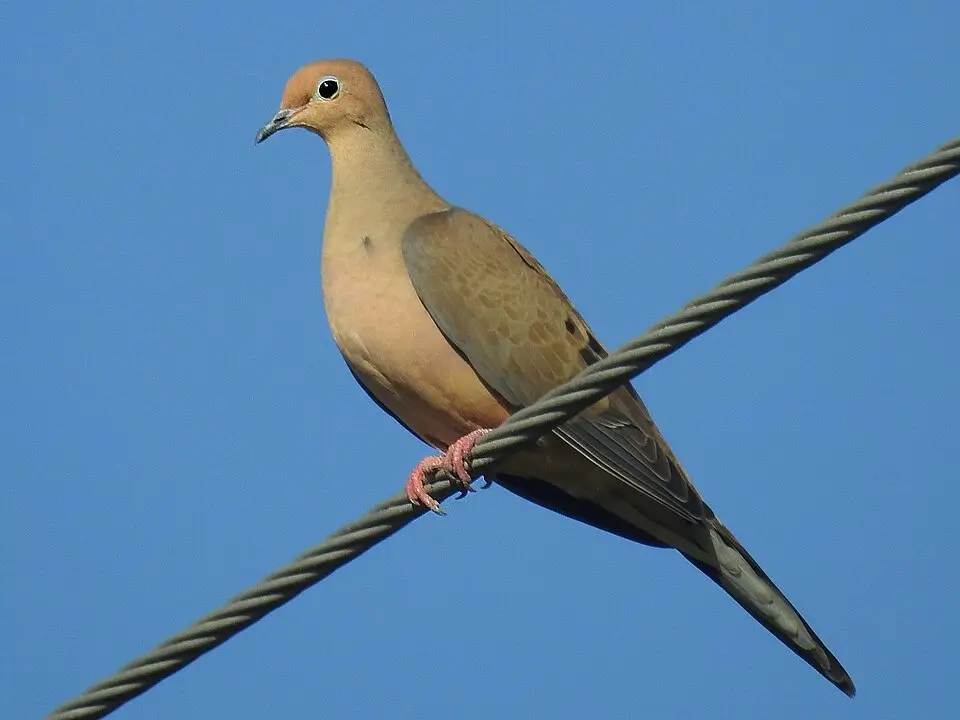
In terms of physical appearance, the Mourning Dove is an elegantly proportioned bird. It has a small, rounded head perched atop a plump body, and its long, tapered tail is one of its most recognizable characteristics. The plumage is primarily a soft grayish-brown or buffy tan, with subtle iridescent patches of pink and green on the neck. Black spots are scattered across the wings, and the underparts carry a warm pinkish or peachy hue. The eyes are dark and large, surrounded by a distinctive ring of light blue skin. The bill is slender and slightly downcurved, adapted for picking up seeds from the ground, while the legs are short and reddish-pink.
One of the most fascinating aspects of Mourning Dove biology is its voice. The cooing call — a slow, soft oo-wah-hoo-hoo-hoo — is often mistaken for an owl by those who hear it for the first time. This call is primarily produced by males and serves as both a territorial proclamation and a courtship display. In flight, the wings produce a distinctive whistling sound as air passes through the feathers, which is thought to serve as an alarm signal to other birds.
Mourning Doves are prolific breeders. Unlike many bird species that raise only one or two clutches per year, doves can produce multiple broods in a single breeding season — sometimes as many as five or six in warmer climates, though fewer in northern states like Vermont. The female typically lays two white eggs per clutch. Both parents share incubation duties, and the young, known as squabs, are fed a nutrient-rich secretion called "crop milk" produced in the parents' crop. This adaptation allows the species to feed its young independent of insect availability, a significant evolutionary advantage.
The diet of the Mourning Dove is composed almost entirely of seeds. They are granivores of the first order, consuming seeds from a wide variety of grasses, weeds, and cultivated crops. Sunflower seeds, millet, milo, safflower, and corn are among their favorites. Unlike many birds, doves swallow seeds whole and store them in the crop before digestion, meaning they often need to visit water sources to aid in the digestive process.
Habitat & Range
The Mourning Dove is one of the most widely distributed birds in North America. Its range extends from southern Canada through the entire continental United States, into Mexico and Central America, and across much of the Caribbean. In the United States, it is found in virtually every habitat type, from arid deserts to coastal wetlands, though it shows a clear preference for open and semi-open environments.
The species thrives at habitat edges — places where open land meets woodland, where agricultural fields border hedgerows, or where suburban lawns give way to shrubby cover. This preference makes Vermont's mosaic of farms, forests, and small towns an excellent landscape for doves. The Champlain Valley, with its agricultural fields and open corridors, is particularly productive dove country. Doves favor areas with short vegetation or bare ground for foraging, along with nearby trees or shrubs for roosting and nesting.
While Mourning Doves are year-round residents across much of the United States, populations in the northern portions of their range — including Vermont — are migratory. Birds that breed in Vermont and other New England states typically move southward in the fall, seeking warmer climates and reliable food sources during the winter months. This migratory behavior is what classifies the Mourning Dove as a federally managed migratory game bird under the Migratory Bird Treaty Act.
Mourning Doves are not secretive birds. They readily adapt to human-altered environments and can frequently be found perching on telephone wires, foraging in gravel driveways, and visiting suburban bird feeders. Their tolerance for human presence has contributed significantly to their success and abundance across North America.
Hunting Information
The Mourning Dove is the most hunted migratory bird in North America, with tens of millions harvested by hunters each year across the United States. Dove hunting holds a cherished cultural tradition in many parts of the country, particularly in the South and Midwest, where late summer dove shoots over harvested grain fields are a beloved seasonal ritual.
Because the Mourning Dove is classified as a migratory game bird, all dove hunting in the United States is regulated at both the federal and state levels. The U.S. Fish & Wildlife Service sets the framework for dove seasons each year through the Migratory Bird Treaty Act, and individual states may establish their own seasons and regulations within that federal framework.
In Vermont, the regulatory landscape for Mourning Dove hunting has its own unique character. Vermont is a Northeastern state, and dove hunting opportunities in New England have historically been more limited compared to states in the Mid-Atlantic, Southeast, and Midwest. Hunters interested in pursuing Mourning Doves in Vermont are strongly encouraged to consult the Vermont Fish & Wildlife Department directly for the most current and accurate information on season dates, bag limits, and licensing requirements, as these regulations can change from year to year.
For those pursuing doves anywhere in the country, understanding the bird's behavior is the key to success. Doves are fast, erratic fliers, and their deceptive speed makes them a challenging target for shotgunners of all skill levels. They are most commonly hunted over agricultural fields where grain has been harvested, near water sources such as ponds and streams where birds come to drink, and along flyways that doves use when moving between feeding and roosting areas. Early morning and late afternoon tend to be the most productive times to hunt, as doves are most active during these periods.
Popular shotgun loads for dove hunting typically range from size 7.5 to size 9 shot, with improved cylinder or modified chokes being the most commonly recommended. Hunters are advised to brush up on their shooting form before the season, as the fast, twisting flight of the Mourning Dove is famously humbling even for experienced wingshooters.
Conservation
The Mourning Dove is one of the great conservation success stories in North American wildlife management. Despite being the most heavily harvested migratory bird on the continent, the species maintains robust, stable populations thanks to its exceptional reproductive rate and broad habitat adaptability. The population is estimated in the hundreds of millions of individuals, making it one of the most abundant birds in North America.
Management of Mourning Dove populations is conducted under the framework of the Migratory Bird Treaty Act, with ongoing monitoring by the U.S. Fish & Wildlife Service and state wildlife agencies. Population surveys, including annual Breeding Bird Surveys and Mourning Dove Call Count Surveys, help managers track population trends and adjust harvest regulations accordingly.
For those who wish to support Mourning Dove populations, simple habitat enhancements can make a meaningful difference. Planting native grasses and wildflowers that produce seeds, providing shallow water sources for drinking and bathing, and maintaining open ground areas near shrubby cover can all encourage doves to use your property. Hunters, through license fees and excise taxes on sporting equipment via the Federal Aid in Wildlife Restoration Act (Pittman-Robertson Act), also contribute significantly to the funding of dove and migratory bird management programs.
In Vermont, supporting local wildlife habitat initiatives and engaging with the Vermont Fish & Wildlife Department are excellent ways to contribute to the long-term stewardship of this iconic species and the landscapes it calls home.