Overview
Few animals capture the imagination quite like the cougar. Known by more names than perhaps any other mammal in the Western Hemisphere — mountain lion, puma, panther, catamount — this magnificent apex predator has roamed the Americas for millennia, weaving itself into the fabric of countless ecosystems and human cultures alike. Scientifically classified as Puma concolor, the cougar holds the distinction of being the widest-ranging wild land mammal in the Western Hemisphere, a testament to its extraordinary adaptability and resilience.
The cougar occupies a unique place in the natural world. It is simultaneously a symbol of wild, untamed landscapes and a creature of remarkable subtlety — rarely seen, often heard only as a distant cry in the night, and always present as a quiet, powerful force in the ecosystems it inhabits. Whether you are a wildlife enthusiast, a hunter, a conservationist, or simply someone who marvels at the natural world, the story of the cougar is one of enduring fascination.
In the context of the northeastern United States, and particularly in a state like Vermont, the cougar carries a deeply layered history — one tied to colonial settlement, landscape transformation, ecological change, and the ongoing conversation about what it means to live alongside large predators. Understanding this animal in its full biological and ecological context helps us appreciate not only what it is, but what its presence — or absence — means for wild places like Vermont.
Biological Traits
The cougar, Puma concolor, is the second-largest cat in the Americas, surpassed only by the jaguar (Panthera onca). Despite its impressive size, the cougar is more closely related to smaller felines than it is to lions or tigers. It belongs to the subfamily Felinae rather than Pantherinae, which means it cannot roar in the way that "big cats" like lions and leopards do. Instead, cougars communicate through a range of vocalizations including hisses, growls, chirps, and a haunting, high-pitched scream that has startled many a hiker in the backcountry.
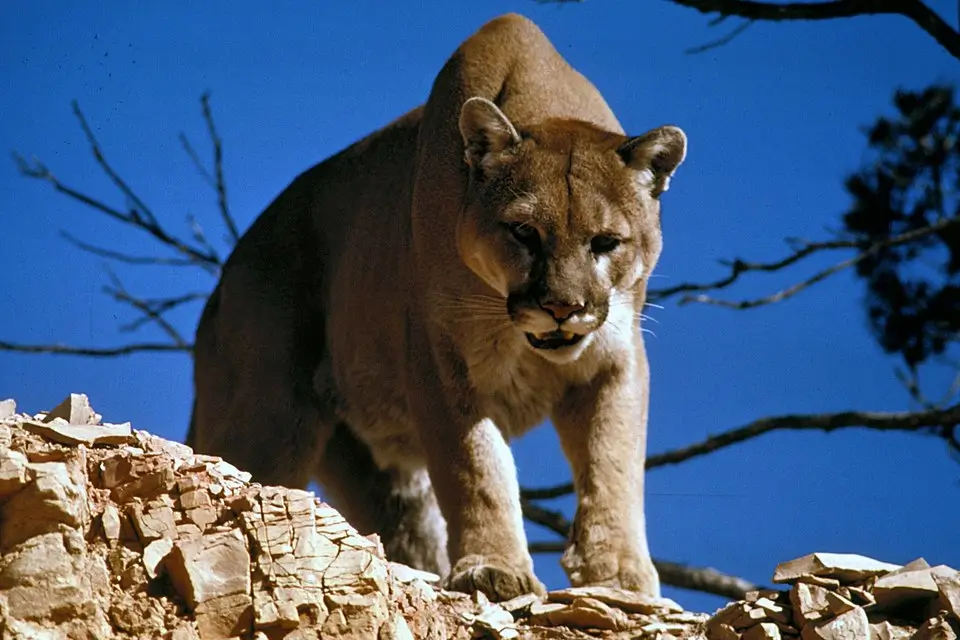
Adult cougars are powerful, athletic animals built for speed, stealth, and strength. They are characterized by a slender, muscular body, a long tail that aids in balance during high-speed pursuits, large paws, and a relatively small, rounded head. Their coat is typically tawny or buff-colored — the species name concolor means "of uniform color" in Latin — though shading can vary from grayish to reddish-brown depending on the geographic region. The ears are rounded and relatively small, and the underparts are typically lighter or whitish.
Cougars are ambush predators, relying on stealth and explosive bursts of speed rather than long-distance endurance chases. They are capable of remarkable athletic feats: leaping vertically up to 18 feet, covering horizontal distances of up to 40 feet in a single bound, and sprinting at speeds exceeding 50 miles per hour over short distances. These physical capabilities make them supremely effective hunters across a wide variety of terrain.
As obligate carnivores, cougars rely entirely on meat for sustenance. Deer are typically their primary prey across most of their range, though they are highly opportunistic and will hunt a broad spectrum of animals, including elk, bighorn sheep, smaller mammals, and even insects and small reptiles when prey is scarce. Their hunting technique typically involves a slow, patient stalk followed by a swift, powerful attack, often targeting the back of the neck or skull of the prey animal.
Cougars are solitary animals, with the exception of mothers raising cubs. Males maintain large home ranges that overlap with the smaller ranges of several females. They are primarily crepuscular and nocturnal, meaning they are most active during dawn, dusk, and the nighttime hours — behavior that contributes to their elusive reputation.
Females give birth to litters of one to six cubs, though two to three is typical. Cubs are born with spotted coats and blue eyes, which gradually change as the animal matures. Young cougars stay with their mothers for up to two years, learning the hunting and survival skills they will need as independent adults. The spotted coat of the cubs fades as they approach adulthood, replaced by the uniform tawny coloration characteristic of the species.
Habitat & Range
The cougar's range is, by any measure, extraordinary. Historically, Puma concolor ranged from the Yukon in Canada all the way to the southern tip of South America, and from the Atlantic coast to the Pacific coast of both continents. This enormous range spans virtually every type of habitat on the American continents, from tropical rainforests and high mountain ranges to arid deserts and temperate forests.
In North America, cougar populations are today most robust in the western United States, Canada, and throughout Central and South America. In the eastern United States, however, the story is more complicated. The eastern cougar (Puma concolor couguar), the subspecies that historically inhabited the entire eastern portion of North America, was declared officially extinct by the U.S. Fish and Wildlife Service in 2011 following decades of absence. The only confirmed wild cougar population east of the Mississippi River exists in southern Florida, where the Florida panther — a subspecies of Puma concolor — persists in small but recovering numbers.
Cougars are habitat generalists, meaning they can thrive in a remarkable diversity of environments. They show a preference for areas with adequate cover — whether forest, brush, rocky terrain, or grassland — combined with healthy populations of prey species. Elevation is no barrier; cougars are comfortable at sea level and at high-altitude alpine environments alike.
Hunting Information
For hunters in Vermont and across the northeastern United States, the cougar represents a topic of considerable interest, though the practical landscape is straightforward: there is no established hunting season for cougars in Vermont. The state of Vermont does not currently have official hunting regulations governing cougar harvest, largely because there is no confirmed, established population of cougars in the state.
Historically, the catamount — as the cougar was known in New England — was a fixture of Vermont's wild landscapes. The animal gave the University of Vermont its beloved mascot and is embedded in the region's cultural and natural history. However, like elsewhere in the eastern United States, the cougar was extirpated from Vermont and the broader New England region over the course of the 18th and 19th centuries, driven out by a combination of habitat loss, prey depletion, and direct persecution as European settlers expanded across the landscape.
Today, occasional unverified sightings of large cats are reported in Vermont and neighboring states, sparking ongoing debate and curiosity among locals and wildlife watchers. Wildlife biologists note that dispersing young male cougars from western populations have been documented traveling remarkable distances eastward, and it is not impossible that individual animals may occasionally pass through New England. However, no breeding population has been confirmed in Vermont.
For hunters interested in pursuing cougars legally, opportunities currently exist primarily in select western states and Canadian provinces where cougar populations are healthy and managed. Any hunter interested in pursuing this species should consult the wildlife management agency of the specific state or province they wish to hunt in for current, accurate licensing and season information.
Conservation
The conservation status of Puma concolor overall is listed as "Least Concern" by the International Union for Conservation of Nature (IUCN), reflecting the species' broad range and relatively stable populations in many parts of its habitat. However, this designation masks significant regional variation. Several subspecies and regional populations face serious conservation challenges, including habitat fragmentation, prey base decline, vehicle collisions, and human-wildlife conflict.
The Florida panther is perhaps the most well-known example of cougar conservation effort in North America. Once reduced to a population of fewer than 30 individuals, intensive conservation measures including genetic restoration, habitat protection, and wildlife crossing construction have helped the Florida panther population recover to estimated numbers well above that historic low.
Across the American West, cougar populations are managed through regulated hunting seasons that serve as the primary conservation and population management tool. Managed hunting, combined with habitat preservation and science-based population monitoring, helps maintain healthy cougar numbers while minimizing conflict with livestock producers and human communities.
In the broader context of northeastern states like Vermont, conservation conversation around cougars often focuses on the question of natural recolonization. As forest cover has returned to Vermont and other New England states over the past century — a remarkable ecological recovery story in its own right — the habitat base that could theoretically support cougars has improved significantly. White-tailed deer, the cougar's primary prey species, are abundant throughout Vermont and New England. Whether cougars will naturally return to Vermont in coming decades remains an open and genuinely exciting ecological question.
Regardless of the outcome, the cougar stands as a powerful symbol of wild nature's resilience, adaptability, and enduring capacity to inspire awe. For Vermonters and New Englanders, the catamount remains a creature of myth, memory, and hope — a reminder that the wild world is full of surprises, and that landscapes can heal in ways that once seemed impossible.