Overview
Few birds capture the imagination of hunters, birdwatchers, and naturalists quite like the Common pheasant (Phasianus colchicus). With its dazzling plumage, spirited temperament, and remarkable adaptability, this iconic game bird has earned a celebrated place in both the natural world and the traditions of upland hunting across the globe. Originally native to Asia, the Common pheasant has been successfully introduced to virtually every corner of the world, thriving in landscapes as diverse as the rolling farmlands of England, the prairies of the American Midwest, and the forested hills of New England states like Vermont. Whether you are a seasoned wingshooter, a curious naturalist, or simply someone who has glimpsed a brilliantly colored rooster flushing from a hedgerow, the Common pheasant is a species that commands attention and respect.
The story of this bird is one of extraordinary success — a tale of biological resilience, human stewardship, and an enduring partnership between wildlife managers and the hunting community. Understanding the Common pheasant in depth means appreciating not just its striking appearance, but its fascinating biology, its complex relationship with the landscape, and the ongoing conservation efforts that help sustain its populations for future generations.
Biological Traits
The Common pheasant, Phasianus colchicus, belongs to the family Phasianidae, which includes turkeys, grouse, quail, and peacocks — a family renowned for producing some of the most visually spectacular birds on Earth. The pheasant itself is no exception to this rule.
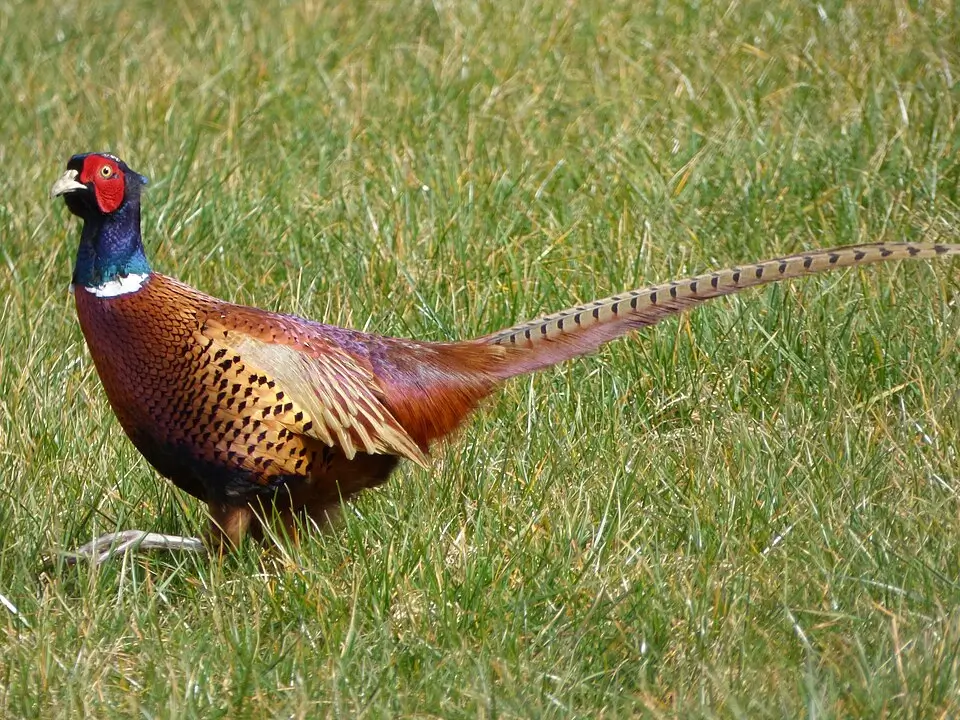
Perhaps the most immediately recognizable feature of the Common pheasant is the dramatic sexual dimorphism between males and females. The male, commonly called a rooster or cock, is a truly breathtaking sight. His plumage is an intricate tapestry of iridescent copper, gold, and chestnut tones across the body, while the head and neck often display a rich, glossy green or blue-green coloration, depending on the subspecies. Many rooster pheasants sport a distinctive white ring around the neck — a marking that has become almost synonymous with the species in North America and Europe, though not all subspecies carry this feature. Bright red facial wattles frame the rooster's face, and his tail is long, elegantly barred, and can account for a substantial portion of his total length.
By contrast, the female pheasant, known as a hen, is dressed in far more muted tones. Her plumage is a warm, streaked brown that provides excellent camouflage against the grasses, leaf litter, and brush in which she nests and forages. This cryptic coloration is not a shortcoming — it is a masterful evolutionary adaptation that helps protect nesting hens and their eggs from predators.
The Common pheasant is a fairly large bird by upland game standards. Roosters are notably larger than hens, and the species overall has a robust, muscular build well suited to life on the ground. Like other members of the Phasianidae family, pheasants are primarily terrestrial birds. They spend the vast majority of their time on the ground, walking and running with surprising speed and agility. When flushed, they burst into the air with a characteristic explosive wingbeat and a loud, cackling call that is instantly recognizable to anyone who has spent time in pheasant country.
The diet of the Common pheasant is broadly omnivorous, shifting with the seasons and the availability of food resources. Seeds, grains, berries, insects, worms, and various plant materials all feature in their diet. This dietary flexibility is one of the key factors behind the species' remarkable adaptability to different landscapes and climates.
Reproduction in the Common pheasant follows a polygynous mating system, meaning that a single dominant rooster will typically mate with multiple hens during the breeding season. Hens are solely responsible for incubation and chick-rearing. A typical clutch contains a substantial number of eggs, and the precocial chicks — meaning they are born in a relatively advanced state and are mobile almost immediately — grow quickly. This high reproductive potential is another reason the species has proven so successful in introduced ranges.
Habitat & Range
The natural homeland of Phasianus colchicus stretches across a wide swath of Asia, from the Caucasus region — giving the species its species epithet colchicus, a reference to the ancient region of Colchis near the Black Sea — eastward through Central Asia, China, and into the Far East. Across this vast native range, the species occupies a diverse array of habitats, demonstrating the ecological flexibility that would later make it such a successful colonizer of new continents.
In its introduced North American range, the Common pheasant has found particular success in agricultural landscapes interspersed with brushy cover, wetland edges, grasslands, and woodland borders. The species tends to favor areas where open fields for foraging are close to dense vegetative cover for roosting and escape from predators. Hedgerows, shrubby field margins, cattail marshes, and overgrown fence lines are all classic pheasant habitats in agricultural regions.
In a state like Vermont, the landscape presents an interesting mix of opportunities and challenges for pheasant populations. Vermont is characterized by its rolling forested hills, agricultural valleys, and a patchwork of farms and natural areas. While Vermont's heavily forested terrain differs from the open prairie-and-crop-field habitats where pheasants have thrived most spectacularly — such as in South Dakota or Iowa — the state's agricultural valleys, farm fields, and brushy cover areas can provide suitable habitat for pheasants. Vermont's cold winters, however, can pose challenges for resident pheasant populations, making active management and stocking programs important tools for maintaining huntable numbers.
The Common pheasant has been introduced across much of North America, Europe, Australia, New Zealand, Hawaii, and beyond. In each of these regions, local wildlife agencies and hunting organizations have invested significant resources in establishing and maintaining pheasant populations, reflecting the bird's enormous cultural and recreational value.
Hunting Information
The Common pheasant holds a place of distinction in the world of upland game hunting. It is widely regarded as one of the premier game birds for wingshooters, prized for the combination of its dramatic flush, challenging flight, and exceptional table qualities. The rooster pheasant's loud, startling flush from thick cover, its strong and direct flight, and the shooting challenge it presents have made it a beloved quarry for generations of hunters.
Pheasant hunting is typically conducted with pointing breeds or flushing dogs that work through likely cover — grass fields, wetland edges, crop stubble, and brushy draws — to locate birds and either hold them for a pointing dog or push them into the air for the flushing hunter. The sport has a rich tradition and a strong community of practitioners who value both the hunt itself and the conservation efforts that make it possible.
In Vermont specifically, hunters interested in pursuing Common pheasants should consult the Vermont Fish & Wildlife Department directly for current, up-to-date information regarding seasons, bag limits, licensing requirements, and any stocking programs that may be in operation. Hunting regulations are subject to change from year to year, and official state sources will always provide the most accurate and current guidance. Vermont's hunting community has a strong tradition of ethical, regulated hunting, and upland bird hunting — including for pheasants — fits naturally within that tradition.
It is also worth noting that pheasant hunting in many northeastern states, including Vermont, is frequently supported by put-and-take stocking programs administered by state wildlife agencies and private hunting clubs. These programs release farm-raised pheasants into suitable habitat areas prior to or during hunting seasons, providing hunting opportunities in regions where self-sustaining wild pheasant populations may not be established at high densities.
Conservation
The Common pheasant presents an interesting conservation profile. Globally, the species is not considered threatened — in fact, its introduced populations around the world are thriving. Organizations like the International Union for Conservation of Nature (IUCN) reflect the species' overall stability as a result of its broad range and large global population.
However, conservation efforts remain important at the local and regional level. In many areas, pheasant populations have declined due to habitat loss — particularly the removal of hedgerows, the intensification of agriculture, and the reduction of idle, brushy land that pheasants depend upon for cover and nesting. Supporting habitat conservation programs, participating in land improvement initiatives, and advocating for wildlife-friendly agricultural practices are all meaningful ways that hunters, landowners, and conservationists contribute to pheasant populations.
Organizations such as Pheasants Forever have made habitat conservation their central mission, working across North America to restore and protect the grasslands, wetlands, and farmland edges that pheasants and many other wildlife species depend upon. This kind of hunter-led conservation represents one of the most powerful models for wildlife stewardship in the world.
In Vermont and across New England, maintaining pheasant hunting opportunities also depends on continued investment in stocking programs, habitat management, and public access to hunting lands. The partnership between hunters, wildlife agencies, and conservation organizations is essential to ensuring that future generations can enjoy the remarkable experience of hunting the Common pheasant.
Conclusion
The Common pheasant (Phasianus colchicus) is far more than just a game bird. It is a symbol of the intersection between wildlife, wild places, and human tradition. From its ancient origins in Asia to its present-day status as one of the most widely distributed game birds on Earth, the pheasant's story is one of biological success, cultural significance, and ongoing conservation partnership. For hunters in Vermont and beyond, the pursuit of the rooster pheasant represents one of the great upland traditions — a pursuit rooted in respect for the land, the bird, and the timeless rhythms of the hunting season.