Overview
Few birds are as instantly recognizable across the North American landscape as the Canada goose (Branta canadensis). With its distinctive black head and neck, white chinstrap patch, and resonant honking call, this large waterfowl has become one of the most familiar wildlife species on the continent. From remote wilderness lakes to suburban parks and golf courses, the Canada goose has demonstrated a remarkable ability to thrive alongside human civilization while remaining a prized game bird for waterfowl hunters across the United States and Canada.
In Vermont, as in much of the northeastern United States, the Canada goose holds a special place in the rhythm of the seasons. The sight of a V-formation of geese crossing an autumn sky over the Green Mountains is one of the most evocative images of the New England fall, signaling the changing of seasons and drawing hunters to marshes, fields, and lakeshores across the state. Whether you are a dedicated waterfowler, a wildlife enthusiast, or simply someone who has watched these birds glide across a quiet pond, the Canada goose commands attention and respect.
This article explores the biology, behavior, habitat, hunting traditions, and conservation story of one of North America's most successful and celebrated bird species.
Biological Traits
The Canada goose belongs to the family Anatidae, which encompasses ducks, geese, and swans. It is classified within the genus Branta, a group commonly known as the "black geese," which also includes the Brant and the Barnacle Goose of Europe. The species name canadensis simply means "of Canada," reflecting the bird's strong historical association with the northern wilderness.
One of the most notable aspects of the Canada goose is its size variation. Branta canadensis is not a single uniform bird — it encompasses multiple subspecies that can differ dramatically in body size. The largest subspecies, the Giant Canada Goose (Branta canadensis maxima), can weigh upward of 14 pounds and stand nearly four feet tall, making it one of the largest waterfowl in North America. Smaller subspecies, sometimes called "cacklers" by hunters, are considerably more compact. This size variability is one reason the Canada goose taxonomy has been a subject of ongoing scientific discussion.
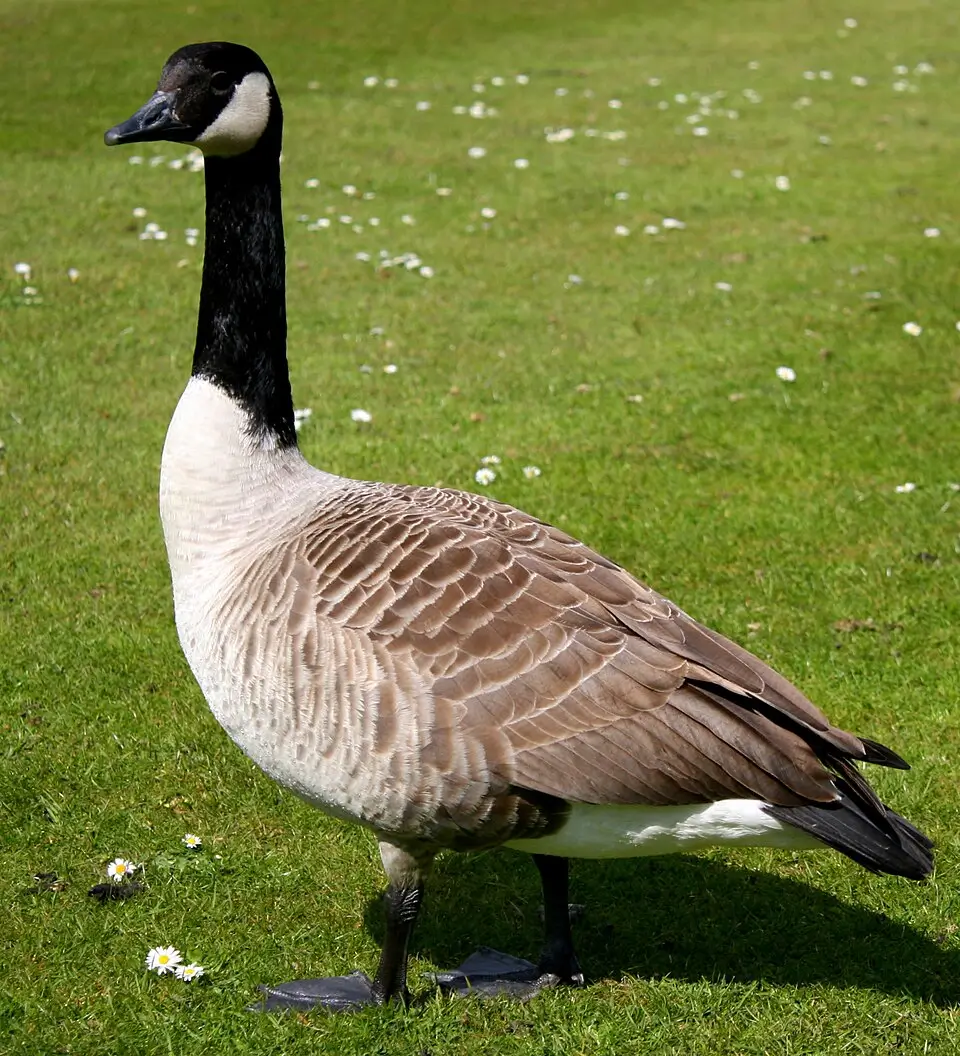
In terms of physical appearance, all Canada geese share the same fundamental color pattern: a black head and long black neck contrasted sharply by a white or cream-colored chinstrap patch that extends from cheek to cheek beneath the bill. The body plumage is generally brown to tan across the back and wings, with a lighter, often whitish breast and belly. The tail is black, and the rump is white — a field mark particularly visible in flight. The bill and legs are black.
Canada geese are highly social birds. Outside of the nesting season, they gather in large flocks that can number in the hundreds or even thousands. These flocks provide safety in numbers, with multiple birds acting as sentinels while others feed. Their social intelligence is significant — geese are known to exhibit strong pair bonds, mate for life in most cases, and display a recognizable grieving behavior when a partner is lost.
The famous V-formation flight pattern of migrating Canada geese is not merely aesthetic. This aerodynamic configuration allows each bird, except the leader, to benefit from the upwash created by the wingtip of the bird ahead, reducing energy expenditure significantly. Birds rotate the lead position to share the burden of breaking wind resistance, a behavior that has long fascinated biologists and aerodynamicists alike.
Canada geese are primarily herbivores. Their diet consists largely of grasses, sedges, grains, aquatic vegetation, and agricultural crops such as corn and soybeans. This dietary preference for open grassy areas and grain fields is a key reason the species has adapted so successfully to agricultural and suburban landscapes.
The lifespan of a wild Canada goose is typically in the range of ten to twenty-four years, with some banded individuals documented living even longer. They reach sexual maturity at around two to three years of age. Nesting typically begins in early spring, with females laying an average clutch of two to eight eggs. Both parents are fiercely protective of the nest and goslings, and their aggressive defense behavior is well known to anyone who has walked too close to a nesting pair.
Habitat & Range
The Canada goose is one of the most widely distributed waterfowl species in North America. Its breeding range spans from the arctic and subarctic regions of Canada and Alaska southward into the northern contiguous United States. Historically, the species was predominantly migratory, traveling along well-defined flyways — the Atlantic, Mississippi, Central, and Pacific Flyways — between northern breeding grounds and southern wintering areas.
Today, however, the picture is considerably more complex. A large and growing population of "resident" Canada geese — birds that no longer undertake long migrations — has established itself throughout much of the continental United States, including Vermont and the broader New England region. These resident populations take advantage of the abundant food resources available in parks, golf courses, corporate campuses, and agricultural fields, and they nest and overwinter in areas where the species was once only a seasonal visitor.
In Vermont, Canada geese are found along the shores of Lake Champlain, on the Connecticut River valley, on inland ponds and lakes, and in agricultural areas throughout the state. The Green Mountain State's mix of open water, wetlands, and farmland provides excellent habitat for both migratory and resident geese. During peak migration periods in autumn and spring, the numbers of Canada geese in Vermont can swell considerably as birds from northern breeding populations pass through or stage in the region.
Vermont's position along the Atlantic Flyway makes it an important corridor for migrating waterfowl. The state's numerous lakes, rivers, and wetlands serve as resting and feeding stops for geese traveling between their Canadian breeding grounds and their wintering areas further south along the eastern seaboard.
Hunting Information
Canada goose hunting is a deeply rooted tradition across North America and holds particular significance in the New England states, including Vermont. Waterfowl hunting, with its early mornings, decoy spreads, calling sequences, and the challenge of reading weather and migration patterns, is considered one of the most skill-intensive and rewarding forms of hunting.
Hunting Canada geese in Vermont falls under the jurisdiction of both the Vermont Fish and Wildlife Department at the state level and the U.S. Fish and Wildlife Service at the federal level, as migratory birds are managed under the Migratory Bird Treaty Act. Hunters are required to possess both a state hunting license and a federal duck stamp, as well as comply with all applicable regulations regarding season dates, bag limits, and legal hunting methods.
Because the specific season dates and bag limits for Canada goose hunting in Vermont can change from year to year based on population assessments and federal frameworks, hunters are strongly encouraged to consult the current Vermont Fish and Wildlife Department regulations guide before each season. Vermont may offer separate seasons for resident Canada geese and migratory Canada geese, reflecting the biological and management distinctions between these two populations.
Hunting methods for Canada geese typically include field hunting over decoys, layout blinds in harvested grain fields, and hunting from blinds along water edges. Calling is an important skill, with hunters using a variety of calls to mimic the clucks, moans, and honks of feeding and landing geese. Pass shooting along flight lines and hunting over open water are also practiced. Steel shot and other non-toxic shot types are required by federal law for all waterfowl hunting in the United States.
Vermont's landscape, with its expansive agricultural valleys, river corridors, and lake shores, offers varied and productive goose hunting opportunities. The Lake Champlain basin in particular is a well-known area for waterfowl activity in the state. Landowner permission is essential for hunting private farmland, and hunters should always respect property boundaries and follow ethical hunting practices.
Conservation
The conservation story of the Canada goose is one of the most remarkable wildlife recovery narratives in North American history. By the early twentieth century, overhunting and habitat loss had dramatically reduced Canada goose populations across much of the continent. The Giant Canada Goose subspecies was, at one point, believed to be extinct.
Through the combined efforts of federal and state wildlife agencies, conservation organizations, and regulated hunting, Canada goose populations rebounded dramatically throughout the latter half of the twentieth century. Habitat protection, nest box programs, and careful management through the Migratory Bird Treaty Act all contributed to this recovery. Today, Canada geese are abundant — in some urban and suburban areas, so abundant that population management has become a priority concern for wildlife managers.
Hunters play an essential role in the ongoing management of Canada goose populations. Through the purchase of hunting licenses and federal duck stamps, waterfowl hunters directly fund wetland conservation and wildlife research. The Federal Duck Stamp program alone has protected millions of acres of critical waterfowl habitat across North America. This connection between hunting and conservation represents one of the most effective and enduring models of wildlife stewardship on the continent.
In Vermont, as elsewhere, maintaining healthy and balanced Canada goose populations requires ongoing monitoring, adaptive management, and cooperation between state and federal agencies, landowners, hunters, and the general public. The Canada goose serves as a living symbol of what thoughtful conservation efforts can achieve.