Overview
Few birds capture the imagination of hunters and naturalists quite like the American woodcock (Scolopax minor). This compact, secretive shorebird that long ago traded coastal mudflats for the thickets and alder runs of the eastern United States is one of North America's most beloved and unusual upland game birds. Known by a rich collection of colorful nicknames — timberdoodle, bogsucker, Labrador twister, and mud snipe among them — the American woodcock occupies a special place in the hearts of those who pursue it through the tangled second-growth forests of autumn. In a state like Vermont, with its patchwork of young forests, moist bottomlands, and brushy cover, the woodcock is as much a symbol of fall as the turning maples themselves.
The American woodcock is a study in contradictions. Technically classified as a shorebird within the order Charadriiformes and the family Scolopacidae — the same family that includes snipe and sandpipers — it behaves far more like a grouse or woodcock of the deep woods than a wading bird of the coastline. It probes the soft earth of dense, wet thickets for earthworms rather than wading through tidal flats. It flushes in an explosive, twisting burst from underfoot rather than lifting gracefully from open water. And it performs one of the most mesmerizing courtship displays in the avian world, spiraling high into the twilight sky on whistling wings before tumbling back to earth in a cascade of liquid song. To know the American woodcock is to appreciate the full, surprising diversity of North American wildlife.
Biological Traits
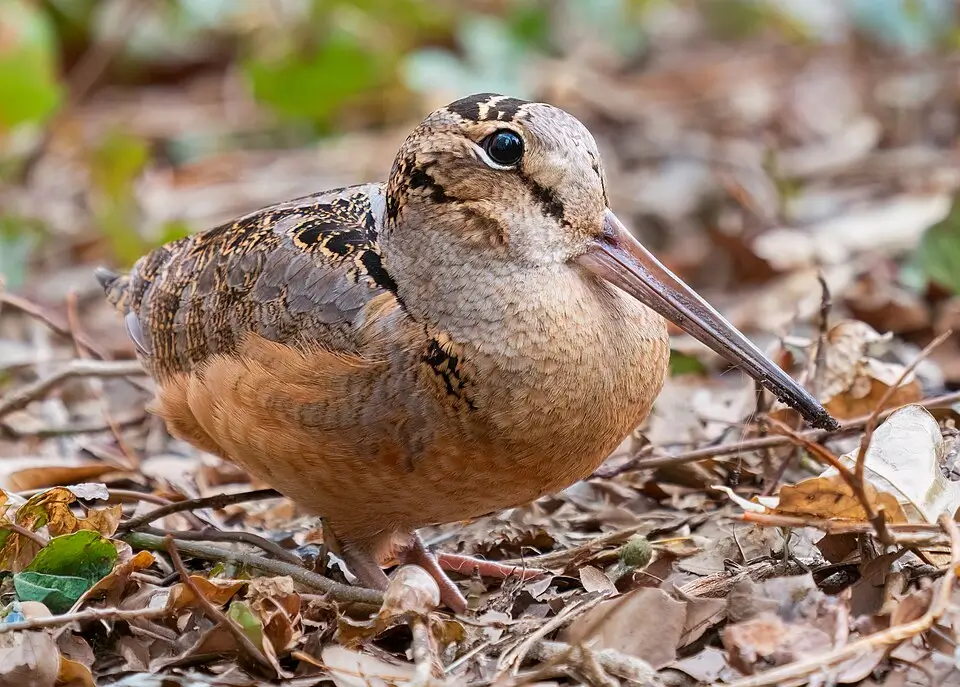
The American woodcock is a compact, rotund bird with a silhouette unlike almost any other species in the field. Its most immediately striking feature is its extraordinarily long bill — a flexible, prehensile instrument perfectly evolved for probing deep into soft, moist soil in search of its primary prey: earthworms. The bill's sensitive tip is packed with nerve endings that allow the woodcock to detect the movement of worms underground, and the bird's lower mandible can be flexed independently at the tip, allowing it to grasp prey without opening the entire bill — an adaptation that biologists describe as rhynchokinesis.
The woodcock's eyes are placed far back and high on its skull, giving it an unusually wide field of vision — nearly 360 degrees — that allows it to watch for predators even while its bill is buried in the ground. Its brain is actually positioned somewhat upside down relative to most birds, a remarkable anatomical consequence of this eye placement.
In terms of size, the American woodcock is a relatively small bird, though it carries a surprising amount of body weight for its compact frame. Males are noticeably smaller than females, making the American woodcock one of the more pronounced examples of reverse sexual size dimorphism among North American game birds. The plumage of both sexes is a beautifully cryptic blend of russet, brown, black, and gray tones — dead-leaf patterning that renders the bird essentially invisible on the forest floor.
Perhaps the woodcock's most celebrated behavior is its springtime sky dance. Beginning at dusk and again at dawn, male woodcocks gather on open singing grounds — old fields, forest clearings, and forest edges — to deliver their famous "peent" call repeatedly from the ground before launching into a steep, spiraling aerial display. As they climb to heights that can reach several hundred feet, the outer wing feathers produce a distinctive twittering sound. At the apex of their flight, the males tumble and chirp in a bubbly, musical cascade before landing near where they started, often within a few feet of females watching from the nearby brush.
Habitat & Range
The American woodcock is a bird of young, successional forests and moist bottomlands across eastern North America. It breeds across a broad swath of the eastern United States and Canada, from the Gulf Coast states northward through New England and into the Maritime provinces of Canada. It winters primarily in the southeastern United States, migrating north in early spring — often arriving at northern breeding grounds while patches of snow still linger in the woods, following the frost line as the ground thaws and earthworms become accessible.
Ideal woodcock habitat combines several key elements: young forest or shrubby growth with dense overhead cover for protection and nesting, proximity to moist, soft-soiled areas where earthworms are abundant, and open areas nearby for singing grounds. Alder runs, aspen groves, old apple orchards growing back to brush, and streamside thickets are classic woodcock haunts throughout the Northeast.
Vermont, with its extensive acreage of regenerating forests, river bottomlands, and mosaic of agricultural land growing back to young forest, provides excellent woodcock habitat throughout much of the state. The Green Mountain State's landscape has always been well-suited to supporting healthy populations of this bird, particularly in the valleys and river corridors of the Champlain Basin, the Connecticut River drainage, and the numerous smaller drainages threading through the hill towns.
Woodcock are nocturnal feeders, spending much of the night probing the soft earth for worms, and typically roosting in more open, drier upland areas during daylight hours. This daily movement between feeding and roosting habitat is an important consideration for hunters seeking to locate birds efficiently.
Hunting Information
The American woodcock holds a cherished place in the tradition of New England upland bird hunting. Hunting woodcock in Vermont and across the Northeast is a pursuit that blends physical challenge, skilled dog work, and an intimate knowledge of the landscape into one of the most rewarding experiences the upland hunter can seek.
Woodcock hunting is typically conducted with pointing or flushing dogs, breeds like English setters, Brittanys, and German shorthaired pointers that excel at working tight cover and locating the crouching, scent-rich birds before they flush. Because woodcock hold tight and rely on their camouflage as a first line of defense, a well-trained dog can locate birds that a lone hunter walking through the brush would never find.
The season for American woodcock is regulated federally by the U.S. Fish and Wildlife Service, which sets frameworks for state seasons across the country. Hunters in Vermont should consult the Vermont Fish and Wildlife Department for the current year's specific season dates, bag limits, and licensing requirements, as these details are subject to annual review and adjustment. A federal migratory bird hunting stamp — the "Duck Stamp" — is required in addition to a state license to hunt migratory birds including woodcock, and hunters should ensure their licensing is complete before taking the field.
The flight hunting that occurs during the fall migration is among the most exciting woodcock hunting available. As birds migrate south ahead of cold fronts, fresh "flights" of woodcock can arrive overnight to fill coverts that held no birds the day before. Experienced Vermont woodcock hunters learn to read weather patterns, paying close attention to northwest winds and dropping temperatures that signal incoming flights of birds from Canada and northern New England.
Because woodcock populations are influenced by the availability of young forest habitat — habitat that has declined as forests mature across the Northeast — many hunters are also active participants in habitat management efforts, working with state agencies and private landowners to create and maintain the early successional cover that woodcock depend upon.
Conservation
The American woodcock is classified as a species of conservation concern across much of its range. Long-term population monitoring by the U.S. Fish and Wildlife Service through programs like the Breeding Bird Survey and dedicated woodcock singing-ground surveys has documented gradual declines in population indices over several decades. The primary driver of these declines is understood to be the loss of young forest habitat — the early successional shrublands and young forest that woodcock depend on for nesting and feeding have diminished as forests across the Northeast have matured and as agricultural land has either been developed or allowed to revert to closed-canopy forest.
Conservation organizations such as the American Woodcock Society and various state wildlife agencies have been active in promoting habitat management practices that benefit woodcock. Timber harvesting, prescribed fire, and targeted brushwork can all be used to set back forest succession and create the young cover that woodcock need. In Vermont, the state's working forests represent an ongoing opportunity to maintain and enhance woodcock habitat through thoughtful forest management.
Hunters have historically been among the most committed advocates for woodcock conservation, both through the funding that hunting license fees and federal excise taxes provide to state and federal wildlife agencies, and through direct habitat work conducted by sportsmen's organizations. This partnership between hunters and conservation agencies continues to be one of the most effective forces for maintaining woodcock populations and the landscapes they depend upon.