Overview
Few birds in North America command attention quite like the Wood duck (Aix sponsa). Known widely as one of the most visually spectacular waterfowl species on the continent, the Wood duck has captivated hunters, birders, nature photographers, and wildlife enthusiasts for generations. Its vivid, almost jewel-like plumage, its preference for forested waterways, and its remarkable adaptability have made it an enduring symbol of wild, healthy wetland ecosystems across the eastern and western United States — including the forests, river bottoms, and bayous of Texas.
The scientific name Aix sponsa is derived from Greek and Latin, roughly translating to "a water bird in bridal dress," a fitting description for a species whose breeding-plumage male is among the most ornate birds found anywhere in the world. Whether you are an experienced waterfowl hunter preparing for the season, a conservationist tracking population trends, or simply a curious nature lover, the Wood duck offers something remarkable to discover. This article explores the Wood duck's biology, habitat preferences, relationship with hunters and conservationists, and its place in the diverse wildlife landscape of Texas.
Biological Traits
The Wood duck is a member of the family Anatidae — the broad family of birds that includes ducks, geese, and swans. It belongs to the genus Aix, which it shares with only one other species worldwide: the Mandarin duck (Aix galericulata) of East Asia. The close relationship between these two species is evident in their similarly elaborate plumage and their shared preference for wooded, freshwater habitats.
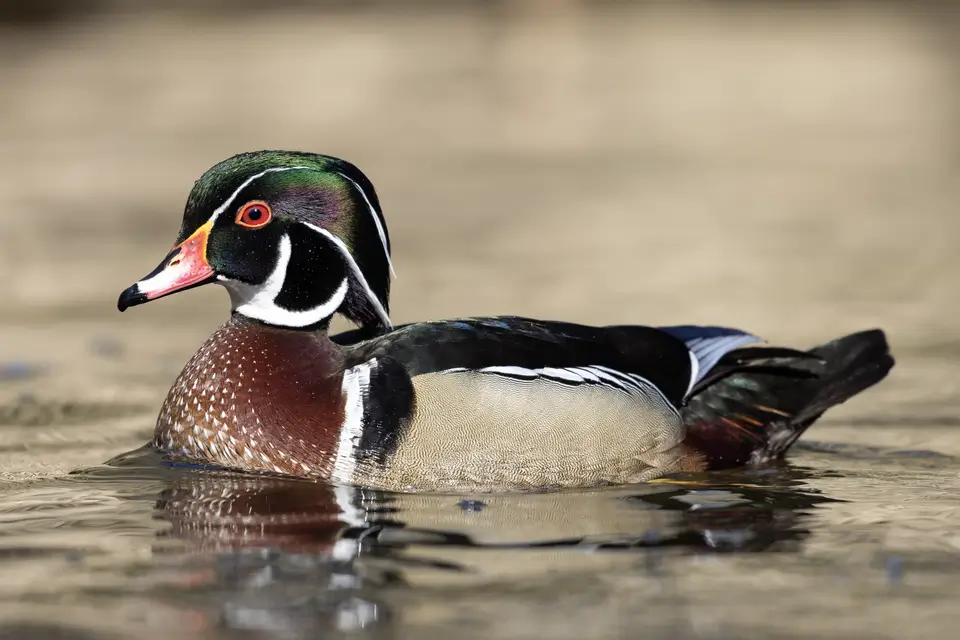
The adult male Wood duck in breeding plumage is unmistakable. His head is adorned with an iridescent green and purple crested helmet, accented by bold white stripes that run along the face and neck. His chest is chestnut-brown, speckled with white spots, and his flanks are golden-buff, separated from the chest by sharp black and white vertical bars. His bill is red, white, and black, and his eyes glow a brilliant scarlet-red. Taken altogether, the male Wood duck is a living mosaic of color, pattern, and form.
The female Wood duck, while more subdued, is still a beautifully marked bird. She is predominantly brown and gray, with a distinctive white teardrop-shaped eye ring that makes her face immediately recognizable. Both sexes share one uniquely identifying characteristic: a long, squared-off crest at the back of the head, which gives the bird a distinctive silhouette even in flight.
One of the most fascinating and ecologically distinctive features of the Wood duck is its use of tree cavities for nesting — a trait virtually unmatched among North American waterfowl. Females seek out natural hollows in large, mature trees near water, as well as man-made nest boxes, in which to lay and incubate their eggs. Clutch sizes are typically large, and in a well-known phenomenon called "egg dumping" or brood parasitism, multiple females will sometimes lay their eggs in a single nest cavity, resulting in clutches that can be extraordinarily large.
Shortly after hatching, Wood duck ducklings face one of the most dramatic first moments of any bird's life: the nest leap. Within hours of hatching, the tiny, downy chicks must climb to the entrance of the nest cavity — sometimes many feet above the ground or water — and hurl themselves into the open air. Their light weight and downy feathers cushion the fall, and they are typically unharmed. The hen calls from below, and the ducklings instinctively respond, tumbling down to join her before she leads them to the nearest water. It is one of the most extraordinary behavioral sequences in all of North American wildlife.
Wood ducks are also notable for their diet, which is highly varied and opportunistic. They feed on aquatic plants, seeds, berries, acorns, insects, and other invertebrates. Acorns, in particular, are a critical food source during the fall season, and the availability of mast-producing hardwood trees near water is a key factor in determining the quality of Wood duck habitat.
Habitat & Range
The Wood duck is broadly distributed across North America. The species occupies two primary population zones: a large eastern population that ranges across much of the eastern United States and into southeastern Canada, and a smaller western population found along the Pacific Coast from British Columbia down through California. Migratory birds from more northern latitudes move southward each autumn, swelling populations in southern states during the hunting season.
The species' preferred habitat is closely tied to forested wetlands, bottomland hardwood forests, swampy river corridors, beaver ponds, and wooded margins of lakes and slow-moving streams. Wood ducks thrive wherever mature trees grow near calm or slow-moving freshwater — environments that provide both the cavity nesting sites females require and the aquatic and mast-based foods both sexes depend upon.
In Texas, Wood ducks are a well-established and beloved component of the state's rich waterfowl community. Texas offers a remarkable diversity of landscapes, and the wooded river bottoms, cypress swamps, oxbow lakes, and forested creek drainages of East Texas provide excellent habitat for Wood ducks. The Pineywoods region, the Post Oak Savanna, and the forested bottomlands along rivers such as the Sabine, Neches, Trinity, and Angelina provide some of the finest Wood duck habitat in the state. These areas mirror the broader ecological requirements of the species: mature hardwoods near water, with abundant food resources and suitable nesting sites.
Texas's extensive coastline along the Gulf of Mexico and the state's position along the Central Flyway — one of North America's four major migratory bird corridors — also means that Texas receives significant numbers of migratory Wood ducks each fall and winter, further enriching hunting and wildlife observation opportunities.
Hunting Information
Wood ducks are one of the most prized game birds for waterfowl hunters across the United States, and Texas is no exception. Their vivid plumage, their tendency to fly through timber in swift, twisting flight, and their early-morning movements through forested swamps make them a uniquely challenging and rewarding quarry. Hunting Wood ducks often means setting up in flooded timber, cypress swamps, or wooded creek bottoms before first light, waiting for the birds to trade through the treetops as dawn breaks.
In Texas, waterfowl hunting is regulated by the Texas Parks and Wildlife Department (TPWD), which works in coordination with the U.S. Fish and Wildlife Service to establish annual season dates, bag limits, and licensing requirements. Hunters pursuing Wood ducks in Texas are required to comply with all applicable state and federal regulations, which include possession of a valid Texas hunting license as well as the required federal Duck Stamp.
It is important for all hunters to consult the most current TPWD hunting regulations before heading afield, as season dates, bag limits, and zone designations can change from year to year based on population surveys and management decisions. The TPWD website provides up-to-date information on season dates and licensing requirements for the current and upcoming seasons. As of the time of writing, the TPWD has posted information for upcoming 2026–2027 hunting season dates, and hunters are encouraged to review those materials carefully.
Wood duck hunting in Texas is particularly productive in the eastern portions of the state, where the combination of forested wetlands, river bottoms, and bottomland hardwoods creates ideal conditions. Hunters frequently employ decoys, calls, and carefully chosen timber setups to bring birds within range. Because Wood ducks are early risers and tend to move during the first light of dawn, timing and patience are essential elements of a successful hunt.
Conservation
The story of the Wood duck's conservation is one of the great success narratives in American wildlife management. By the late 19th and early 20th centuries, the species had been severely depleted across much of its range due to a combination of unregulated market hunting and the widespread loss of old-growth forested wetlands. At its lowest point, the Wood duck was considered by some ornithologists to be at serious risk of extinction.
The passage of the Migratory Bird Treaty Act of 1918 was a turning point, bringing federal protection to Wood ducks and hundreds of other migratory bird species. Combined with habitat restoration efforts and the large-scale deployment of artificial nest boxes — which compensated for the loss of natural tree cavities caused by logging — Wood duck populations rebounded remarkably over the following decades. Today, the Wood duck is one of the most abundant dabbling ducks in North America, a testament to what thoughtful conservation policy and engaged wildlife management can achieve.
Nest box programs remain an important conservation tool for Wood ducks to this day. Wildlife agencies, conservation organizations, landowners, and individual volunteers continue to install and monitor nest boxes across the species' range, providing critical nesting habitat in areas where large, cavity-bearing trees may be scarce. Texas hunters and landowners can play a meaningful role in this conservation effort by installing properly designed and located nest boxes on their properties near suitable water sources.
The broader conservation of forested wetland habitats is equally important. Bottomland hardwood forests in Texas and across the South continue to face pressures from land conversion, drainage, and development. Supporting wetland conservation programs, responsible land stewardship, and habitat restoration initiatives all contribute to the long-term health of Wood duck populations and the many other species — from songbirds to white-tailed deer — that depend on these rich forest wetland ecosystems.
Conclusion
The Wood duck (Aix sponsa) is far more than just a beautiful face in the wetlands. It is a biological marvel, a conservation success story, a cherished game bird, and an indicator species for the health of North America's forested waterways. In Texas, the species finds some of its finest southern habitat in the lush river bottoms and wooded swamps of the eastern portion of the state, drawing hunters, birders, and wildlife watchers alike to these remarkable natural places.
Whether you encounter a drake Wood duck in full breeding plumage gliding silently through a cypress swamp at dawn, or watch a hen lead her freshly hatched ducklings across a still forest pool, the experience is one that stays with you. The Wood duck is, in every sense, a treasure of the American wild — one worth protecting, celebrating, and pursuing with both passion and responsibility.